

a thickness was achieved by continuous shedding from
perennial growth and algal mat development. This may
define a mechanism of growth applicable to the early
stages of meadow development of the transgressed Pleistocene surface. However, Drew and Abel (1988a) showed
that shallow meadows in the Great Barrier Reef are comprised of non-Rhipsalian algae without strong holdfasts.
Further work is required to determine whether such
meadows grow out of meadows like those at Enewetak.
Growth of Halimeda bioherms
A number of features are pertinent to growth and origin:
1. They grow from a prominent surface defined in the
Great Barrier Reef as the transgressed Pleistocene surface. A similar reflector also occurs below the Makassar Strait bioherms and is also interpreted as the
Pleistocene transgressed surface. The shape of
biohermal mounds bears no relation to any minor relief
features on this transgressed surface. There is little
antecedence effect.
2. They occur intimately associated with sheet-like bedded biostromal deposits (Meadows).
3. In the Great Barrier Reef they occur in the lee-shelter of
the Holocene outer barrier.
4. At least in the Cooktown region, they are largest close
to the outer barrier, becoming smaller to the west.
5. They are comprised of in situ and derived accumulations of Halimeda leaves and an associated fauna of
foraminifers, bryozoans, and mollusks, which form
a series of multigenerational mounds, sometimes bedded, sometimes transparent.
6. In the Great Barrier Reef and in the Makassar Strait,
their presence on the same Pleistocene surface that
underlies the modern reefs, places their age as post
Pleistocene, growing at the same time as the Reefs.
Radiocarbon dating corroborates this conclusion.
The relations (if any) of Bioherms to the Biostromal
meadows has intrigued many. Orme et al. (1985, 1988)
and Davies and co-workers (1985, 1988) have drawn
attention to the co-occurrence of bioherms and biostromes
(meadows) and Davies and coworkers in particular cite
a variety of evidence (seismic, bathymetric, and visual
observations from submersible) to indicate that meadows
grade into biohermal areas. In the Great Barrier Reef,
a case can be made, therefore, to suggest that meadows
(biostromes) first occupied the transgressed Pleistocene
surface and evolved into bioherms in places favorable to
vertical growth. However, the development of a vertical
growth potential demands special conditions and Davies
et al. (op cit) and Drew and Abel (1988b) point to the
likely importance of enhanced nutrients as an essential
requirement. Thompson and Wolanski (1984) proposed
that strong tidal currents operating in the inter-reef channels produce a Bernoulli Effect, lifting off-reef water onto
the shelf through passes deeper than 50 m. Further
Wolanski et al. (1988) propose that off the Cooktown
region, upwelling and development of a tidal jet is occurring and carrying nutrient rich water from a reef passage to
the Halimeda meadows. Such upwelling is limited to
channels shallower than 45 m. These mechanisms add
substantial weight to the timing and modes of origin
defined by Davies and Marshall (1985) and summarized
in Figure 7.
Significance of Halimeda bioherms
Originally the term “bioherm” was coined and used by
petroleum geologists, particularly in an exploration sense,
to describe features that did or could contain petroleum.
Thereafter, it became synonymous with “reef-like” structures and important targets in petroleum exploration.
Davies et al. (1988) described Halimeda bioherms as
potential exploration targets in the Australian region.
More recently, however, Davies and Marshall (1985)
pointed out a different and perhaps more significant
Grand Cayman Island
20°N
12°N
84°W
80°W
Isla de
San Andres
Roncador
Bank
Serrana Bank
Ban
Nu
ALIC
SHOA
Serranilla
Bank
Rosalind Bank
WALT
E
PED
Ca ym an Tro ugh
400 0
40 00
3000
200 0
200 0
2 0 0 0
1 0 0 0
30 00
2
0
0
20 0
20 0
20 0
10 00
Miskita
Banks
Nicaragua
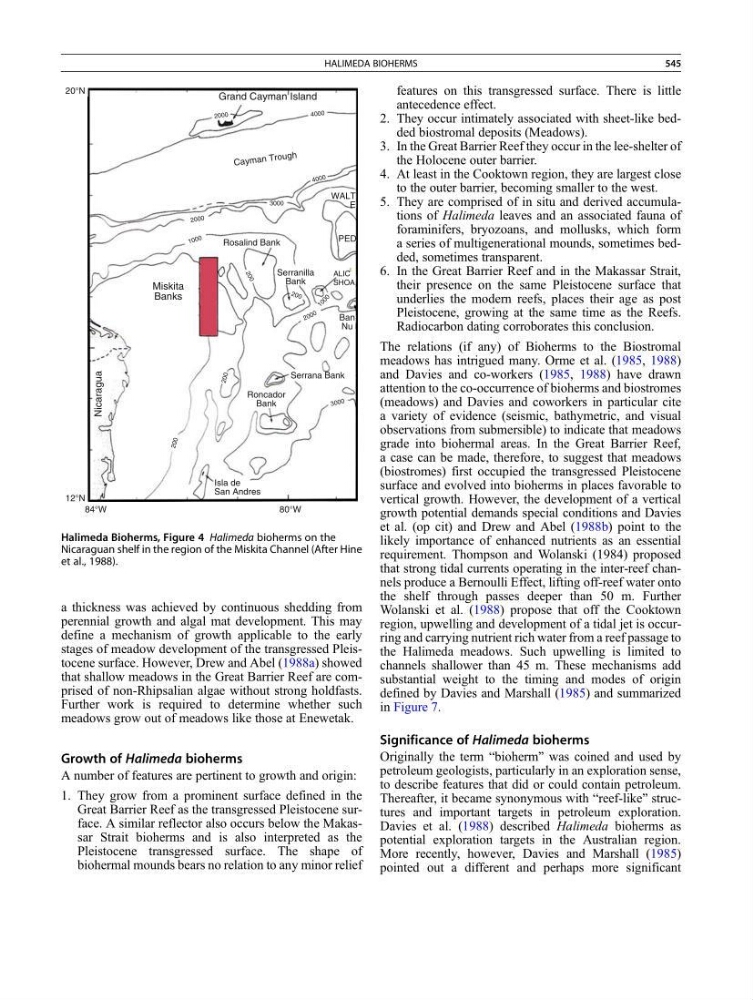
Halimeda Bioherms, Figure 4 Halimeda bioherms on the
Nicaraguan shelf in the region of the Miskita Channel (After Hine
et al., 1988).
HALIMEDA BIOHERMS
545