

are composed of coarse Halimeda plates, some of which
are still unbroken. Occasionally, layers 5–10 mm thick
are comprised of Halimeda plates orientated parallel to
the bioherm surface.
Rates of growth of Halimeda bioherms
Biologic studies report a wide range of growth rates for
Halimeda, varying from 420 g CaCO 3 m
2 year
À1 in
the Florida Straits to 2,234–3,000 g m
2 year
À1 in the Great
Barrier Reef (Drew, 1986). The high rates in the GBR are
attained by the plant doubling the biomass of the colony
every 15 days. This represents an enormous production
of carbonate sediments indicating that Halimeda are
a major contributor to tropical marine environments. The
bioherms described in this entry are testimony to that conclusion. Radiocarbon dating (Table 2) provides some indication of the vertical accumulation rates of the bioherms in
the Great Barrier Reef and Makassar Straits.
Table 2 indicates clearly that accumulation rates have
been similar in both the Great Barrier Reef and in the
Makassar Straits. Depending on porosity, accumulation
rates of close to 3 m/1,000 years are very close to Drew’s
estimates and confirm that not only are Halimeda significant contributors to reef ecosystems, but that they are
capable of producing geologically significant ecosystems
in their own right.
Relations between bioherms (banks) and
meadows (biostromes) and the lagoonal meadows
at Enewetak
In the Great Barrier Reef, Bioherms are intimately associated with widespread crudely bedded areas which are not
mounded and which have been described by Drew and
Abel (1988a) as Meadows. Such areas occupy a range of
water depths but often deeper than 50 m and extending
down to 96 m in places. Similar deposits are reported to
occur extensively over K bank east of Makassar Straits.
The growth of such features and their relations to the truly
biohermal deposits is, therefore, pertinent to the current
discussion. Clues as to growth were defined at Enewetak
by Hillis-Colinvaux (1988) where various ages of thalli
(successional development) were observed to spread
Echo Shoals
Big Bank Shoals
Karma Shoals
Pulau Roti
Ashmore Reef
Cartier Island
Seringapatam Reef
Darwin
Joseph
Banaparle
Gulf
Australia
T i m
o r
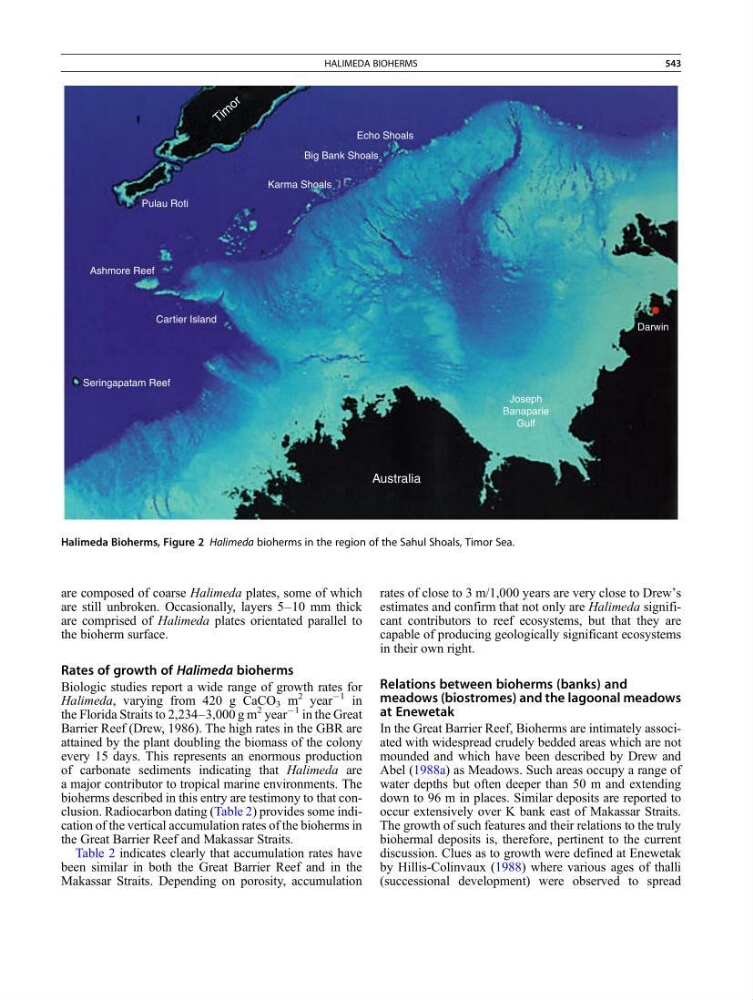
Halimeda Bioherms, Figure 2 Halimeda bioherms in the region of the Sahul Shoals, Timor Sea.
HALIMEDA BIOHERMS
543