

Branch coral facies
20
Metres
Metres
15
?
10
5
4
3
2
1 0
Coral head facies
Sediment facies
Pleistocene LST
B
A
Sediment transport
Terrigenous
0
0
10
1
2
2
Highstand
Lowstand
1
Highstand
3
2
A
B
Coralline cap
3
4
1
4
20
4
8
C
14 yrs x 10 3
Carbonate
40 CMSEC
–1 80 CMSEC
–1
Cyclones
Trade wind
conditions
27 GM M 3 1.57 GM M 3
up to 1 M
Branching Fm
Massive Fm
Rubble
Inter-tidal sand
Sub-tidal sand
Lagoon sand
Antecedent surface
Caliche
Vadose zone
a
b
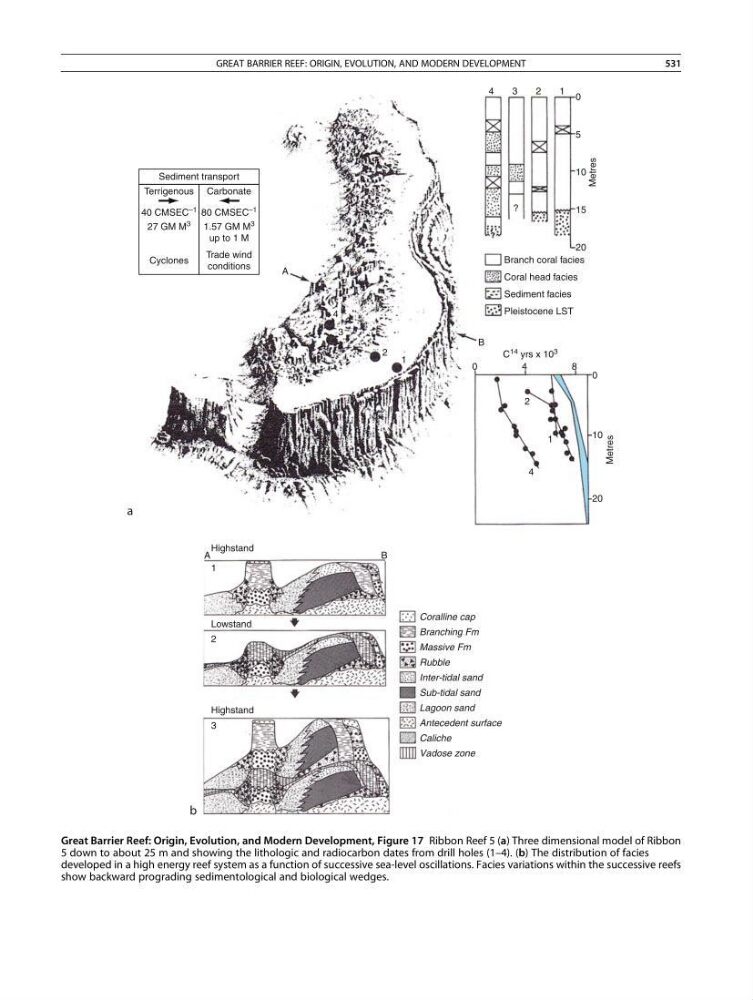
Great Barrier Reef: Origin, Evolution, and Modern Development, Figure 17 Ribbon Reef 5 (a) Three dimensional model of Ribbon
5 down to about 25 m and showing the lithologic and radiocarbon dates from drill holes (1–4). (b) The distribution of facies
developed in a high energy reef system as a function of successive sea-level oscillations. Facies variations within the successive reefs
show backward prograding sedimentological and biological wedges.
GREAT BARRIER REEF: ORIGIN, EVOLUTION, AND MODERN DEVELOPMENT
531
20
Metres
Metres
15
?
10
5
4
3
2
1 0
Coral head facies
Sediment facies
Pleistocene LST
B
A
Sediment transport
Terrigenous
0
0
10
1
2
2
Highstand
Lowstand
1
Highstand
3
2
A
B
Coralline cap
3
4
1
4
20
4
8
C
14 yrs x 10 3
Carbonate
40 CMSEC
–1 80 CMSEC
–1
Cyclones
Trade wind
conditions
27 GM M 3 1.57 GM M 3
up to 1 M
Branching Fm
Massive Fm
Rubble
Inter-tidal sand
Sub-tidal sand
Lagoon sand
Antecedent surface
Caliche
Vadose zone
a
b
Great Barrier Reef: Origin, Evolution, and Modern Development, Figure 17 Ribbon Reef 5 (a) Three dimensional model of Ribbon
5 down to about 25 m and showing the lithologic and radiocarbon dates from drill holes (1–4). (b) The distribution of facies
developed in a high energy reef system as a function of successive sea-level oscillations. Facies variations within the successive reefs
show backward prograding sedimentological and biological wedges.
GREAT BARRIER REEF: ORIGIN, EVOLUTION, AND MODERN DEVELOPMENT
531