

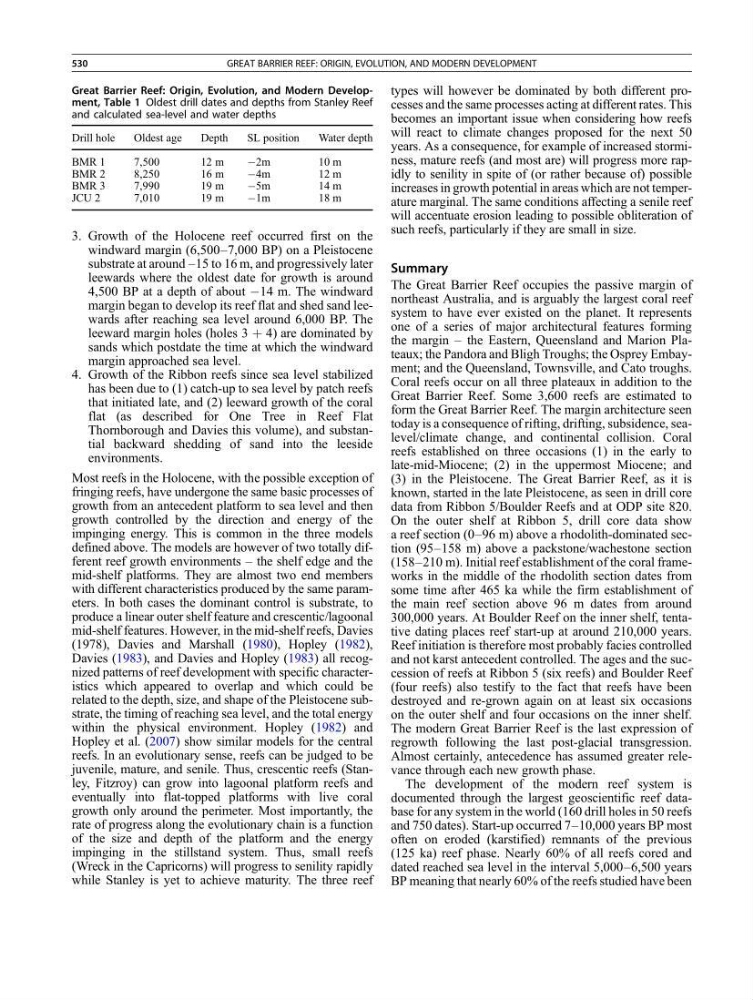
3. Growth of the Holocene reef occurred first on the
windward margin (6,500–7,000 BP) on a Pleistocene
substrate at around –15 to 16 m, and progressively later
leewards where the oldest date for growth is around
4,500 BP at a depth of about À14 m. The windward
margin began to develop its reef flat and shed sand leewards after reaching sea level around 6,000 BP. The
leeward margin holes (holes 3 þ 4) are dominated by
sands which postdate the time at which the windward
margin approached sea level.
4. Growth of the Ribbon reefs since sea level stabilized
has been due to (1) catch-up to sea level by patch reefs
that initiated late, and (2) leeward growth of the coral
flat (as described for One Tree in Reef Flat
Thornborough and Davies this volume), and substantial backward shedding of sand into the leeside
environments.
Most reefs in the Holocene, with the possible exception of
fringing reefs, have undergone the same basic processes of
growth from an antecedent platform to sea level and then
growth controlled by the direction and energy of the
impinging energy. This is common in the three models
defined above. The models are however of two totally different reef growth environments – the shelf edge and the
mid-shelf platforms. They are almost two end members
with different characteristics produced by the same parameters. In both cases the dominant control is substrate, to
produce a linear outer shelf feature and crescentic/lagoonal
mid-shelf features. However, in the mid-shelf reefs, Davies
(1978), Davies and Marshall (1980), Hopley (1982),
Davies (1983), and Davies and Hopley (1983) all recognized patterns of reef development with specific characteristics which appeared to overlap and which could be
related to the depth, size, and shape of the Pleistocene substrate, the timing of reaching sea level, and the total energy
within the physical environment. Hopley (1982) and
Hopley et al. (2007) show similar models for the central
reefs. In an evolutionary sense, reefs can be judged to be
juvenile, mature, and senile. Thus, crescentic reefs (Stanley, Fitzroy) can grow into lagoonal platform reefs and
eventually into flat-topped platforms with live coral
growth only around the perimeter. Most importantly, the
rate of progress along the evolutionary chain is a function
of the size and depth of the platform and the energy
impinging in the stillstand system. Thus, small reefs
(Wreck in the Capricorns) will progress to senility rapidly
while Stanley is yet to achieve maturity. The three reef
types will however be dominated by both different processes and the same processes acting at different rates. This
becomes an important issue when considering how reefs
will react to climate changes proposed for the next 50
years. As a consequence, for example of increased storminess, mature reefs (and most are) will progress more rapidly to senility in spite of (or rather because of) possible
increases in growth potential in areas which are not temperature marginal. The same conditions affecting a senile reef
will accentuate erosion leading to possible obliteration of
such reefs, particularly if they are small in size.
Summary
The Great Barrier Reef occupies the passive margin of
northeast Australia, and is arguably the largest coral reef
system to have ever existed on the planet. It represents
one of a series of major architectural features forming
the margin – the Eastern, Queensland and Marion Plateaux; the Pandora and Bligh Troughs; the Osprey Embayment; and the Queensland, Townsville, and Cato troughs.
Coral reefs occur on all three plateaux in addition to the
Great Barrier Reef. Some 3,600 reefs are estimated to
form the Great Barrier Reef. The margin architecture seen
today is a consequence of rifting, drifting, subsidence, sealevel/climate change, and continental collision. Coral
reefs established on three occasions (1) in the early to
late-mid-Miocene; (2) in the uppermost Miocene; and
(3) in the Pleistocene. The Great Barrier Reef, as it is
known, started in the late Pleistocene, as seen in drill core
data from Ribbon 5/Boulder Reefs and at ODP site 820.
On the outer shelf at Ribbon 5, drill core data show
a reef section (0–96 m) above a rhodolith-dominated section (95–158 m) above a packstone/wachestone section
(158–210 m). Initial reef establishment of the coral frameworks in the middle of the rhodolith section dates from
some time after 465 ka while the firm establishment of
the main reef section above 96 m dates from around
300,000 years. At Boulder Reef on the inner shelf, tentative dating places reef start-up at around 210,000 years.
Reef initiation is therefore most probably facies controlled
and not karst antecedent controlled. The ages and the succession of reefs at Ribbon 5 (six reefs) and Boulder Reef
(four reefs) also testify to the fact that reefs have been
destroyed and re-grown again on at least six occasions
on the outer shelf and four occasions on the inner shelf.
The modern Great Barrier Reef is the last expression of
regrowth following the last post-glacial transgression.
Almost certainly, antecedence has assumed greater relevance through each new growth phase.
The development of the modern reef system is
documented through the largest geoscientific reef database for any system in the world (160 drill holes in 50 reefs
and 750 dates). Start-up occurred 7–10,000 years BP most
often on eroded (karstified) remnants of the previous
(125 ka) reef phase. Nearly 60% of all reefs cored and
dated reached sea level in the interval 5,000–6,500 years
BP meaning that nearly 60% of the reefs studied have been
Great Barrier Reef: Origin, Evolution, and Modern Development, Table 1 Oldest drill dates and depths from Stanley Reef
and calculated sea-level and water depths
Drill hole
Oldest age
Depth
SL position
Water depth
BMR 1
7,500
12 m
À2m
10 m
BMR 2
8,250
16 m
À4m
12 m
BMR 3
7,990
19 m
À5m
14 m
JCU 2
7,010
19 m
À1m
18 m
530
GREAT BARRIER REEF: ORIGIN, EVOLUTION, AND MODERN DEVELOPMENT