

Mid-shelf reefs occur throughout the Great Barrier Reef
region although the number, shape, and complexity varies
substantially. On the basis of size and physical attributes,
they are classified as patches, crescentic, lagoonal platforms, and flat-topped planar reefs. Juvenile, mature, and
senile varieties of the crescents, lagoonal, and flat-topped
reefs have been described (Davies, 1983; Hopley et al.,
2007). Critical factors in their evolution are size, depth,
and shape of the Pleistocene substrate; the length of time
they have been at sea level; and the energy in the shallow
water environment.
Outer shelf reefs occur on the shelf edge and are often
linear, and aligned parallel to the edge which can be steep
or stepped. Detached reefs occur in the northern region
eastward of the main reef edge (and therefore detached),
particularly east of the Torres Shelf where the AshmoreBoot-Portlock complex occurs Figure 14a. They have
grown on pinnacles of continental crust and are fronted
by very deep water in excess of 1,000 m, while the moat
between the reefs and the shelf edge can be up to 700 m
deep and infilled with prograding siliciclastics from the
Papuan platform (Figure 14a). Deltaic reefs also occur in
the extreme northern region and are made up of short narrow reef segments separated by passes behind which distinctive delta-like patterns have been produced by tidal
currents flooding through the passes and on which reefs
have grown mimicking the delta-like shapes of the underlying sand substrate (Figure 14b).
Ribbon reefs occur on the shelf edge over a distance of
700 km between 11S and 17S as a series of narrow discrete
reefs (10–28 km long) separated by passes up to
a kilometer wide. They are numbered sequentially northwards. Probably the best known of the Ribbons is
Ribbon 5 (Figure 14c) because there are three drill holes
0.01 mm.y.
–1
Core
5
40
Sediment
fining
Suspension
Load –14.6 kg. d –1
? kg (small)
Fines
0
5
m
?m
Note 1. Past growthy >
2. In vertical profile, growth
R
T
3. Facies i fine to coarse
upwards
ii coarse to fine
laterally
4. Fines thicken with time
Gravel
(> 2mm)
Coarse sand
1-2 mm
Sand
(0.063-1mm)
Mud
(<0.063)
0
1
2
a
b
c
d
5 10 20 50
50 60 70 80 90100
40
Fraction %
A
B
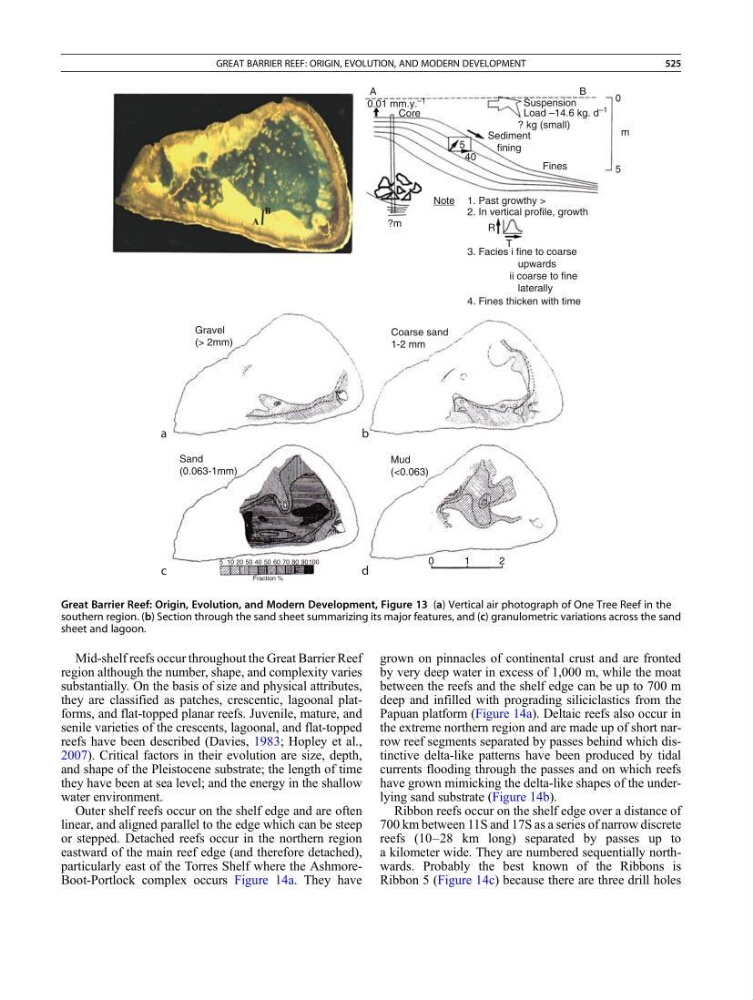
Great Barrier Reef: Origin, Evolution, and Modern Development, Figure 13 (a) Vertical air photograph of One Tree Reef in the
southern region. (b) Section through the sand sheet summarizing its major features, and (c) granulometric variations across the sand
sheet and lagoon.
GREAT BARRIER REEF: ORIGIN, EVOLUTION, AND MODERN DEVELOPMENT
525