

speculations on the magnitude of temperature fall were of
the correct order of magnitude, his interpretation of their
likely impact was incorrect. It was only on the very margins
of the reef seas and in the area of the eastern boundary currents that sea temperature cooling was sufficient to cause
a likely cessation of reef growth. Interestingly, these marginal belts were the one area where W. M. Davis was prepared to accept the occurrence of coral platforms of lowlevel abrasion, these being the only locations in the reef seas
where cliffed volcanic island slopes can be seen on the margins of barrier reef lagoons (Davis, 1915, 1928).
Daly estimated that 50–200,000 years was available for
platform abrasion and leveling in the periods of low sea
level during the glaciations. This inference is broadly correct; environmental reconstructions from ice-cores and
marine sediments in deep-sea cores show that lower than
present sea levels have typically characterized 88,000 years
of the characteristic 100,000-year long glacial–interglacial
cycles of the last 500,000 years (e.g., Imbrie et al., 1993;
Petit et al., 1999). While accepting that young volcanic
islands were composed of erosionally resistant lava flows,
Daly believed that most volcanic and coral islands were
“composed of generally weak material” (Daly, 1934, p.
177) and that erosion rates of coral limestones would be
comparable to the 0.3–1.0 m a
À1 retreat rates of the chalk
cliffs in coastal southern England and northern France and
that pyroclastic deposits and shelf sediments might be
removed at rates comparable to the retreat rates of ca.
2 m a
À1 of the glacial cliffs on the UK Yorkshire coast of
the North Sea. Thus, there appeared to be no difficulty in
beveling even large volcanic islands and extensive reef
deposits in the time available, particularly if material had
been weakened by previous phases of weathering and erosion under earlier glaciations. Recent quantitative measurements using the microerosion meter technique on shore
platforms, over a range of materials and in different process
environments around the world suggest, however, that erosion rates are several orders of magnitude lower than the
rates used by Daly, with a mean rate of surface lowering
of 1.5 mm a
À1 (Stephenson and Finlayson, 2009). Within
this dataset, the erosional behavior of presently raised reef
limestones provides an apt modern day analog for the reaction of reefs exposed by glacial falls in sea level. Such surfaces have been comprehensively investigated in two
locations: at meso- to macrotidal Aldabra Atoll, western
Indian Ocean by S. T. Trudgill (Trudgill, 1976a, b, 1983;
Viles and Trudgill 1984) and at microtidal Grand Cayman
Island, West Indies by T. Spencer (1985a–c). At Aldabra,
mean intertidal rates of surface lowering were 1.79 mm a
À1
,
varying between 1 mm a
À1 on low energy coasts to
4–7 mm a
À1 on exposed coasts. In the supratidal zone, the
mean rate of subaerial erosion was 0.26 mm a
À1
. On Grand
Cayman, the mean intertidal erosion rate was 1.23 mm a
À1
,
varying between 0.45 and 2.43 mm a
À1 on reef-protected
and exposed coasts, respectively (with bioprotection
reducing rates to 0.22 mm a
À1 on the most exposed surf
platforms). Subaerial downwearing was between 0.45
and 0.97 mm a
À1
. If these rates were characteristic of
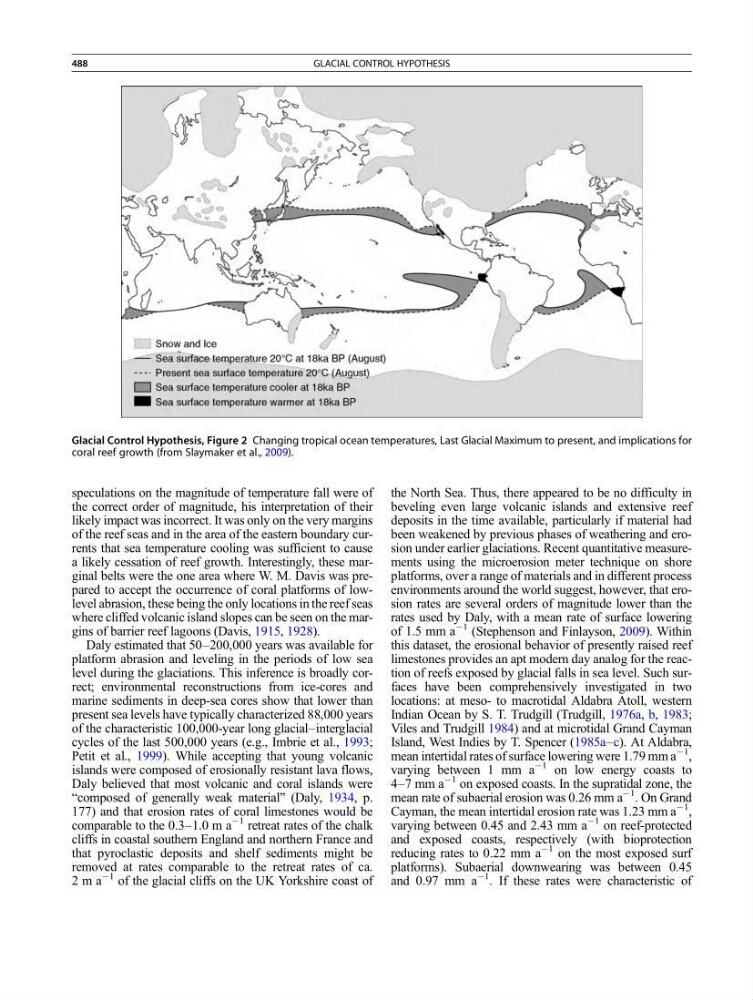
Glacial Control Hypothesis, Figure 2 Changing tropical ocean temperatures, Last Glacial Maximum to present, and implications for
coral reef growth (from Slaymaker et al., 2009).
488
GLACIAL CONTROL HYPOTHESIS
the correct order of magnitude, his interpretation of their
likely impact was incorrect. It was only on the very margins
of the reef seas and in the area of the eastern boundary currents that sea temperature cooling was sufficient to cause
a likely cessation of reef growth. Interestingly, these marginal belts were the one area where W. M. Davis was prepared to accept the occurrence of coral platforms of lowlevel abrasion, these being the only locations in the reef seas
where cliffed volcanic island slopes can be seen on the margins of barrier reef lagoons (Davis, 1915, 1928).
Daly estimated that 50–200,000 years was available for
platform abrasion and leveling in the periods of low sea
level during the glaciations. This inference is broadly correct; environmental reconstructions from ice-cores and
marine sediments in deep-sea cores show that lower than
present sea levels have typically characterized 88,000 years
of the characteristic 100,000-year long glacial–interglacial
cycles of the last 500,000 years (e.g., Imbrie et al., 1993;
Petit et al., 1999). While accepting that young volcanic
islands were composed of erosionally resistant lava flows,
Daly believed that most volcanic and coral islands were
“composed of generally weak material” (Daly, 1934, p.
177) and that erosion rates of coral limestones would be
comparable to the 0.3–1.0 m a
À1 retreat rates of the chalk
cliffs in coastal southern England and northern France and
that pyroclastic deposits and shelf sediments might be
removed at rates comparable to the retreat rates of ca.
2 m a
À1 of the glacial cliffs on the UK Yorkshire coast of
the North Sea. Thus, there appeared to be no difficulty in
beveling even large volcanic islands and extensive reef
deposits in the time available, particularly if material had
been weakened by previous phases of weathering and erosion under earlier glaciations. Recent quantitative measurements using the microerosion meter technique on shore
platforms, over a range of materials and in different process
environments around the world suggest, however, that erosion rates are several orders of magnitude lower than the
rates used by Daly, with a mean rate of surface lowering
of 1.5 mm a
À1 (Stephenson and Finlayson, 2009). Within
this dataset, the erosional behavior of presently raised reef
limestones provides an apt modern day analog for the reaction of reefs exposed by glacial falls in sea level. Such surfaces have been comprehensively investigated in two
locations: at meso- to macrotidal Aldabra Atoll, western
Indian Ocean by S. T. Trudgill (Trudgill, 1976a, b, 1983;
Viles and Trudgill 1984) and at microtidal Grand Cayman
Island, West Indies by T. Spencer (1985a–c). At Aldabra,
mean intertidal rates of surface lowering were 1.79 mm a
À1
,
varying between 1 mm a
À1 on low energy coasts to
4–7 mm a
À1 on exposed coasts. In the supratidal zone, the
mean rate of subaerial erosion was 0.26 mm a
À1
. On Grand
Cayman, the mean intertidal erosion rate was 1.23 mm a
À1
,
varying between 0.45 and 2.43 mm a
À1 on reef-protected
and exposed coasts, respectively (with bioprotection
reducing rates to 0.22 mm a
À1 on the most exposed surf
platforms). Subaerial downwearing was between 0.45
and 0.97 mm a
À1
. If these rates were characteristic of
Glacial Control Hypothesis, Figure 2 Changing tropical ocean temperatures, Last Glacial Maximum to present, and implications for
coral reef growth (from Slaymaker et al., 2009).
488
GLACIAL CONTROL HYPOTHESIS