

Daly (1910) originally postulated a sea-level fall of
46 m at the glacial maximum which he then revised to
a figure of 60–70 m, having dismissed the estimates of
sea-level fall of 150 m as “excessive” (Daly, 1934,
p. 165). It is now clear from drilling submerged Acropora
palmata reefs offshore from the south coast of Barbados
that sea level at the last glacial maximum (18 ka BP)
was 121 Æ 5 m (Fairbanks, 1989).
For glacial sea surface temperature, Daly suggested
a typical cooling of 5
C, with a maximum potential fall of
10
C. Quantitative reconstructions of last glacial maximum
sea surface temperature, based on the microfossil and geochemical analyses of deep-sea cores, were first developed
by the Climate Long-Range Investigation, Mapping, and
Prediction (CLIMAP) project in the 1970s and 1980s
(CLIMAP project members, 1976) and have recently been
updated by the Multiproxy Approach for the Reconstruction of the Glacial Ocean Surface (MARGO) project.
MARGO project members (2009) report an average mean
annual cooling at the last glacial maximum of 1.7 Æ 1
C
for the tropical ocean between 15
N and 15
S. This can
be disaggregated regionally into a cooling of 2.9 Æ 1.3
C
in the Atlantic Ocean, 1.4 Æ 0.7
C in the Indian Ocean,
and 1.2 Æ 1.1
C in the Pacific Ocean. There were, however,
considerable temperature variations in the latter region:
cooling of 1–3
C in the western Pacific Ocean warm pool,
cooling of 5–6
C in the equatorial eastern boundary current
along the Chilean coast but warming of 1–2
C in the subtropical gyres in both hemispheres. Daly claimed that “over
wide stretches of the tropical seas the reef corals were exterminated or greatly weakened in their reef-building power”
(Daly, 1934, p. 159). However, if the known falls in temperature are subtracted from the present patterns of ocean temperature isotherms for the coldest month, and the isotherm
of 20
C is taken as the limit to effective reef growth, then
the change in the area available for reef growth during the
glacial periods can be illustrated (Slaymaker et al., 2009;
Figure 2). This analysis shows that while Daly’s
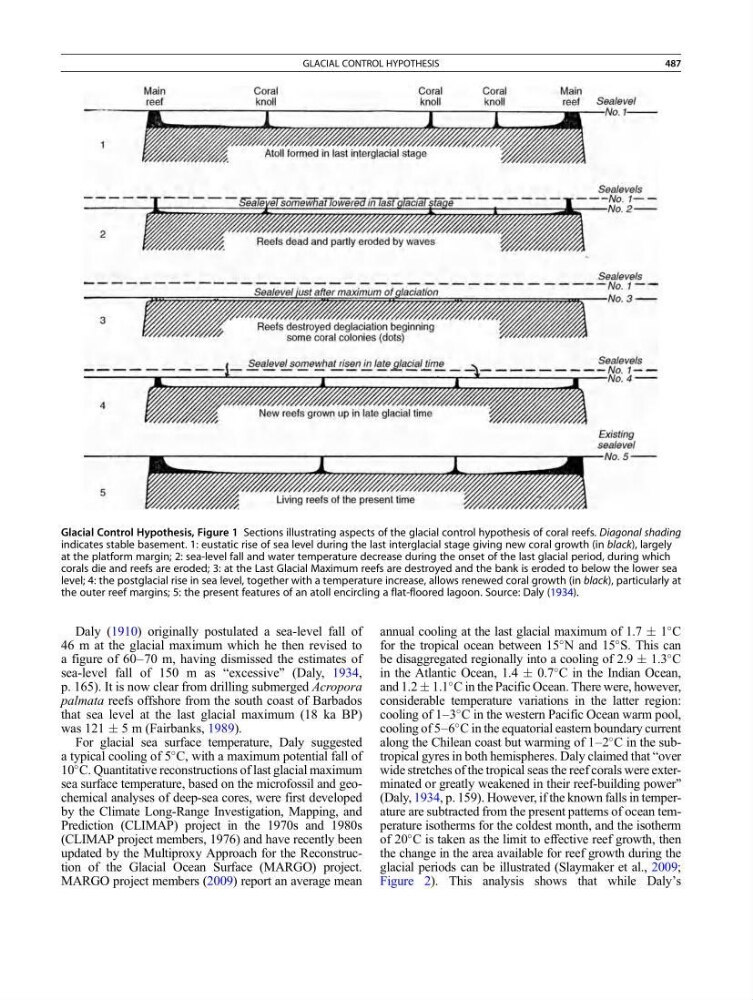
Glacial Control Hypothesis, Figure 1 Sections illustrating aspects of the glacial control hypothesis of coral reefs. Diagonal shading
indicates stable basement. 1: eustatic rise of sea level during the last interglacial stage giving new coral growth (in black), largely
at the platform margin; 2: sea-level fall and water temperature decrease during the onset of the last glacial period, during which
corals die and reefs are eroded; 3: at the Last Glacial Maximum reefs are destroyed and the bank is eroded to below the lower sea
level; 4: the postglacial rise in sea level, together with a temperature increase, allows renewed coral growth (in black), particularly at
the outer reef margins; 5: the present features of an atoll encircling a flat-floored lagoon. Source: Daly (1934).
GLACIAL CONTROL HYPOTHESIS
487
46 m at the glacial maximum which he then revised to
a figure of 60–70 m, having dismissed the estimates of
sea-level fall of 150 m as “excessive” (Daly, 1934,
p. 165). It is now clear from drilling submerged Acropora
palmata reefs offshore from the south coast of Barbados
that sea level at the last glacial maximum (18 ka BP)
was 121 Æ 5 m (Fairbanks, 1989).
For glacial sea surface temperature, Daly suggested
a typical cooling of 5
C, with a maximum potential fall of
10
C. Quantitative reconstructions of last glacial maximum
sea surface temperature, based on the microfossil and geochemical analyses of deep-sea cores, were first developed
by the Climate Long-Range Investigation, Mapping, and
Prediction (CLIMAP) project in the 1970s and 1980s
(CLIMAP project members, 1976) and have recently been
updated by the Multiproxy Approach for the Reconstruction of the Glacial Ocean Surface (MARGO) project.
MARGO project members (2009) report an average mean
annual cooling at the last glacial maximum of 1.7 Æ 1
C
for the tropical ocean between 15
N and 15
S. This can
be disaggregated regionally into a cooling of 2.9 Æ 1.3
C
in the Atlantic Ocean, 1.4 Æ 0.7
C in the Indian Ocean,
and 1.2 Æ 1.1
C in the Pacific Ocean. There were, however,
considerable temperature variations in the latter region:
cooling of 1–3
C in the western Pacific Ocean warm pool,
cooling of 5–6
C in the equatorial eastern boundary current
along the Chilean coast but warming of 1–2
C in the subtropical gyres in both hemispheres. Daly claimed that “over
wide stretches of the tropical seas the reef corals were exterminated or greatly weakened in their reef-building power”
(Daly, 1934, p. 159). However, if the known falls in temperature are subtracted from the present patterns of ocean temperature isotherms for the coldest month, and the isotherm
of 20
C is taken as the limit to effective reef growth, then
the change in the area available for reef growth during the
glacial periods can be illustrated (Slaymaker et al., 2009;
Figure 2). This analysis shows that while Daly’s
Glacial Control Hypothesis, Figure 1 Sections illustrating aspects of the glacial control hypothesis of coral reefs. Diagonal shading
indicates stable basement. 1: eustatic rise of sea level during the last interglacial stage giving new coral growth (in black), largely
at the platform margin; 2: sea-level fall and water temperature decrease during the onset of the last glacial period, during which
corals die and reefs are eroded; 3: at the Last Glacial Maximum reefs are destroyed and the bank is eroded to below the lower sea
level; 4: the postglacial rise in sea level, together with a temperature increase, allows renewed coral growth (in black), particularly at
the outer reef margins; 5: the present features of an atoll encircling a flat-floored lagoon. Source: Daly (1934).
GLACIAL CONTROL HYPOTHESIS
487