

(Sheppard, 1982; Intes and Calliart, 1994). Second, coral
growth in front of the algal spurs is largely dead and overgrown with crustose corallines (Glynn et al., 1996), indicating that the framework in these areas is rapidly
stabilized and might be more resistant to removal or pruning during storms. These two observations imply that the
distal spur ends have the highest potential for lateral and
vertical accretion, which can proceed rapidly until they
intersect with surf base at $3 m. From there, thick crusts
of Porolithon onkoides, previously excluded due to fleshy
algal overgrowth and surface grazing, causes a continued
rapid accretion into the surf zone, leading to the upgrowth
of a new algal ridge (Tracey et al., 1948). In this way, the
process of distal spur upgrowth could not only facilitate
spur development but also might drive reef-flat
progradation over time. It also explains the problematic
occurrence of double reef crests in several areas (Hopley,
1982; Guilcher, 1988).
More subsurface data is available for coral spur
systems – mostly those from the greater Caribbean (Shinn
1963; Shinn et al., 1982a, b). In both Florida and Belize,
for example, blasting and drilling indicate that shallow
spur systems are composed of interlocking branched
colonies of the surf-zone coral Acropora palmata, thickly
encrusted by corallines (Shinn, 1963). Although this
resembles the structure of algal spurs, the basal age of
the coral spurs shows that they are older at their seaward
end and get younger toward the reef crest, suggesting that
they retrograded over their own back-reef deposits as sea
level rose (Shinn et al., 1982a). Although the age structure
of algal spurs is still unknown, ridge progradation indicates that spurs develop in the opposite direction and prograde seaward. If confirmed, this would be a major
difference between these two types of spur system.
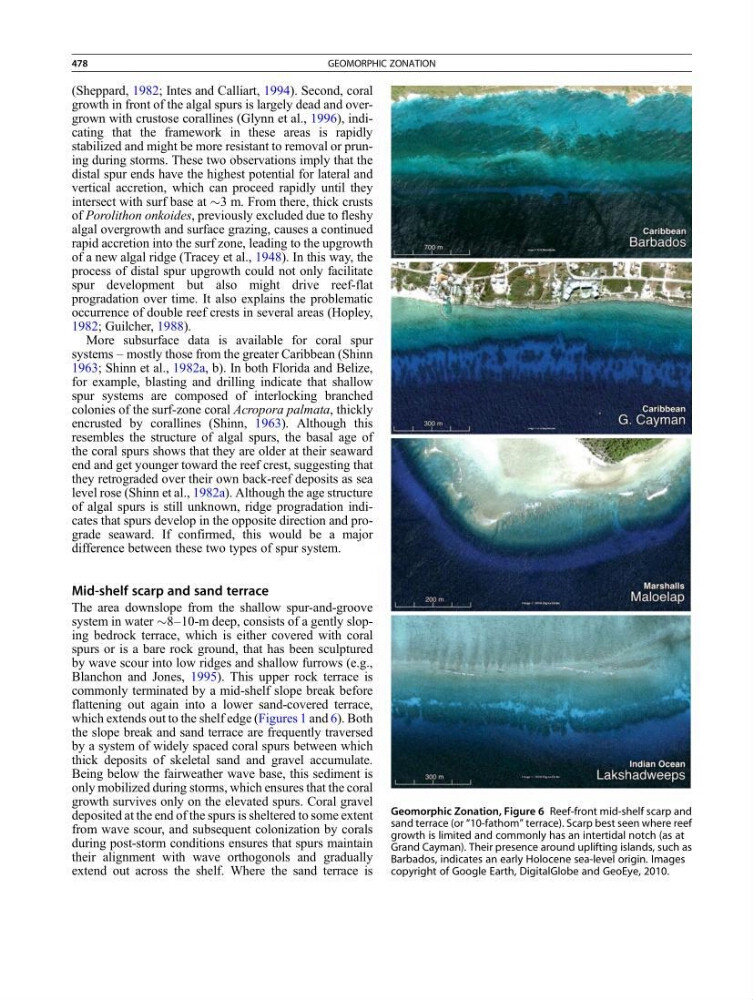
Mid-shelf scarp and sand terrace
The area downslope from the shallow spur-and-groove
system in water $8–10-m deep, consists of a gently sloping bedrock terrace, which is either covered with coral
spurs or is a bare rock ground, that has been sculptured
by wave scour into low ridges and shallow furrows (e.g.,
Blanchon and Jones, 1995). This upper rock terrace is
commonly terminated by a mid-shelf slope break before
flattening out again into a lower sand-covered terrace,
which extends out to the shelf edge (Figures 1 and 6). Both
the slope break and sand terrace are frequently traversed
by a system of widely spaced coral spurs between which
thick deposits of skeletal sand and gravel accumulate.
Being below the fairweather wave base, this sediment is
only mobilized during storms, which ensures that the coral
growth survives only on the elevated spurs. Coral gravel
deposited at the end of the spurs is sheltered to some extent
from wave scour, and subsequent colonization by corals
during post-storm conditions ensures that spurs maintain
their alignment with wave orthogonols and gradually
extend out across the shelf. Where the sand terrace is
Geomorphic Zonation, Figure 6 Reef-front mid-shelf scarp and
sand terrace (or “10-fathom” terrace). Scarp best seen where reef
growth is limited and commonly has an intertidal notch (as at
Grand Cayman). Their presence around uplifting islands, such as
Barbados, indicates an early Holocene sea-level origin. Images
copyright of Google Earth, DigitalGlobe and GeoEye, 2010.
478
GEOMORPHIC ZONATION
growth in front of the algal spurs is largely dead and overgrown with crustose corallines (Glynn et al., 1996), indicating that the framework in these areas is rapidly
stabilized and might be more resistant to removal or pruning during storms. These two observations imply that the
distal spur ends have the highest potential for lateral and
vertical accretion, which can proceed rapidly until they
intersect with surf base at $3 m. From there, thick crusts
of Porolithon onkoides, previously excluded due to fleshy
algal overgrowth and surface grazing, causes a continued
rapid accretion into the surf zone, leading to the upgrowth
of a new algal ridge (Tracey et al., 1948). In this way, the
process of distal spur upgrowth could not only facilitate
spur development but also might drive reef-flat
progradation over time. It also explains the problematic
occurrence of double reef crests in several areas (Hopley,
1982; Guilcher, 1988).
More subsurface data is available for coral spur
systems – mostly those from the greater Caribbean (Shinn
1963; Shinn et al., 1982a, b). In both Florida and Belize,
for example, blasting and drilling indicate that shallow
spur systems are composed of interlocking branched
colonies of the surf-zone coral Acropora palmata, thickly
encrusted by corallines (Shinn, 1963). Although this
resembles the structure of algal spurs, the basal age of
the coral spurs shows that they are older at their seaward
end and get younger toward the reef crest, suggesting that
they retrograded over their own back-reef deposits as sea
level rose (Shinn et al., 1982a). Although the age structure
of algal spurs is still unknown, ridge progradation indicates that spurs develop in the opposite direction and prograde seaward. If confirmed, this would be a major
difference between these two types of spur system.
Mid-shelf scarp and sand terrace
The area downslope from the shallow spur-and-groove
system in water $8–10-m deep, consists of a gently sloping bedrock terrace, which is either covered with coral
spurs or is a bare rock ground, that has been sculptured
by wave scour into low ridges and shallow furrows (e.g.,
Blanchon and Jones, 1995). This upper rock terrace is
commonly terminated by a mid-shelf slope break before
flattening out again into a lower sand-covered terrace,
which extends out to the shelf edge (Figures 1 and 6). Both
the slope break and sand terrace are frequently traversed
by a system of widely spaced coral spurs between which
thick deposits of skeletal sand and gravel accumulate.
Being below the fairweather wave base, this sediment is
only mobilized during storms, which ensures that the coral
growth survives only on the elevated spurs. Coral gravel
deposited at the end of the spurs is sheltered to some extent
from wave scour, and subsequent colonization by corals
during post-storm conditions ensures that spurs maintain
their alignment with wave orthogonols and gradually
extend out across the shelf. Where the sand terrace is
Geomorphic Zonation, Figure 6 Reef-front mid-shelf scarp and
sand terrace (or “10-fathom” terrace). Scarp best seen where reef
growth is limited and commonly has an intertidal notch (as at
Grand Cayman). Their presence around uplifting islands, such as
Barbados, indicates an early Holocene sea-level origin. Images
copyright of Google Earth, DigitalGlobe and GeoEye, 2010.
478
GEOMORPHIC ZONATION