

1–3-m wide and 2–8-m deep and are commonly floored
with coral gravel that is moved only during storms. At their
seaward ends, spurs have an amplitude of 5–8 m and terminate in waters 5–10-m deep (Tracey et al., 1948; Ladd
et al., 1950; Cloud, 1952; Newell, 1956; MacNeil, 1972;
Pichon, 1978; Sheppard, 1981; Intes and Caillart, 1994;
Glynn et al., 1996). Spurs narrow seaward and can be
straight-sided with a smooth surface or more irregular
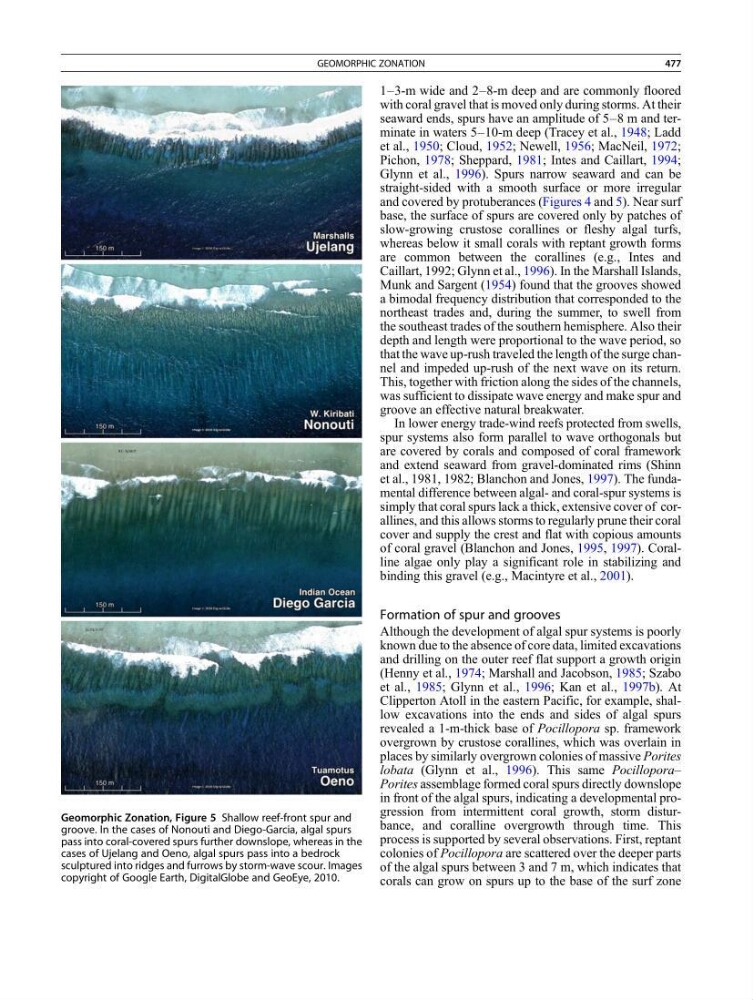
and covered by protuberances (Figures 4 and 5). Near surf
base, the surface of spurs are covered only by patches of
slow-growing crustose corallines or fleshy algal turfs,
whereas below it small corals with reptant growth forms
are common between the corallines (e.g., Intes and
Caillart, 1992; Glynn et al., 1996). In the Marshall Islands,
Munk and Sargent (1954) found that the grooves showed
a bimodal frequency distribution that corresponded to the
northeast trades and, during the summer, to swell from
the southeast trades of the southern hemisphere. Also their
depth and length were proportional to the wave period, so
that the wave up-rush traveled the length of the surge channel and impeded up-rush of the next wave on its return.
This, together with friction along the sides of the channels,
was sufficient to dissipate wave energy and make spur and
groove an effective natural breakwater.
In lower energy trade-wind reefs protected from swells,
spur systems also form parallel to wave orthogonals but
are covered by corals and composed of coral framework
and extend seaward from gravel-dominated rims (Shinn
et al., 1981, 1982; Blanchon and Jones, 1997). The fundamental difference between algal- and coral-spur systems is
simply that coral spurs lack a thick, extensive cover of corallines, and this allows storms to regularly prune their coral
cover and supply the crest and flat with copious amounts
of coral gravel (Blanchon and Jones, 1995, 1997). Coralline algae only play a significant role in stabilizing and
binding this gravel (e.g., Macintyre et al., 2001).
Formation of spur and grooves
Although the development of algal spur systems is poorly
known due to the absence of core data, limited excavations
and drilling on the outer reef flat support a growth origin
(Henny et al., 1974; Marshall and Jacobson, 1985; Szabo
et al., 1985; Glynn et al., 1996; Kan et al., 1997b). At
Clipperton Atoll in the eastern Pacific, for example, shallow excavations into the ends and sides of algal spurs
revealed a 1-m-thick base of Pocillopora sp. framework
overgrown by crustose corallines, which was overlain in
places by similarly overgrown colonies of massive Porites
lobata (Glynn et al., 1996). This same Pocillopora–
Porites assemblage formed coral spurs directly downslope
in front of the algal spurs, indicating a developmental progression from intermittent coral growth, storm disturbance, and coralline overgrowth through time. This
process is supported by several observations. First, reptant
colonies of Pocillopora are scattered over the deeper parts
of the algal spurs between 3 and 7 m, which indicates that
corals can grow on spurs up to the base of the surf zone
Geomorphic Zonation, Figure 5 Shallow reef-front spur and
groove. In the cases of Nonouti and Diego-Garcia, algal spurs
pass into coral-covered spurs further downslope, whereas in the
cases of Ujelang and Oeno, algal spurs pass into a bedrock
sculptured into ridges and furrows by storm-wave scour. Images
copyright of Google Earth, DigitalGlobe and GeoEye, 2010.
GEOMORPHIC ZONATION
477
with coral gravel that is moved only during storms. At their
seaward ends, spurs have an amplitude of 5–8 m and terminate in waters 5–10-m deep (Tracey et al., 1948; Ladd
et al., 1950; Cloud, 1952; Newell, 1956; MacNeil, 1972;
Pichon, 1978; Sheppard, 1981; Intes and Caillart, 1994;
Glynn et al., 1996). Spurs narrow seaward and can be
straight-sided with a smooth surface or more irregular
and covered by protuberances (Figures 4 and 5). Near surf
base, the surface of spurs are covered only by patches of
slow-growing crustose corallines or fleshy algal turfs,
whereas below it small corals with reptant growth forms
are common between the corallines (e.g., Intes and
Caillart, 1992; Glynn et al., 1996). In the Marshall Islands,
Munk and Sargent (1954) found that the grooves showed
a bimodal frequency distribution that corresponded to the
northeast trades and, during the summer, to swell from
the southeast trades of the southern hemisphere. Also their
depth and length were proportional to the wave period, so
that the wave up-rush traveled the length of the surge channel and impeded up-rush of the next wave on its return.
This, together with friction along the sides of the channels,
was sufficient to dissipate wave energy and make spur and
groove an effective natural breakwater.
In lower energy trade-wind reefs protected from swells,
spur systems also form parallel to wave orthogonals but
are covered by corals and composed of coral framework
and extend seaward from gravel-dominated rims (Shinn
et al., 1981, 1982; Blanchon and Jones, 1997). The fundamental difference between algal- and coral-spur systems is
simply that coral spurs lack a thick, extensive cover of corallines, and this allows storms to regularly prune their coral
cover and supply the crest and flat with copious amounts
of coral gravel (Blanchon and Jones, 1995, 1997). Coralline algae only play a significant role in stabilizing and
binding this gravel (e.g., Macintyre et al., 2001).
Formation of spur and grooves
Although the development of algal spur systems is poorly
known due to the absence of core data, limited excavations
and drilling on the outer reef flat support a growth origin
(Henny et al., 1974; Marshall and Jacobson, 1985; Szabo
et al., 1985; Glynn et al., 1996; Kan et al., 1997b). At
Clipperton Atoll in the eastern Pacific, for example, shallow excavations into the ends and sides of algal spurs
revealed a 1-m-thick base of Pocillopora sp. framework
overgrown by crustose corallines, which was overlain in
places by similarly overgrown colonies of massive Porites
lobata (Glynn et al., 1996). This same Pocillopora–
Porites assemblage formed coral spurs directly downslope
in front of the algal spurs, indicating a developmental progression from intermittent coral growth, storm disturbance, and coralline overgrowth through time. This
process is supported by several observations. First, reptant
colonies of Pocillopora are scattered over the deeper parts
of the algal spurs between 3 and 7 m, which indicates that
corals can grow on spurs up to the base of the surf zone
Geomorphic Zonation, Figure 5 Shallow reef-front spur and
groove. In the cases of Nonouti and Diego-Garcia, algal spurs
pass into coral-covered spurs further downslope, whereas in the
cases of Ujelang and Oeno, algal spurs pass into a bedrock
sculptured into ridges and furrows by storm-wave scour. Images
copyright of Google Earth, DigitalGlobe and GeoEye, 2010.
GEOMORPHIC ZONATION
477