

can provide positive overall benefits to reefs as well,
including important primary productivity yields in otherwise dead substrates. Endoliths attract excavating grazers
(Figures 3 and 4), which contributes to massive
biodestruction processes and sediment formation. In other
words, the bioerosional effect of boring Cyanobacteria
alone is secondary; their primary significance is in providing the nutritional base for excavating grazers.
Boring Cyanobacteria have been important in the
destruction of carbonate, throughout geological times.
Marine limestones can be infiltrated by more than
0.5 million endolithic filaments per square centimeter.
The oldest recorded endolithic blue-green was found from
1.5 billion-year-old stromatolite rocks in China (Zhang
and Golubic, 1987) – the earliest known occurrence of
bioerosion.
The diversity of boring micro flora is thought to be
large, comprising not only undiscovered blue-green algae,
but also including other algae (chlorophytes, rhodophytes)
and fungi. Although their taxonomy has been studied for
decades, new species are still being discovered, especially
following the advent of molecular techniques. However,
Algae, Blue-Green Boring, Figure 2 Example of boring
blue-green algal intertidal zone mostly undercut by
deep-rasping chitons.
Algae, Blue-Green Boring, Figure 3 Chitons rasping deep holes
in the intertidal substrate.
Algae, Blue-Green Boring, Figure 4 Gastropods taking shelter
in sharp karst formed by these excavating grazers.
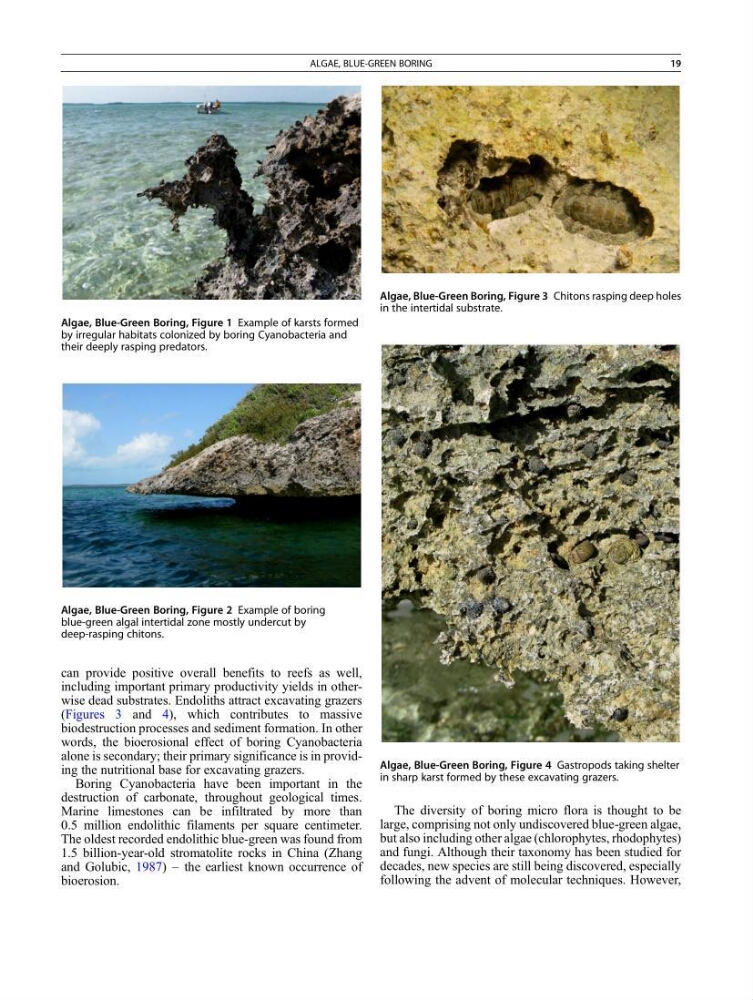
Algae, Blue-Green Boring, Figure 1 Example of karsts formed
by irregular habitats colonized by boring Cyanobacteria and
their deeply rasping predators.
ALGAE, BLUE-GREEN BORING
19
including important primary productivity yields in otherwise dead substrates. Endoliths attract excavating grazers
(Figures 3 and 4), which contributes to massive
biodestruction processes and sediment formation. In other
words, the bioerosional effect of boring Cyanobacteria
alone is secondary; their primary significance is in providing the nutritional base for excavating grazers.
Boring Cyanobacteria have been important in the
destruction of carbonate, throughout geological times.
Marine limestones can be infiltrated by more than
0.5 million endolithic filaments per square centimeter.
The oldest recorded endolithic blue-green was found from
1.5 billion-year-old stromatolite rocks in China (Zhang
and Golubic, 1987) – the earliest known occurrence of
bioerosion.
The diversity of boring micro flora is thought to be
large, comprising not only undiscovered blue-green algae,
but also including other algae (chlorophytes, rhodophytes)
and fungi. Although their taxonomy has been studied for
decades, new species are still being discovered, especially
following the advent of molecular techniques. However,
Algae, Blue-Green Boring, Figure 2 Example of boring
blue-green algal intertidal zone mostly undercut by
deep-rasping chitons.
Algae, Blue-Green Boring, Figure 3 Chitons rasping deep holes
in the intertidal substrate.
Algae, Blue-Green Boring, Figure 4 Gastropods taking shelter
in sharp karst formed by these excavating grazers.
Algae, Blue-Green Boring, Figure 1 Example of karsts formed
by irregular habitats colonized by boring Cyanobacteria and
their deeply rasping predators.
ALGAE, BLUE-GREEN BORING
19