

surviving and regrowing or even multiplying after damage
to their living tissues. All are obligate calcifiers in that the
organism controls biomineralization.
Reef calcareous metazoans can be either heterotrophs
or mixotrophs. Heterotrophs consume other organisms
whereas mixotrophs are heterotrophs that also contain
symbiotic microorganisms, generally photosynthetic
cyanobacteria or single-celled algae.
Sponges including hexactinellids with siliceous spicules alone and those with calcareous skeletons were major
reef builders in the past. Calcified sponges belong to several different groups including calcareans, demosponges,
stromatoporoids (a group of sponges of probably mixed
affinity that are distantly related to various modern calcified sponges), archaeocyaths, and chaetetids. Corals comprise both tabulates and rugosans from the Cambrian/
Ordovician to the end Permian and scleractinians from
the mid-Triassic onward. The other important organisms
are bryozoans that, even though relatively small and delicate, are critical elements of many reefs and often act as
scaffolds between which in situ microbially induced lime
mud (micrite) can form and cements precipitate.
Although we cannot be certain about the physiological
tolerances of many ancient fossil reef builders, some generalities are possible. In contrast to those organisms that
contained phototrophic symbionts, heterotrophs would
have been limited by the availability of light and nutrients.
On the basis of isotopic (Stanley and Swart, 1995), and
growth-form evidence, scleractinian corals probably possessed zooxanthellae by the late Triassic. Tabulate corals
were a diverse group of organisms and it is not clear
whether they contained similar symbionts. Rudist
bivalves formed low-relief aggregations and were massive
producers of sediment in the Cretaceous, but some of the
most important groups did not appear to have symbionts
(Steuber, 1999). Fossil sponges, both spiculate and soft
bodied, and calcified sponges (such as stromatoporoids
and archaeocyaths) are poorly understood and their association with photosymbionts is uncertain (Wood, 1999).
Calcareous algae
Calcareous algae, both red (coralline and squamaracean)
and green (codiacean and udoteacean), are obligate
Predator
Branching
Sponge
Massive
and Domal
Cavity with
internal sediment
Automicrite
Metazoan
Calcimicrobe
Crinoid
Bryozoan
Deep
Water
Reef
Shallow
Water
Reef
Platy and
encrusting
Grazer
Calcareous
algae
Cementation
Destruction
Sedimentation
Flank
Core
Forereef
Facies
Organic
growth
Reef
Mosaic
Boring
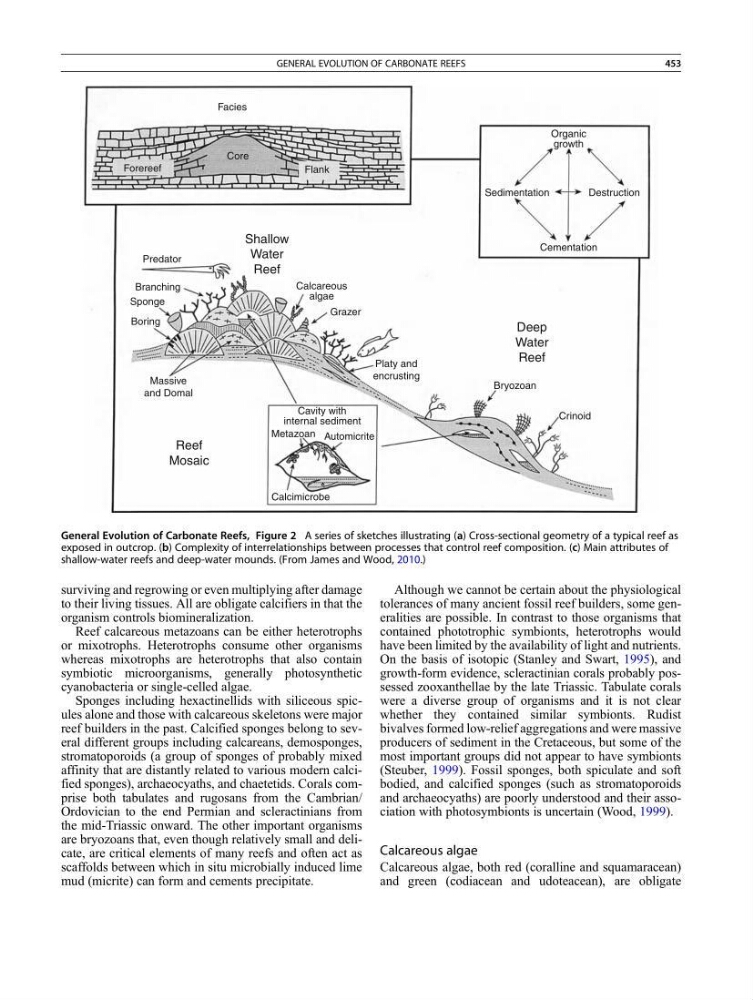
General Evolution of Carbonate Reefs, Figure 2 A series of sketches illustrating (a) Cross-sectional geometry of a typical reef as
exposed in outcrop. (b) Complexity of interrelationships between processes that control reef composition. (c) Main attributes of
shallow-water reefs and deep-water mounds. (From James and Wood, 2010.)
GENERAL EVOLUTION OF CARBONATE REEFS
453
to their living tissues. All are obligate calcifiers in that the
organism controls biomineralization.
Reef calcareous metazoans can be either heterotrophs
or mixotrophs. Heterotrophs consume other organisms
whereas mixotrophs are heterotrophs that also contain
symbiotic microorganisms, generally photosynthetic
cyanobacteria or single-celled algae.
Sponges including hexactinellids with siliceous spicules alone and those with calcareous skeletons were major
reef builders in the past. Calcified sponges belong to several different groups including calcareans, demosponges,
stromatoporoids (a group of sponges of probably mixed
affinity that are distantly related to various modern calcified sponges), archaeocyaths, and chaetetids. Corals comprise both tabulates and rugosans from the Cambrian/
Ordovician to the end Permian and scleractinians from
the mid-Triassic onward. The other important organisms
are bryozoans that, even though relatively small and delicate, are critical elements of many reefs and often act as
scaffolds between which in situ microbially induced lime
mud (micrite) can form and cements precipitate.
Although we cannot be certain about the physiological
tolerances of many ancient fossil reef builders, some generalities are possible. In contrast to those organisms that
contained phototrophic symbionts, heterotrophs would
have been limited by the availability of light and nutrients.
On the basis of isotopic (Stanley and Swart, 1995), and
growth-form evidence, scleractinian corals probably possessed zooxanthellae by the late Triassic. Tabulate corals
were a diverse group of organisms and it is not clear
whether they contained similar symbionts. Rudist
bivalves formed low-relief aggregations and were massive
producers of sediment in the Cretaceous, but some of the
most important groups did not appear to have symbionts
(Steuber, 1999). Fossil sponges, both spiculate and soft
bodied, and calcified sponges (such as stromatoporoids
and archaeocyaths) are poorly understood and their association with photosymbionts is uncertain (Wood, 1999).
Calcareous algae
Calcareous algae, both red (coralline and squamaracean)
and green (codiacean and udoteacean), are obligate
Predator
Branching
Sponge
Massive
and Domal
Cavity with
internal sediment
Automicrite
Metazoan
Calcimicrobe
Crinoid
Bryozoan
Deep
Water
Reef
Shallow
Water
Reef
Platy and
encrusting
Grazer
Calcareous
algae
Cementation
Destruction
Sedimentation
Flank
Core
Forereef
Facies
Organic
growth
Reef
Mosaic
Boring
General Evolution of Carbonate Reefs, Figure 2 A series of sketches illustrating (a) Cross-sectional geometry of a typical reef as
exposed in outcrop. (b) Complexity of interrelationships between processes that control reef composition. (c) Main attributes of
shallow-water reefs and deep-water mounds. (From James and Wood, 2010.)
GENERAL EVOLUTION OF CARBONATE REEFS
453