

Gardiner, J. S., 1907–1936. Reports of the Percy Sladen Trust Expedition to the Indian Ocean in 1905. Transactions of the Linnean
Society of London, Vol. 2, pp. 12–19.
Gardiner, J. S., 1931. Photosynthesis and solution in formation of
coral reefs. Nature, 127, 857–858.
Cross-references
Indian Ocean Reefs
GENERAL EVOLUTION OF CARBONATE REEFS
Rachel Wood
University of Edinburgh, Edinburgh, UK
Introduction
While modern coral reefs are sites of high biodiversity
forming impressive wave-resistant structures in clear tropical waters, many other organisms are known to form
diverse types of reefs in temperate, low-energy settings
or in deep waters.
Reefs have developed on Earth for over 3.5 billion
years, and a tremendous diversity of communities of
skeletal and nonskeletal metazoans, plants, algae, and
microbes as well as inorganic calcium carbonate precipitation processes have contributed to their formation during
this time. Reefs have shown zonation in response to environmental gradients from their inception, and metazoan
reefs have been differentiated into open surface and cryptic reef communities for their entire $550 million-year
history (Wood et al., 2002).
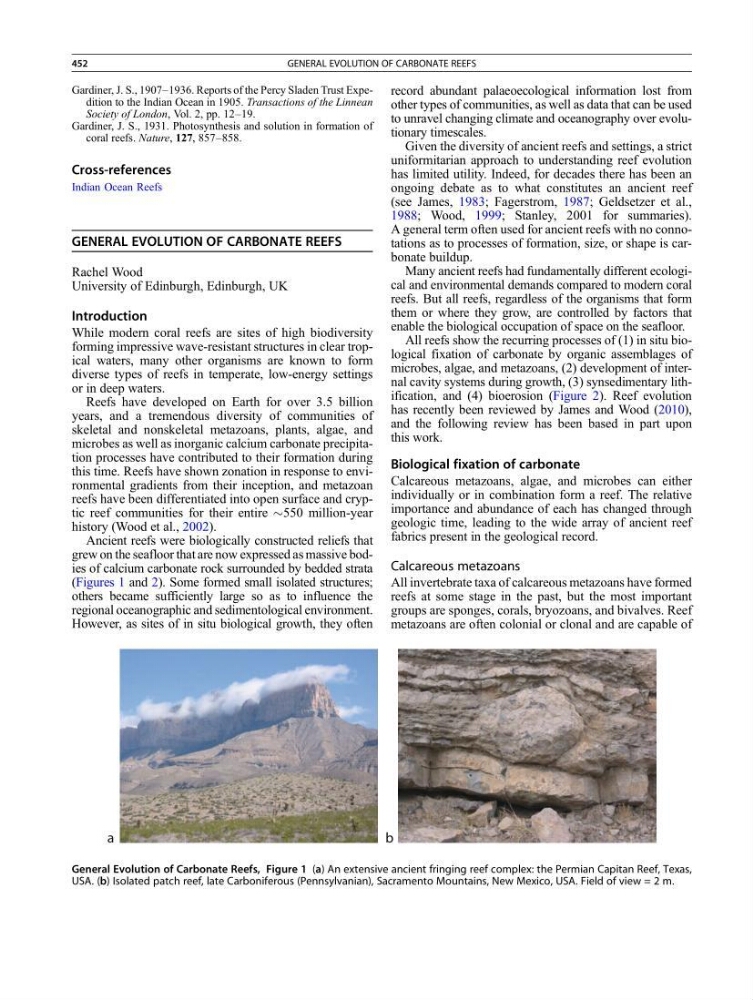
Ancient reefs were biologically constructed reliefs that
grew on the seafloor that are now expressed as massive bodies of calcium carbonate rock surrounded by bedded strata
(Figures 1 and 2). Some formed small isolated structures;
others became sufficiently large so as to influence the
regional oceanographic and sedimentological environment.
However, as sites of in situ biological growth, they often
record abundant palaeoecological information lost from
other types of communities, as well as data that can be used
to unravel changing climate and oceanography over evolutionary timescales.
Given the diversity of ancient reefs and settings, a strict
uniformitarian approach to understanding reef evolution
has limited utility. Indeed, for decades there has been an
ongoing debate as to what constitutes an ancient reef
(see James, 1983; Fagerstrom, 1987; Geldsetzer et al.,
1988; Wood, 1999; Stanley, 2001 for summaries).
A general term often used for ancient reefs with no connotations as to processes of formation, size, or shape is carbonate buildup.
Many ancient reefs had fundamentally different ecological and environmental demands compared to modern coral
reefs. But all reefs, regardless of the organisms that form
them or where they grow, are controlled by factors that
enable the biological occupation of space on the seafloor.
All reefs show the recurring processes of (1) in situ biological fixation of carbonate by organic assemblages of
microbes, algae, and metazoans, (2) development of internal cavity systems during growth, (3) synsedimentary lithification, and (4) bioerosion (Figure 2). Reef evolution
has recently been reviewed by James and Wood (2010),
and the following review has been based in part upon
this work.
Biological fixation of carbonate
Calcareous metazoans, algae, and microbes can either
individually or in combination form a reef. The relative
importance and abundance of each has changed through
geologic time, leading to the wide array of ancient reef
fabrics present in the geological record.
Calcareous metazoans
All invertebrate taxa of calcareous metazoans have formed
reefs at some stage in the past, but the most important
groups are sponges, corals, bryozoans, and bivalves. Reef
metazoans are often colonial or clonal and are capable of
a
b
General Evolution of Carbonate Reefs, Figure 1 (a) An extensive ancient fringing reef complex: the Permian Capitan Reef, Texas,
USA. (b) Isolated patch reef, late Carboniferous (Pennsylvanian), Sacramento Mountains, New Mexico, USA. Field of view = 2 m.
452
GENERAL EVOLUTION OF CARBONATE REEFS
Society of London, Vol. 2, pp. 12–19.
Gardiner, J. S., 1931. Photosynthesis and solution in formation of
coral reefs. Nature, 127, 857–858.
Cross-references
Indian Ocean Reefs
GENERAL EVOLUTION OF CARBONATE REEFS
Rachel Wood
University of Edinburgh, Edinburgh, UK
Introduction
While modern coral reefs are sites of high biodiversity
forming impressive wave-resistant structures in clear tropical waters, many other organisms are known to form
diverse types of reefs in temperate, low-energy settings
or in deep waters.
Reefs have developed on Earth for over 3.5 billion
years, and a tremendous diversity of communities of
skeletal and nonskeletal metazoans, plants, algae, and
microbes as well as inorganic calcium carbonate precipitation processes have contributed to their formation during
this time. Reefs have shown zonation in response to environmental gradients from their inception, and metazoan
reefs have been differentiated into open surface and cryptic reef communities for their entire $550 million-year
history (Wood et al., 2002).
Ancient reefs were biologically constructed reliefs that
grew on the seafloor that are now expressed as massive bodies of calcium carbonate rock surrounded by bedded strata
(Figures 1 and 2). Some formed small isolated structures;
others became sufficiently large so as to influence the
regional oceanographic and sedimentological environment.
However, as sites of in situ biological growth, they often
record abundant palaeoecological information lost from
other types of communities, as well as data that can be used
to unravel changing climate and oceanography over evolutionary timescales.
Given the diversity of ancient reefs and settings, a strict
uniformitarian approach to understanding reef evolution
has limited utility. Indeed, for decades there has been an
ongoing debate as to what constitutes an ancient reef
(see James, 1983; Fagerstrom, 1987; Geldsetzer et al.,
1988; Wood, 1999; Stanley, 2001 for summaries).
A general term often used for ancient reefs with no connotations as to processes of formation, size, or shape is carbonate buildup.
Many ancient reefs had fundamentally different ecological and environmental demands compared to modern coral
reefs. But all reefs, regardless of the organisms that form
them or where they grow, are controlled by factors that
enable the biological occupation of space on the seafloor.
All reefs show the recurring processes of (1) in situ biological fixation of carbonate by organic assemblages of
microbes, algae, and metazoans, (2) development of internal cavity systems during growth, (3) synsedimentary lithification, and (4) bioerosion (Figure 2). Reef evolution
has recently been reviewed by James and Wood (2010),
and the following review has been based in part upon
this work.
Biological fixation of carbonate
Calcareous metazoans, algae, and microbes can either
individually or in combination form a reef. The relative
importance and abundance of each has changed through
geologic time, leading to the wide array of ancient reef
fabrics present in the geological record.
Calcareous metazoans
All invertebrate taxa of calcareous metazoans have formed
reefs at some stage in the past, but the most important
groups are sponges, corals, bryozoans, and bivalves. Reef
metazoans are often colonial or clonal and are capable of
a
b
General Evolution of Carbonate Reefs, Figure 1 (a) An extensive ancient fringing reef complex: the Permian Capitan Reef, Texas,
USA. (b) Isolated patch reef, late Carboniferous (Pennsylvanian), Sacramento Mountains, New Mexico, USA. Field of view = 2 m.
452
GENERAL EVOLUTION OF CARBONATE REEFS