

Introduction
In the 30 plus years since Steers and Stoddart (1977)
suggested that
Of the three main types, fringing reefs are the simplest,
apparently the least in need of complex explanations, and
also the least studied.
There have been numerous geomorphological studies of
fringing reefs, including morphostratigraphic and geochronological investigations. These studies show that although
many fringing reefs are relatively thin structures of recent
age, their growth and development is usually more complex
than formerly recognized. Kennedy and Woodroffe (2002)
provide an excellent review of geomorphological research
on fringing reefs that summarizes this complexity. The proliferation of fringing reef research since the late 1970s
occurred partly because they are the most common type of
reef (more than 50% of the total reef area globally – Hopley,
2004), and they are relatively easy reefs to access compared
to those offshore, but another significant motivation has
been their perceived vulnerability to threats associated with
land-based human activities (see Nutrient Pollution/Eutrophication). In recent years, this interest has intensified as
many fringing reefs are reportedly in decline, even on the
Great Barrier Reef (GBR) – the world’s best protected reef
ecosystem (e.g., McCulloch et al., 2003; Fabricius, 2005;
Wilkinson, 2008) (see Great Barrier Reef : Origin, Evolution, and Modern Development ).
Following Darwin’s classification (1842) (see Darwin,
Charles (1809–1882)), fringing reefs are interpreted as the
first stage in a long-term evolutionary sequence, in which
reef growth is initiated over a substrate on the shoreline
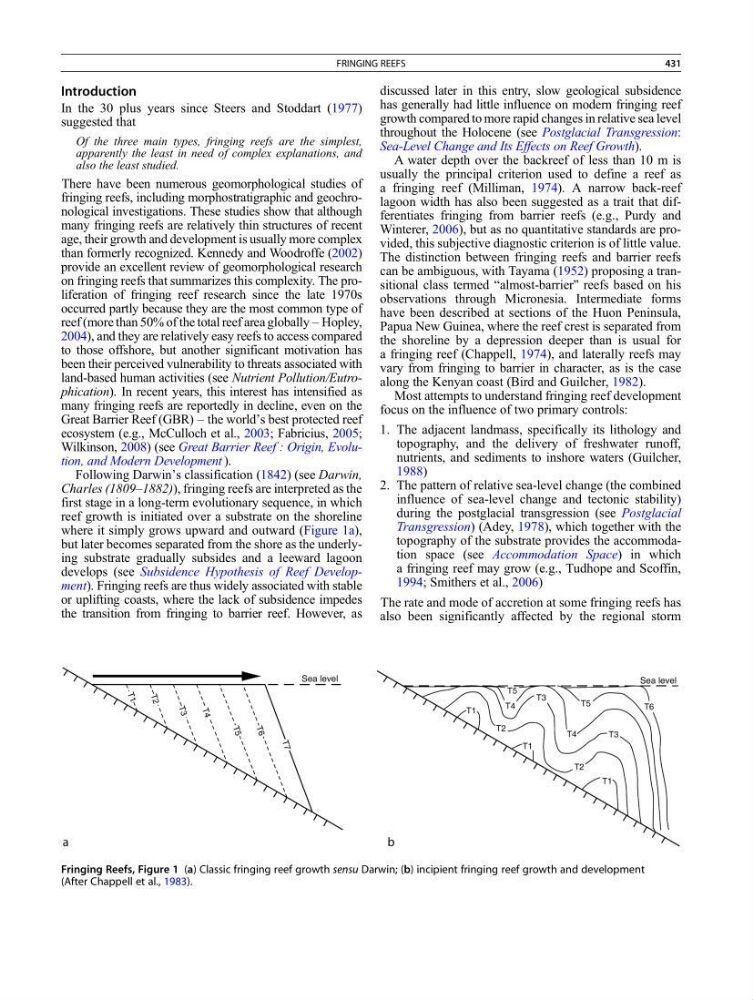
where it simply grows upward and outward (Figure 1a),
but later becomes separated from the shore as the underlying substrate gradually subsides and a leeward lagoon
develops (see Subsidence Hypothesis of Reef Development). Fringing reefs are thus widely associated with stable
or uplifting coasts, where the lack of subsidence impedes
the transition from fringing to barrier reef. However, as
discussed later in this entry, slow geological subsidence
has generally had little influence on modern fringing reef
growth compared to more rapid changes in relative sea level
throughout the Holocene (see Postglacial Transgression:
Sea-Level Change and Its Effects on Reef Growth).
A water depth over the backreef of less than 10 m is
usually the principal criterion used to define a reef as
a fringing reef (Milliman, 1974). A narrow back-reef
lagoon width has also been suggested as a trait that differentiates fringing from barrier reefs (e.g., Purdy and
Winterer, 2006), but as no quantitative standards are provided, this subjective diagnostic criterion is of little value.
The distinction between fringing reefs and barrier reefs
can be ambiguous, with Tayama (1952) proposing a transitional class termed “almost-barrier” reefs based on his
observations through Micronesia. Intermediate forms
have been described at sections of the Huon Peninsula,
Papua New Guinea, where the reef crest is separated from
the shoreline by a depression deeper than is usual for
a fringing reef (Chappell, 1974), and laterally reefs may
vary from fringing to barrier in character, as is the case
along the Kenyan coast (Bird and Guilcher, 1982).
Most attempts to understand fringing reef development
focus on the influence of two primary controls:
1. The adjacent landmass, specifically its lithology and
topography, and the delivery of freshwater runoff,
nutrients, and sediments to inshore waters (Guilcher,
1988)
2. The pattern of relative sea-level change (the combined
influence of sea-level change and tectonic stability)
during the postglacial transgression (see Postglacial
Transgression) (Adey, 1978), which together with the
topography of the substrate provides the accommodation space (see Accommodation Space) in which
a fringing reef may grow (e.g., Tudhope and Scoffin,
1994; Smithers et al., 2006)
The rate and mode of accretion at some fringing reefs has
also been significantly affected by the regional storm
Fringing Reefs, Figure 1 (a) Classic fringing reef growth sensu Darwin; (b) incipient fringing reef growth and development
(After Chappell et al., 1983).
FRINGING REEFS
431
In the 30 plus years since Steers and Stoddart (1977)
suggested that
Of the three main types, fringing reefs are the simplest,
apparently the least in need of complex explanations, and
also the least studied.
There have been numerous geomorphological studies of
fringing reefs, including morphostratigraphic and geochronological investigations. These studies show that although
many fringing reefs are relatively thin structures of recent
age, their growth and development is usually more complex
than formerly recognized. Kennedy and Woodroffe (2002)
provide an excellent review of geomorphological research
on fringing reefs that summarizes this complexity. The proliferation of fringing reef research since the late 1970s
occurred partly because they are the most common type of
reef (more than 50% of the total reef area globally – Hopley,
2004), and they are relatively easy reefs to access compared
to those offshore, but another significant motivation has
been their perceived vulnerability to threats associated with
land-based human activities (see Nutrient Pollution/Eutrophication). In recent years, this interest has intensified as
many fringing reefs are reportedly in decline, even on the
Great Barrier Reef (GBR) – the world’s best protected reef
ecosystem (e.g., McCulloch et al., 2003; Fabricius, 2005;
Wilkinson, 2008) (see Great Barrier Reef : Origin, Evolution, and Modern Development ).
Following Darwin’s classification (1842) (see Darwin,
Charles (1809–1882)), fringing reefs are interpreted as the
first stage in a long-term evolutionary sequence, in which
reef growth is initiated over a substrate on the shoreline
where it simply grows upward and outward (Figure 1a),
but later becomes separated from the shore as the underlying substrate gradually subsides and a leeward lagoon
develops (see Subsidence Hypothesis of Reef Development). Fringing reefs are thus widely associated with stable
or uplifting coasts, where the lack of subsidence impedes
the transition from fringing to barrier reef. However, as
discussed later in this entry, slow geological subsidence
has generally had little influence on modern fringing reef
growth compared to more rapid changes in relative sea level
throughout the Holocene (see Postglacial Transgression:
Sea-Level Change and Its Effects on Reef Growth).
A water depth over the backreef of less than 10 m is
usually the principal criterion used to define a reef as
a fringing reef (Milliman, 1974). A narrow back-reef
lagoon width has also been suggested as a trait that differentiates fringing from barrier reefs (e.g., Purdy and
Winterer, 2006), but as no quantitative standards are provided, this subjective diagnostic criterion is of little value.
The distinction between fringing reefs and barrier reefs
can be ambiguous, with Tayama (1952) proposing a transitional class termed “almost-barrier” reefs based on his
observations through Micronesia. Intermediate forms
have been described at sections of the Huon Peninsula,
Papua New Guinea, where the reef crest is separated from
the shoreline by a depression deeper than is usual for
a fringing reef (Chappell, 1974), and laterally reefs may
vary from fringing to barrier in character, as is the case
along the Kenyan coast (Bird and Guilcher, 1982).
Most attempts to understand fringing reef development
focus on the influence of two primary controls:
1. The adjacent landmass, specifically its lithology and
topography, and the delivery of freshwater runoff,
nutrients, and sediments to inshore waters (Guilcher,
1988)
2. The pattern of relative sea-level change (the combined
influence of sea-level change and tectonic stability)
during the postglacial transgression (see Postglacial
Transgression) (Adey, 1978), which together with the
topography of the substrate provides the accommodation space (see Accommodation Space) in which
a fringing reef may grow (e.g., Tudhope and Scoffin,
1994; Smithers et al., 2006)
The rate and mode of accretion at some fringing reefs has
also been significantly affected by the regional storm
Fringing Reefs, Figure 1 (a) Classic fringing reef growth sensu Darwin; (b) incipient fringing reef growth and development
(After Chappell et al., 1983).
FRINGING REEFS
431