

water (Wolanski, 1986). At smaller scales, wave-driven
circulation might be expected to dominate on windward
coasts, whereas on leeward shores, the interaction of
tide-generated or wind-generated currents with the local
topography will set up topographically controlled circulation patterns, with eddy circulation dominating.
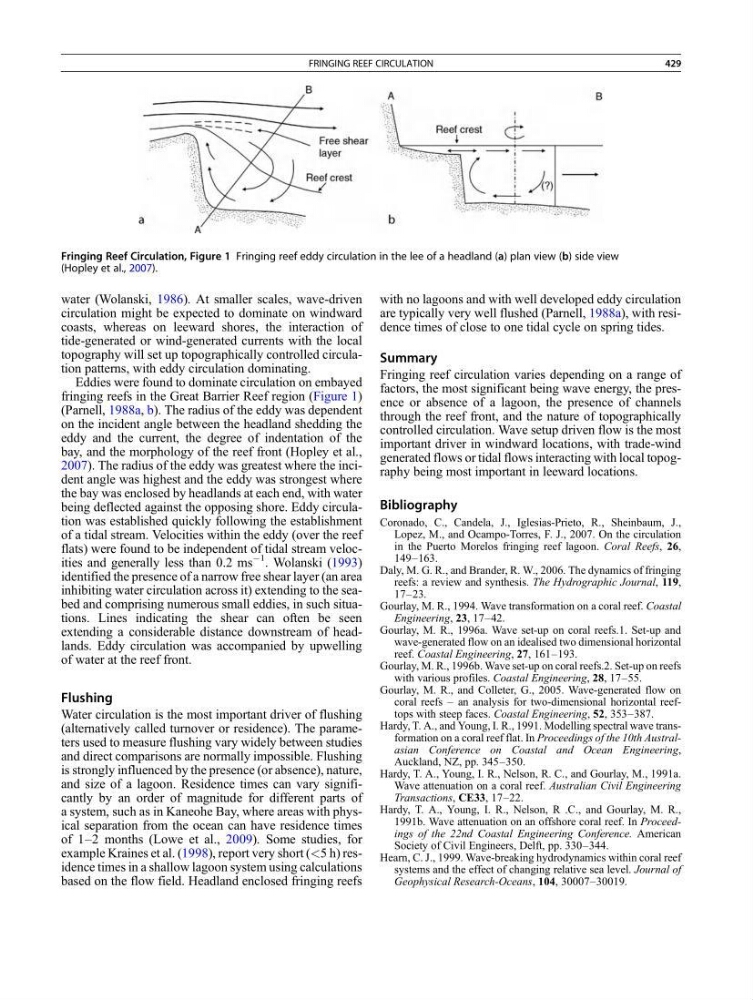
Eddies were found to dominate circulation on embayed
fringing reefs in the Great Barrier Reef region (Figure 1)
(Parnell, 1988a, b). The radius of the eddy was dependent
on the incident angle between the headland shedding the
eddy and the current, the degree of indentation of the
bay, and the morphology of the reef front (Hopley et al.,
2007). The radius of the eddy was greatest where the incident angle was highest and the eddy was strongest where
the bay was enclosed by headlands at each end, with water
being deflected against the opposing shore. Eddy circulation was established quickly following the establishment
of a tidal stream. Velocities within the eddy (over the reef
flats) were found to be independent of tidal stream velocities and generally less than 0.2 ms
À1
. Wolanski (1993)
identified the presence of a narrow free shear layer (an area
inhibiting water circulation across it) extending to the seabed and comprising numerous small eddies, in such situations. Lines indicating the shear can often be seen
extending a considerable distance downstream of headlands. Eddy circulation was accompanied by upwelling
of water at the reef front.
Flushing
Water circulation is the most important driver of flushing
(alternatively called turnover or residence). The parameters used to measure flushing vary widely between studies
and direct comparisons are normally impossible. Flushing
is strongly influenced by the presence (or absence), nature,
and size of a lagoon. Residence times can vary significantly by an order of magnitude for different parts of
a system, such as in Kaneohe Bay, where areas with physical separation from the ocean can have residence times
of 1–2 months (Lowe et al., 2009). Some studies, for
example Kraines et al. (1998), report very short (<5 h) residence times in a shallow lagoon system using calculations
based on the flow field. Headland enclosed fringing reefs
with no lagoons and with well developed eddy circulation
are typically very well flushed (Parnell, 1988a), with residence times of close to one tidal cycle on spring tides.
Summary
Fringing reef circulation varies depending on a range of
factors, the most significant being wave energy, the presence or absence of a lagoon, the presence of channels
through the reef front, and the nature of topographically
controlled circulation. Wave setup driven flow is the most
important driver in windward locations, with trade-wind
generated flows or tidal flows interacting with local topography being most important in leeward locations.
Bibliography
Coronado, C., Candela, J., Iglesias-Prieto, R., Sheinbaum, J.,
Lopez, M., and Ocampo-Torres, F. J., 2007. On the circulation
in the Puerto Morelos fringing reef lagoon. Coral Reefs, 26,
149–163.
Daly, M. G. R., and Brander, R. W., 2006. The dynamics of fringing
reefs: a review and synthesis. The Hydrographic Journal, 119,
17–23.
Gourlay, M. R., 1994. Wave transformation on a coral reef. Coastal
Engineering, 23, 17–42.
Gourlay, M. R., 1996a. Wave set-up on coral reefs.1. Set-up and
wave-generated flow on an idealised two dimensional horizontal
reef. Coastal Engineering, 27, 161–193.
Gourlay, M. R., 1996b. Wave set-up on coral reefs.2. Set-up on reefs
with various profiles. Coastal Engineering, 28, 17–55.
Gourlay, M. R., and Colleter, G., 2005. Wave-generated flow on
coral reefs – an analysis for two-dimensional horizontal reeftops with steep faces. Coastal Engineering, 52, 353–387.
Hardy, T. A., and Young, I. R., 1991. Modelling spectral wave transformation on a coral reef flat. In Proceedings of the 10th Australasian Conference on Coastal and Ocean Engineering,
Auckland, NZ, pp. 345–350.
Hardy, T. A., Young, I. R., Nelson, R. C., and Gourlay, M., 1991a.
Wave attenuation on a coral reef. Australian Civil Engineering
Transactions, CE33, 17–22.
Hardy, T. A., Young, I. R., Nelson, R .C., and Gourlay, M. R.,
1991b. Wave attenuation on an offshore coral reef. In Proceedings of the 22nd Coastal Engineering Conference. American
Society of Civil Engineers, Delft, pp. 330–344.
Hearn, C. J., 1999. Wave-breaking hydrodynamics within coral reef
systems and the effect of changing relative sea level. Journal of
Geophysical Research-Oceans, 104, 30007–30019.
Fringing Reef Circulation, Figure 1 Fringing reef eddy circulation in the lee of a headland (a) plan view (b) side view
(Hopley et al., 2007).
FRINGING REEF CIRCULATION
429
circulation might be expected to dominate on windward
coasts, whereas on leeward shores, the interaction of
tide-generated or wind-generated currents with the local
topography will set up topographically controlled circulation patterns, with eddy circulation dominating.
Eddies were found to dominate circulation on embayed
fringing reefs in the Great Barrier Reef region (Figure 1)
(Parnell, 1988a, b). The radius of the eddy was dependent
on the incident angle between the headland shedding the
eddy and the current, the degree of indentation of the
bay, and the morphology of the reef front (Hopley et al.,
2007). The radius of the eddy was greatest where the incident angle was highest and the eddy was strongest where
the bay was enclosed by headlands at each end, with water
being deflected against the opposing shore. Eddy circulation was established quickly following the establishment
of a tidal stream. Velocities within the eddy (over the reef
flats) were found to be independent of tidal stream velocities and generally less than 0.2 ms
À1
. Wolanski (1993)
identified the presence of a narrow free shear layer (an area
inhibiting water circulation across it) extending to the seabed and comprising numerous small eddies, in such situations. Lines indicating the shear can often be seen
extending a considerable distance downstream of headlands. Eddy circulation was accompanied by upwelling
of water at the reef front.
Flushing
Water circulation is the most important driver of flushing
(alternatively called turnover or residence). The parameters used to measure flushing vary widely between studies
and direct comparisons are normally impossible. Flushing
is strongly influenced by the presence (or absence), nature,
and size of a lagoon. Residence times can vary significantly by an order of magnitude for different parts of
a system, such as in Kaneohe Bay, where areas with physical separation from the ocean can have residence times
of 1–2 months (Lowe et al., 2009). Some studies, for
example Kraines et al. (1998), report very short (<5 h) residence times in a shallow lagoon system using calculations
based on the flow field. Headland enclosed fringing reefs
with no lagoons and with well developed eddy circulation
are typically very well flushed (Parnell, 1988a), with residence times of close to one tidal cycle on spring tides.
Summary
Fringing reef circulation varies depending on a range of
factors, the most significant being wave energy, the presence or absence of a lagoon, the presence of channels
through the reef front, and the nature of topographically
controlled circulation. Wave setup driven flow is the most
important driver in windward locations, with trade-wind
generated flows or tidal flows interacting with local topography being most important in leeward locations.
Bibliography
Coronado, C., Candela, J., Iglesias-Prieto, R., Sheinbaum, J.,
Lopez, M., and Ocampo-Torres, F. J., 2007. On the circulation
in the Puerto Morelos fringing reef lagoon. Coral Reefs, 26,
149–163.
Daly, M. G. R., and Brander, R. W., 2006. The dynamics of fringing
reefs: a review and synthesis. The Hydrographic Journal, 119,
17–23.
Gourlay, M. R., 1994. Wave transformation on a coral reef. Coastal
Engineering, 23, 17–42.
Gourlay, M. R., 1996a. Wave set-up on coral reefs.1. Set-up and
wave-generated flow on an idealised two dimensional horizontal
reef. Coastal Engineering, 27, 161–193.
Gourlay, M. R., 1996b. Wave set-up on coral reefs.2. Set-up on reefs
with various profiles. Coastal Engineering, 28, 17–55.
Gourlay, M. R., and Colleter, G., 2005. Wave-generated flow on
coral reefs – an analysis for two-dimensional horizontal reeftops with steep faces. Coastal Engineering, 52, 353–387.
Hardy, T. A., and Young, I. R., 1991. Modelling spectral wave transformation on a coral reef flat. In Proceedings of the 10th Australasian Conference on Coastal and Ocean Engineering,
Auckland, NZ, pp. 345–350.
Hardy, T. A., Young, I. R., Nelson, R. C., and Gourlay, M., 1991a.
Wave attenuation on a coral reef. Australian Civil Engineering
Transactions, CE33, 17–22.
Hardy, T. A., Young, I. R., Nelson, R .C., and Gourlay, M. R.,
1991b. Wave attenuation on an offshore coral reef. In Proceedings of the 22nd Coastal Engineering Conference. American
Society of Civil Engineers, Delft, pp. 330–344.
Hearn, C. J., 1999. Wave-breaking hydrodynamics within coral reef
systems and the effect of changing relative sea level. Journal of
Geophysical Research-Oceans, 104, 30007–30019.
Fringing Reef Circulation, Figure 1 Fringing reef eddy circulation in the lee of a headland (a) plan view (b) side view
(Hopley et al., 2007).
FRINGING REEF CIRCULATION
429