

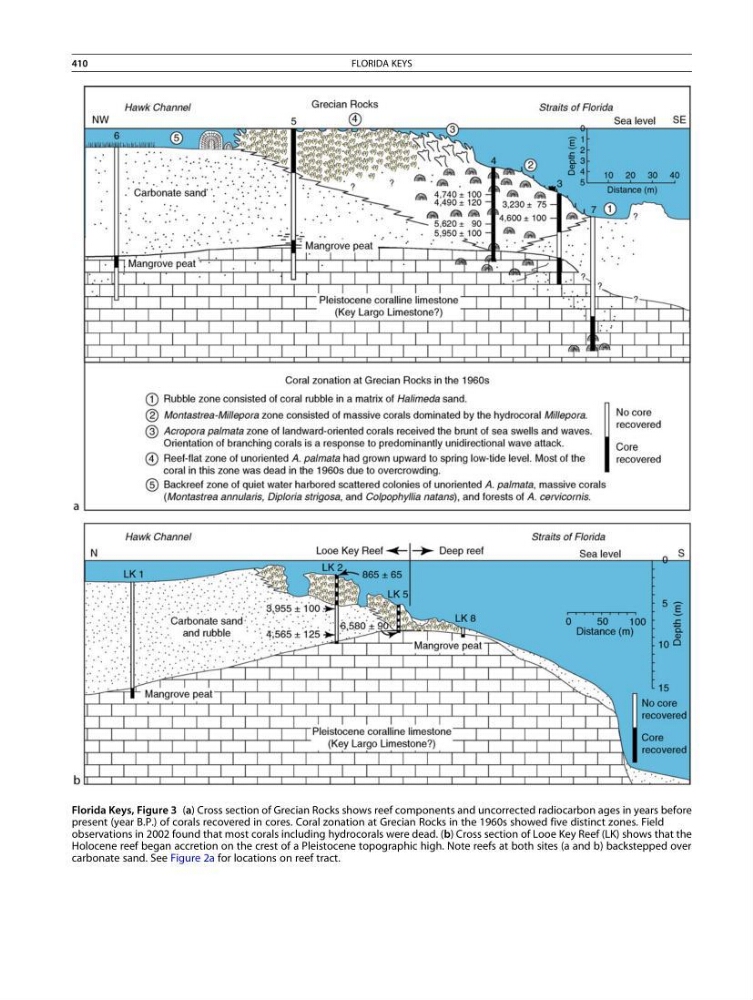
Florida Keys, Figure 3 (a) Cross section of Grecian Rocks shows reef components and uncorrected radiocarbon ages in years before
present (year B.P.) of corals recovered in cores. Coral zonation at Grecian Rocks in the 1960s showed five distinct zones. Field
observations in 2002 found that most corals including hydrocorals were dead. (b) Cross section of Looe Key Reef (LK) shows that the
Holocene reef began accretion on the crest of a Pleistocene topographic high. Note reefs at both sites (a and b) backstepped over
carbonate sand. See Figure 2a for locations on reef tract.
410
FLORIDA KEYS
present (year B.P.) of corals recovered in cores. Coral zonation at Grecian Rocks in the 1960s showed five distinct zones. Field
observations in 2002 found that most corals including hydrocorals were dead. (b) Cross section of Looe Key Reef (LK) shows that the
Holocene reef began accretion on the crest of a Pleistocene topographic high. Note reefs at both sites (a and b) backstepped over
carbonate sand. See Figure 2a for locations on reef tract.
410
FLORIDA KEYS