

depths terminate at the west end of a bedrock ridge known
as the Marquesas–Quicksands ridge (Figure 2a). Farther
west, the shelf underlies Holocene reefs and islands of
the Dry Tortugas. Holocene flooding from southwest to
northeast produced older reefs to the southwest. Most
Keys reefs occupy water depths of $3–30 m.
Bedrock topography controls major geomorphic elements: a depression under Florida Bay, the Florida Keys,
an inner shelf, a depression beneath Hawk Channel, an
outer shelf, and an upper-slope terrace in 40 m of water
(Lidz et al., 2006). All parallel the margin, marked by
the 30-m depth contour. Orientation, composition, and
tidal-pass width divide the island chain into lower, middle,
and upper Keys (Figure 2b). Modern reefs, located seaward of the Keys, are healthiest off the upper Keys, which
lack natural tidal passes. The least healthy occur off
the middle Keys where passes are numerous and wide
(Lidz and Hallock, 2000).
The curved Florida Keys shelf is a windward platform
margin. Prevailing southeasterly winds and waves are
onshore in the northeast. Shallower water and lack of tidal
passes limit influence of tides and currents. Daily sediment movement is negligible. Prevailing energy is alongshore in the southwest. Deeper open-marine conditions
and wide tidal passes permit strong tidal and current
exchange between the Gulf of Mexico and Florida Straits.
Sediment is transported offshelf.
Seven coral ecosystems and reef decline
Excluding corals of the Q3 Unit, about which little is conclusively known, the past 325 kyr of Florida reef evolution
are well studied (cf., Lidz et al., 2008). Seismic surveys,
coring, sclerochronology, and radiometric dating of coral,
mangrove peat, and calcrete have shown that the two
most important controls on reefs during that time were
fluctuating sea level and antecedent bedrock topography
(Shinn et al., 1977).
Dates on Florida Keys corals record six late
Pleistocene highstands and reef ecosystems. The two
highest occurred at $125 and 80 ka. The seventh
(Holocene transgression) produced the modern ecosystem. Geomorphogenetic models derived from coral
dates and seismic data show the origin and changing
evolution of landforms at four dissimilar sites (reef and
non-reef ) along the shelf edge (Lidz, 2004). The models
illustrate asymmetric evolution. The seven ecosystems
accrued mainly by successive stacking of new coral
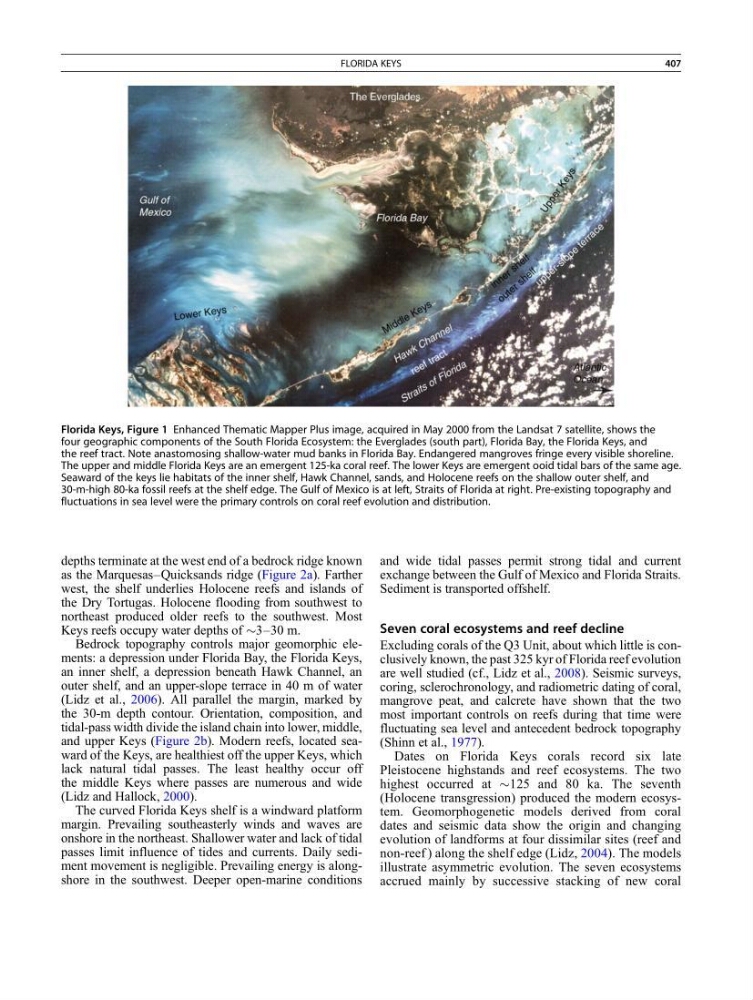
Florida Keys, Figure 1 Enhanced Thematic Mapper Plus image, acquired in May 2000 from the Landsat 7 satellite, shows the
four geographic components of the South Florida Ecosystem: the Everglades (south part), Florida Bay, the Florida Keys, and
the reef tract. Note anastomosing shallow-water mud banks in Florida Bay. Endangered mangroves fringe every visible shoreline.
The upper and middle Florida Keys are an emergent 125-ka coral reef. The lower Keys are emergent ooid tidal bars of the same age.
Seaward of the keys lie habitats of the inner shelf, Hawk Channel, sands, and Holocene reefs on the shallow outer shelf, and
30-m-high 80-ka fossil reefs at the shelf edge. The Gulf of Mexico is at left, Straits of Florida at right. Pre-existing topography and
fluctuations in sea level were the primary controls on coral reef evolution and distribution.
FLORIDA KEYS
407
as the Marquesas–Quicksands ridge (Figure 2a). Farther
west, the shelf underlies Holocene reefs and islands of
the Dry Tortugas. Holocene flooding from southwest to
northeast produced older reefs to the southwest. Most
Keys reefs occupy water depths of $3–30 m.
Bedrock topography controls major geomorphic elements: a depression under Florida Bay, the Florida Keys,
an inner shelf, a depression beneath Hawk Channel, an
outer shelf, and an upper-slope terrace in 40 m of water
(Lidz et al., 2006). All parallel the margin, marked by
the 30-m depth contour. Orientation, composition, and
tidal-pass width divide the island chain into lower, middle,
and upper Keys (Figure 2b). Modern reefs, located seaward of the Keys, are healthiest off the upper Keys, which
lack natural tidal passes. The least healthy occur off
the middle Keys where passes are numerous and wide
(Lidz and Hallock, 2000).
The curved Florida Keys shelf is a windward platform
margin. Prevailing southeasterly winds and waves are
onshore in the northeast. Shallower water and lack of tidal
passes limit influence of tides and currents. Daily sediment movement is negligible. Prevailing energy is alongshore in the southwest. Deeper open-marine conditions
and wide tidal passes permit strong tidal and current
exchange between the Gulf of Mexico and Florida Straits.
Sediment is transported offshelf.
Seven coral ecosystems and reef decline
Excluding corals of the Q3 Unit, about which little is conclusively known, the past 325 kyr of Florida reef evolution
are well studied (cf., Lidz et al., 2008). Seismic surveys,
coring, sclerochronology, and radiometric dating of coral,
mangrove peat, and calcrete have shown that the two
most important controls on reefs during that time were
fluctuating sea level and antecedent bedrock topography
(Shinn et al., 1977).
Dates on Florida Keys corals record six late
Pleistocene highstands and reef ecosystems. The two
highest occurred at $125 and 80 ka. The seventh
(Holocene transgression) produced the modern ecosystem. Geomorphogenetic models derived from coral
dates and seismic data show the origin and changing
evolution of landforms at four dissimilar sites (reef and
non-reef ) along the shelf edge (Lidz, 2004). The models
illustrate asymmetric evolution. The seven ecosystems
accrued mainly by successive stacking of new coral
Florida Keys, Figure 1 Enhanced Thematic Mapper Plus image, acquired in May 2000 from the Landsat 7 satellite, shows the
four geographic components of the South Florida Ecosystem: the Everglades (south part), Florida Bay, the Florida Keys, and
the reef tract. Note anastomosing shallow-water mud banks in Florida Bay. Endangered mangroves fringe every visible shoreline.
The upper and middle Florida Keys are an emergent 125-ka coral reef. The lower Keys are emergent ooid tidal bars of the same age.
Seaward of the keys lie habitats of the inner shelf, Hawk Channel, sands, and Holocene reefs on the shallow outer shelf, and
30-m-high 80-ka fossil reefs at the shelf edge. The Gulf of Mexico is at left, Straits of Florida at right. Pre-existing topography and
fluctuations in sea level were the primary controls on coral reef evolution and distribution.
FLORIDA KEYS
407