

surveys and analyses; evaluation of a full range of alternative sites and designs; and evaluation of a full range
of measures to reduce or avoid adverse impacts.
The final decisions of the EIA should be incorporated
into the construction plans and specifications in the
form of an Environmental Protection Plan that the construction contractor(s) must honor.
The EIA process should require an environmental
audit of the completed project to address impacts not
covered or anticipated in the pre-project phase of the
EIA.
The project area should be monitored by an independent team of scientists and engineers who report construction violations or issues directly to the
government contracting officer who in turn has the
authority to suspend the construction until deficiencies
are corrected.
Use of explosives should include measures to reduce
damage to adjacent reefs by (1) drilling holes to load
smaller charges and (2) covering each detonation site
with heavy cloth to reduce fly-rock, concussion and
shock to marine life.
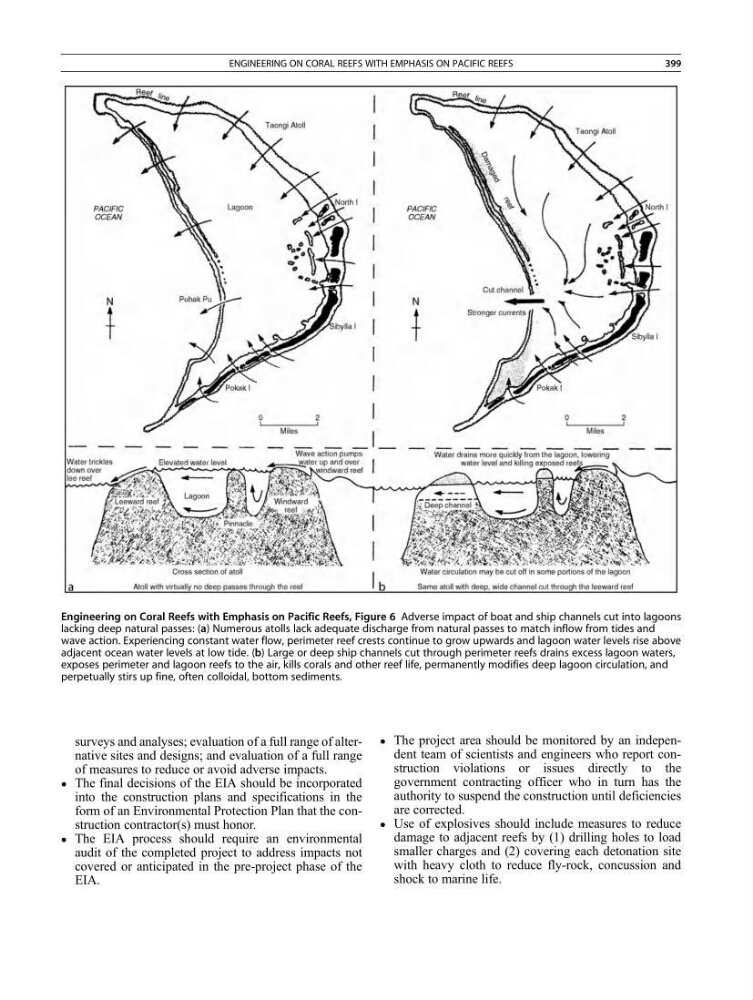
Engineering on Coral Reefs with Emphasis on Pacific Reefs, Figure 6 Adverse impact of boat and ship channels cut into lagoons
lacking deep natural passes: (a) Numerous atolls lack adequate discharge from natural passes to match inflow from tides and
wave action. Experiencing constant water flow, perimeter reef crests continue to grow upwards and lagoon water levels rise above
adjacent ocean water levels at low tide. (b) Large or deep ship channels cut through perimeter reefs drains excess lagoon waters,
exposes perimeter and lagoon reefs to the air, kills corals and other reef life, permanently modifies deep lagoon circulation, and
perpetually stirs up fine, often colloidal, bottom sediments.
ENGINEERING ON CORAL REEFS WITH EMPHASIS ON PACIFIC REEFS
399
of measures to reduce or avoid adverse impacts.
The final decisions of the EIA should be incorporated
into the construction plans and specifications in the
form of an Environmental Protection Plan that the construction contractor(s) must honor.
The EIA process should require an environmental
audit of the completed project to address impacts not
covered or anticipated in the pre-project phase of the
EIA.
The project area should be monitored by an independent team of scientists and engineers who report construction violations or issues directly to the
government contracting officer who in turn has the
authority to suspend the construction until deficiencies
are corrected.
Use of explosives should include measures to reduce
damage to adjacent reefs by (1) drilling holes to load
smaller charges and (2) covering each detonation site
with heavy cloth to reduce fly-rock, concussion and
shock to marine life.
Engineering on Coral Reefs with Emphasis on Pacific Reefs, Figure 6 Adverse impact of boat and ship channels cut into lagoons
lacking deep natural passes: (a) Numerous atolls lack adequate discharge from natural passes to match inflow from tides and
wave action. Experiencing constant water flow, perimeter reef crests continue to grow upwards and lagoon water levels rise above
adjacent ocean water levels at low tide. (b) Large or deep ship channels cut through perimeter reefs drains excess lagoon waters,
exposes perimeter and lagoon reefs to the air, kills corals and other reef life, permanently modifies deep lagoon circulation, and
perpetually stirs up fine, often colloidal, bottom sediments.
ENGINEERING ON CORAL REEFS WITH EMPHASIS ON PACIFIC REEFS
399