

Bikini Atoll to the east, and lower than species totals at
Majuro and Arno atolls to the south. Most likely the high
Bikini totals were due to substantially more survey and
search effort (see “Bikini Atoll, Marshall Islands”). Coral
species totals reported at the several largest islands of
Palau, Yap, and Chuuk are also higher than at Enewetak
but comparable to the Bikini levels. The Enewetak fish
species totals are also much lower than those reported at
Arno Atoll in the Marshall Islands, possibly due to greater
rainfall and upwelling effects where the Equatorial Current meets the Equatorial Countercurrent. Moreover, certain groups of fishes common at Kwajalein Atoll are
absent or rare at Enewetak. Contributing factors for the
lower coral and fish levels may include geographic isolation of Enewetak from neighboring atolls, the reduced survey effort, and possibly the residual effects of the nuclear
testing program.
The marine biological habitats and species at Enewetak
Atoll are still among the most comprehensively studied in
the world even though little research has been accomplished after 1985. Habitats surveyed in detail include:
Deep lagoon biological communities
Pinnacle and patch reefs of the deep lagoon
Lagoon back reefs (or lagoon margins)
Shallow passes on the perimeter reef between the northern islands
Coralline algal ridges
Ocean-facing fore reefs and
Lagoon water column habitats
Other geological and ecological investigations have covered impacts of:
Destructive storms on reefs
Intertidal ecology
Invertebrate coral predators (Acanthaster)
Coral taxonomy
Herbivory in sub-tidal communities
Bioturbation in the deep lagoon including mobilization
of radio-nuclides
Fish communities, including shark assessments, fish
reproduction, and recruitment
Ciguatera fish poisoning and
Biological communities in bomb craters and
Upward reef growth and decline during the Pleistocene
Enewetak Atoll, Marshall Islands, Figure 6 Robert Johannes on
a reconnaissance visit at Enewetak Atoll before leading the
Alpha-Helix Symbios study at Japtan Island in 1971. (Photo
cortesy by James Maragos).
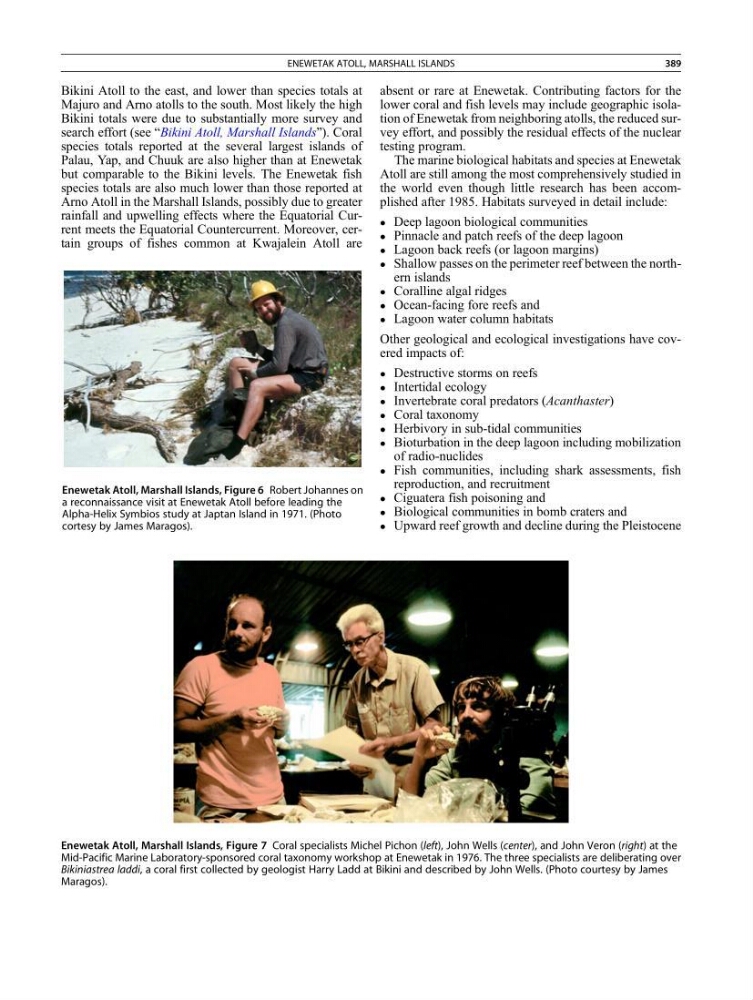
Enewetak Atoll, Marshall Islands, Figure 7 Coral specialists Michel Pichon (left), John Wells (center), and John Veron (right) at the
Mid-Pacific Marine Laboratory-sponsored coral taxonomy workshop at Enewetak in 1976. The three specialists are deliberating over
Bikiniastrea laddi, a coral first collected by geologist Harry Ladd at Bikini and described by John Wells. (Photo courtesy by James
Maragos).
ENEWETAK ATOLL, MARSHALL ISLANDS
389
Majuro and Arno atolls to the south. Most likely the high
Bikini totals were due to substantially more survey and
search effort (see “Bikini Atoll, Marshall Islands”). Coral
species totals reported at the several largest islands of
Palau, Yap, and Chuuk are also higher than at Enewetak
but comparable to the Bikini levels. The Enewetak fish
species totals are also much lower than those reported at
Arno Atoll in the Marshall Islands, possibly due to greater
rainfall and upwelling effects where the Equatorial Current meets the Equatorial Countercurrent. Moreover, certain groups of fishes common at Kwajalein Atoll are
absent or rare at Enewetak. Contributing factors for the
lower coral and fish levels may include geographic isolation of Enewetak from neighboring atolls, the reduced survey effort, and possibly the residual effects of the nuclear
testing program.
The marine biological habitats and species at Enewetak
Atoll are still among the most comprehensively studied in
the world even though little research has been accomplished after 1985. Habitats surveyed in detail include:
Deep lagoon biological communities
Pinnacle and patch reefs of the deep lagoon
Lagoon back reefs (or lagoon margins)
Shallow passes on the perimeter reef between the northern islands
Coralline algal ridges
Ocean-facing fore reefs and
Lagoon water column habitats
Other geological and ecological investigations have covered impacts of:
Destructive storms on reefs
Intertidal ecology
Invertebrate coral predators (Acanthaster)
Coral taxonomy
Herbivory in sub-tidal communities
Bioturbation in the deep lagoon including mobilization
of radio-nuclides
Fish communities, including shark assessments, fish
reproduction, and recruitment
Ciguatera fish poisoning and
Biological communities in bomb craters and
Upward reef growth and decline during the Pleistocene
Enewetak Atoll, Marshall Islands, Figure 6 Robert Johannes on
a reconnaissance visit at Enewetak Atoll before leading the
Alpha-Helix Symbios study at Japtan Island in 1971. (Photo
cortesy by James Maragos).
Enewetak Atoll, Marshall Islands, Figure 7 Coral specialists Michel Pichon (left), John Wells (center), and John Veron (right) at the
Mid-Pacific Marine Laboratory-sponsored coral taxonomy workshop at Enewetak in 1976. The three specialists are deliberating over
Bikiniastrea laddi, a coral first collected by geologist Harry Ladd at Bikini and described by John Wells. (Photo courtesy by James
Maragos).
ENEWETAK ATOLL, MARSHALL ISLANDS
389