

laboratory to be established at Enewetak to promote the
opportunity for other scientists to visit and engage in field
research at the atoll. The Enewetak Marine Biological Laboratory was established in 1955 and directed by marine scientists at the University of Hawaii. Still later the laboratory
was reorganized and renamed the Mid-Pacific Marine Laboratory in 1975 to add neighboring Bikini Atoll to the
research focus. In 1979, with the cleanup of Enewetak
nearing completion, the laboratory was renamed the
Mid-Pacific Research Laboratory and down-phased to concentrate on synthesizing the research of the previous quarter
century and promoting terrestrial research.
With the resettlement of the Enewetak people completed in 1980 and the subsequent reduction in AEC budgets, the laboratory was closed in 1985 with its biological
collections packed and transferred to the Bernice P.
Bishop Museum and the Smithsonian’s National Museum
of Natural History. The reference library of the lab was
transferred to the Hawaii Institute of Marine Biology of
the University of Hawaii in Kāne‘ohe Bay. Over the
30-year period of the lab, 250 formal publications were
produced, more than a thousand contributions
accessioned, and 1,028 scientists utilized the laboratory.
A two volume synthesis of marine research at the lab,
The Natural History of Enewetak Atoll, was prepared by
three dozen scientists and published by the U.S. Department of Energy in 1987.
Deep Drilling Program at Enewetak Atoll
The earliest modern drilling to learn of the origin of atolls
began at Funafuti when British scientists in 1896
penetrated 114 ft. Additional efforts by Japanese scientists
led to the drilling at North Borodino to a depth of 1,416 ft.
American scientists drilled six holes at Bikini in 1947, two
of which penetrated to 1,346 and 2,556 ft. Although all
cores had provided evidence of carbonate deposits
forming in shallow waters, including corals that had
grown in place, none penetrated far enough to reach volcanic base of the atolls. However, in 1951, one Enewetak
drill hole at Medren Island off the southern rim penetrated
to 4,222 ft (1,267 m) and another Enewetak drill hole at
Elugelab Island along the north rim reached to 4,610 ft
(1,405 m), with both hitting volcanic bedrock of the upper
slope of an extinct volcano rising 5,000 m above the surrounding deep ocean floor, and serving as the base of the
atoll. The reef cap above the volcano was estimated at
1,370 m in vertical thickness, and the basalt at the bottom
of the cores was dated from the Eocene at 51–59 million
years before present. These drillings provided the necessary evidence in support of Darwin’s subsidence theory
leading to deep ocean atoll development. All material collected in the two deep Enewetak cores was limestone with
numerous cavities, characteristic of shallow living reefs,
and dominated by corals, coralline algae, mollusks, and
foraminifera that grew and survived only in shallow water.
Since these species cannot survive below 50–100 m,
they must have lived and calcified when they were in shallow waters, meaning that the volcanic foundations had
experienced subsidence. Olivine basalts as well as those
dredged up offshore on the deep slopes of Enewetak Atoll
provide the physical proof that ancient oceanic volcanoes
are the bases of atolls in the central Pacific. Additional tuff
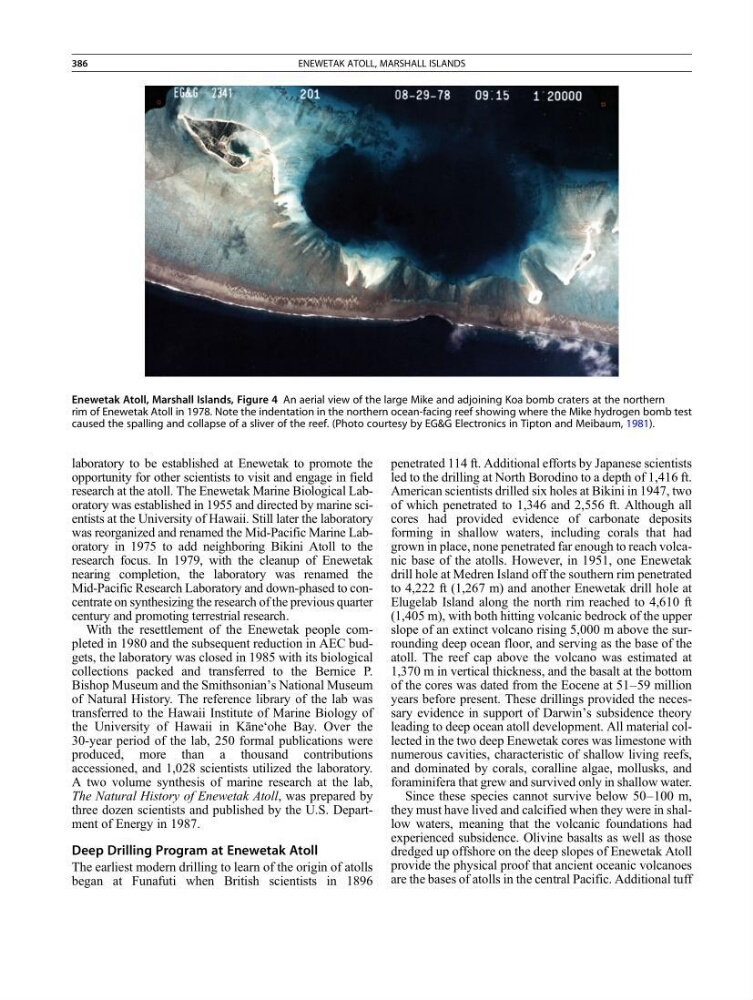
Enewetak Atoll, Marshall Islands, Figure 4 An aerial view of the large Mike and adjoining Koa bomb craters at the northern
rim of Enewetak Atoll in 1978. Note the indentation in the northern ocean-facing reef showing where the Mike hydrogen bomb test
caused the spalling and collapse of a sliver of the reef. (Photo courtesy by EG&G Electronics in Tipton and Meibaum, 1981).
386
ENEWETAK ATOLL, MARSHALL ISLANDS
opportunity for other scientists to visit and engage in field
research at the atoll. The Enewetak Marine Biological Laboratory was established in 1955 and directed by marine scientists at the University of Hawaii. Still later the laboratory
was reorganized and renamed the Mid-Pacific Marine Laboratory in 1975 to add neighboring Bikini Atoll to the
research focus. In 1979, with the cleanup of Enewetak
nearing completion, the laboratory was renamed the
Mid-Pacific Research Laboratory and down-phased to concentrate on synthesizing the research of the previous quarter
century and promoting terrestrial research.
With the resettlement of the Enewetak people completed in 1980 and the subsequent reduction in AEC budgets, the laboratory was closed in 1985 with its biological
collections packed and transferred to the Bernice P.
Bishop Museum and the Smithsonian’s National Museum
of Natural History. The reference library of the lab was
transferred to the Hawaii Institute of Marine Biology of
the University of Hawaii in Kāne‘ohe Bay. Over the
30-year period of the lab, 250 formal publications were
produced, more than a thousand contributions
accessioned, and 1,028 scientists utilized the laboratory.
A two volume synthesis of marine research at the lab,
The Natural History of Enewetak Atoll, was prepared by
three dozen scientists and published by the U.S. Department of Energy in 1987.
Deep Drilling Program at Enewetak Atoll
The earliest modern drilling to learn of the origin of atolls
began at Funafuti when British scientists in 1896
penetrated 114 ft. Additional efforts by Japanese scientists
led to the drilling at North Borodino to a depth of 1,416 ft.
American scientists drilled six holes at Bikini in 1947, two
of which penetrated to 1,346 and 2,556 ft. Although all
cores had provided evidence of carbonate deposits
forming in shallow waters, including corals that had
grown in place, none penetrated far enough to reach volcanic base of the atolls. However, in 1951, one Enewetak
drill hole at Medren Island off the southern rim penetrated
to 4,222 ft (1,267 m) and another Enewetak drill hole at
Elugelab Island along the north rim reached to 4,610 ft
(1,405 m), with both hitting volcanic bedrock of the upper
slope of an extinct volcano rising 5,000 m above the surrounding deep ocean floor, and serving as the base of the
atoll. The reef cap above the volcano was estimated at
1,370 m in vertical thickness, and the basalt at the bottom
of the cores was dated from the Eocene at 51–59 million
years before present. These drillings provided the necessary evidence in support of Darwin’s subsidence theory
leading to deep ocean atoll development. All material collected in the two deep Enewetak cores was limestone with
numerous cavities, characteristic of shallow living reefs,
and dominated by corals, coralline algae, mollusks, and
foraminifera that grew and survived only in shallow water.
Since these species cannot survive below 50–100 m,
they must have lived and calcified when they were in shallow waters, meaning that the volcanic foundations had
experienced subsidence. Olivine basalts as well as those
dredged up offshore on the deep slopes of Enewetak Atoll
provide the physical proof that ancient oceanic volcanoes
are the bases of atolls in the central Pacific. Additional tuff
Enewetak Atoll, Marshall Islands, Figure 4 An aerial view of the large Mike and adjoining Koa bomb craters at the northern
rim of Enewetak Atoll in 1978. Note the indentation in the northern ocean-facing reef showing where the Mike hydrogen bomb test
caused the spalling and collapse of a sliver of the reef. (Photo courtesy by EG&G Electronics in Tipton and Meibaum, 1981).
386
ENEWETAK ATOLL, MARSHALL ISLANDS