

magma chamber inflation of the active volcano Yasur.
Moreover, they estimated the recurrence interval from
125 to 250 years.
Summary
The emerged reefs can be expressed by several morphological features from the single coral colony (microatoll)
to extensive development of coral terraces. Several
causes can be invoked to explain the occurrence of
emerged reefs in the various regions of the world. Among
these causes, the uplift of coral reefs in tectonically active
regions is probably the most widespread. Nevertheless,
the occurrence of such coral terraces in these tectonic
zones is also dependant on eustatic sea-level variations.
Several sites in the world display extensive sequences
of raised reefs including the well-known sites from Barbados in the Caribbean, Papua New Guinea and Vanuatu
in the Pacific Ocean, and Indonesia in the Indian Ocean.
Uplifted atolls in some parts of the world can also attest
to the presence of lithospheric flexures as observed in
the Cook-Sociéty Islands or in the Loyalty Islands. Isostatic readjustments can be invoked to explain the midHolocene relative high sea level. The research carried
out on these morphological features has highly improved
our knowledge of Late Quaternary climatic and eustatic
sea-level variations, their tectonic context, and also the
upper earth rheology. Further studies will provide additional data on these topics of broad interest in the framework of earth science.
Bibliography
Bard, E., Jouannic, C., Hamelin, B., Pirazzoli, P., Arnold, M., Faure,
G., Sumosusastro, P., and Syaefudin, 1995. Pleistocene sea
levels and tectonic uplift based on dating of corals from Sumba
island. Geophysical Research Letters, 23, 1473–1476.
Bender, M. L., Fairbanks, R. G., Taylor, F. W., Matthews, R. K.,
Goddard, J. G., and Broecker, W. S., 1979. Uranium-series dating of the Pleistocene reef tracts of Barbados, West Indies. Geological Society of America Bulletin, 90, 577–594.
Blanchon, P., and Eisenhauer, A., 2001. Multi-stage development
on Barbados during the last interglaciation. Quaternary Science
Reviews, 20, 1093–1112.
Bloom, A. L., Broecker, W. S., Chappell, J. M. A., Matthews, R. K.,
and Mesolella, K. J., 1974. Quaternary sea-level fluctuations
on a tectonic coast: new Th230/U234 dates from the Huon
Peninsula, New Guinea. Quaternary Research, 4, 185–205.
Broecker, W. S., Thurber, D. L., Goddard, J., Ku, T.-L., Matthews,
R. K., and Mesolella, K. J., 1968. Milankovitch hypothesis
supported by precise dating of coral reefs and deep-sea sediments. Science, 159, 297–300.
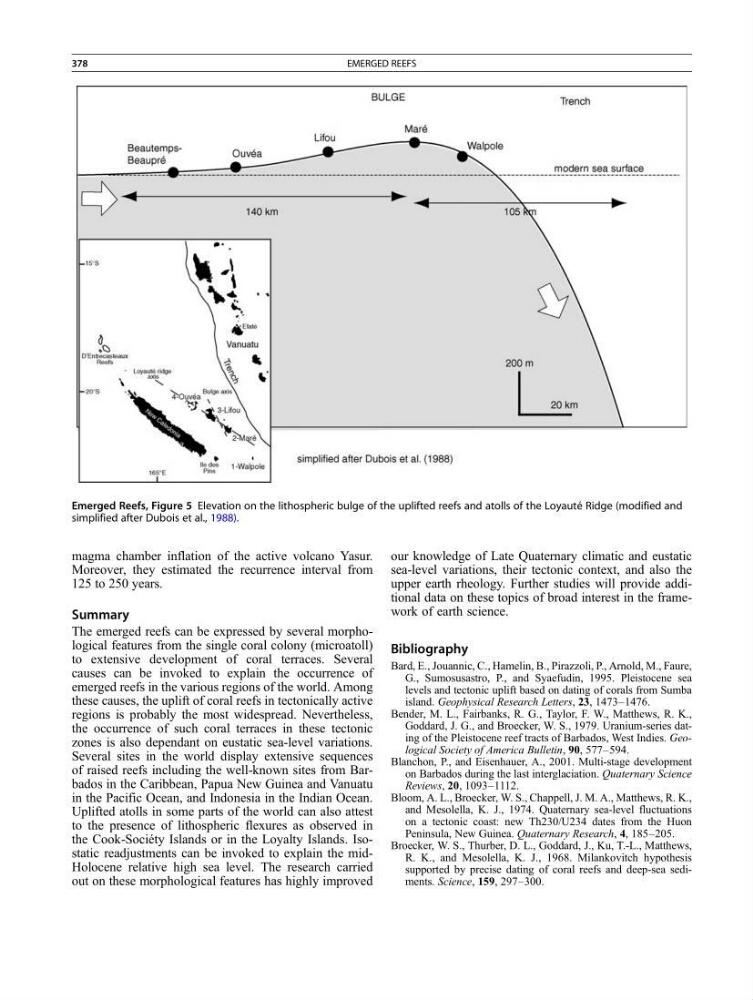
Emerged Reefs, Figure 5 Elevation on the lithospheric bulge of the uplifted reefs and atolls of the Loyaute ´ Ridge (modified and
simplified after Dubois et al., 1988).
378
EMERGED REEFS
Moreover, they estimated the recurrence interval from
125 to 250 years.
Summary
The emerged reefs can be expressed by several morphological features from the single coral colony (microatoll)
to extensive development of coral terraces. Several
causes can be invoked to explain the occurrence of
emerged reefs in the various regions of the world. Among
these causes, the uplift of coral reefs in tectonically active
regions is probably the most widespread. Nevertheless,
the occurrence of such coral terraces in these tectonic
zones is also dependant on eustatic sea-level variations.
Several sites in the world display extensive sequences
of raised reefs including the well-known sites from Barbados in the Caribbean, Papua New Guinea and Vanuatu
in the Pacific Ocean, and Indonesia in the Indian Ocean.
Uplifted atolls in some parts of the world can also attest
to the presence of lithospheric flexures as observed in
the Cook-Sociéty Islands or in the Loyalty Islands. Isostatic readjustments can be invoked to explain the midHolocene relative high sea level. The research carried
out on these morphological features has highly improved
our knowledge of Late Quaternary climatic and eustatic
sea-level variations, their tectonic context, and also the
upper earth rheology. Further studies will provide additional data on these topics of broad interest in the framework of earth science.
Bibliography
Bard, E., Jouannic, C., Hamelin, B., Pirazzoli, P., Arnold, M., Faure,
G., Sumosusastro, P., and Syaefudin, 1995. Pleistocene sea
levels and tectonic uplift based on dating of corals from Sumba
island. Geophysical Research Letters, 23, 1473–1476.
Bender, M. L., Fairbanks, R. G., Taylor, F. W., Matthews, R. K.,
Goddard, J. G., and Broecker, W. S., 1979. Uranium-series dating of the Pleistocene reef tracts of Barbados, West Indies. Geological Society of America Bulletin, 90, 577–594.
Blanchon, P., and Eisenhauer, A., 2001. Multi-stage development
on Barbados during the last interglaciation. Quaternary Science
Reviews, 20, 1093–1112.
Bloom, A. L., Broecker, W. S., Chappell, J. M. A., Matthews, R. K.,
and Mesolella, K. J., 1974. Quaternary sea-level fluctuations
on a tectonic coast: new Th230/U234 dates from the Huon
Peninsula, New Guinea. Quaternary Research, 4, 185–205.
Broecker, W. S., Thurber, D. L., Goddard, J., Ku, T.-L., Matthews,
R. K., and Mesolella, K. J., 1968. Milankovitch hypothesis
supported by precise dating of coral reefs and deep-sea sediments. Science, 159, 297–300.
Emerged Reefs, Figure 5 Elevation on the lithospheric bulge of the uplifted reefs and atolls of the Loyaute ´ Ridge (modified and
simplified after Dubois et al., 1988).
378
EMERGED REEFS