

Jouannic et al., 1980; Taylor et al., 1980, 1987), and the
Ryukyus (Konishi et al., 1974; Nakamori et al., 1995).
Caribbean: Barbados
In the tectonically active region of the Caribbea (see Barbados), the Barbados emerged reefs are probably one of
the most studied sequences of raised coral terraces and
are, with the Huon Peninsula, one of the most important
data set in the world on the knowledge of the Late Quaternary sea-level variations. Previous works by Mesolella
(1967) showed the presence of up to 18 morphological
emerged reef features and provided data on the ecology
and the development of these formations. The lower terraces were dated by Uranium series dating giving ages of
122, 103, and 82 ka (1 ka = 1,000 years) (Broecker et al.,
1968). These ages were found in the coral terraces and
were labeled as Barbados I (þ6 to þ20 m depending on
the sites and the uplift rate), Barbados II (þ21 to þ27 m),
and Barbados III (þ24 to þ55 m), respectively. Taking
into account the local uplift rate, Broecker et al. (1968)
reconstructed the past sea-level variations of these periods.
They obtained a 122-ka (corresponding to the Marine
Isotope Stage 5e, MIS 5e) high stand at þ6 m above the
modern sea level and 103-ka (MIS 5c) and 82-ka (MIS
5a) high stands at À13 m below the modern sea level.
These results were of broad importance, since they were
(and still are) used as a world reference. Similar works
were performed in several other sites on Barbados by
Bender et al. (1979). Further studies on Barbados
provided new data on the timing and the magnitude of
these high stands (Schnellmann et al., 2004). Recently, a
detailed survey on the distribution of reef facies performed
in the west and south of Barbados provided a revised
model of reef history during the last interglacial period
(MIS 5) including three stages of development in relation
to the sea-level variations (Blanchon and Eisenhauer,
2001).
Pacific: Papua New Guinea
Chappell (1974) described in Papua New Guinea (PNG)
(see Huon Peninsula, P.N.G.) a series of coral terraces
on the Huon Peninsula, close to the New Britain trench
at the boundary between the Australian and the Pacific tectonic plates. These terraces are characterized by a decrease
of the uplift rate from south to north. They were first
linked with sea-level variations by Fairbridge (1960, in
Chappell, 1974). These terraces are represented by more
than 20 elevated coral reefs, some of them revealing fossil
reef crests and lagoons, and are particularly well developed along 80 km. They were dated by Veeh and Chappell
(1970) at 30, 40, 50, 60, 80, 105, 120, 140, 185, and
220 ka, the higher by Uranium series dating. These
authors underlined that the succession of such sea levels
supports the Milankovitch astronomical theory, indeed,
recording both eustatic sea-level variations and vertical
motions (Chappell, 1974). In 1974, Bloom et al. reported
new Uranium dates and proposed an improved sea-level
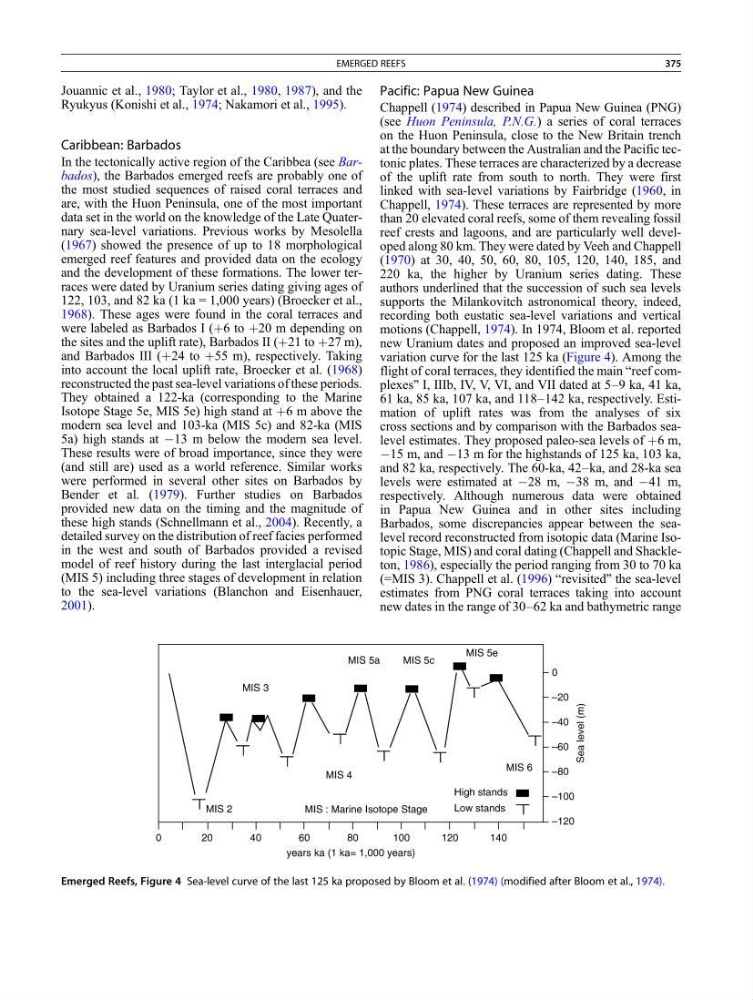
variation curve for the last 125 ka (Figure 4). Among the
flight of coral terraces, they identified the main “reef complexes” I, IIIb, IV, V, VI, and VII dated at 5–9 ka, 41 ka,
61 ka, 85 ka, 107 ka, and 118–142 ka, respectively. Estimation of uplift rates was from the analyses of six
cross sections and by comparison with the Barbados sealevel estimates. They proposed paleo-sea levels of þ6 m,
À15 m, and À13 m for the highstands of 125 ka, 103 ka,
and 82 ka, respectively. The 60-ka, 42–ka, and 28-ka sea
levels were estimated at À28 m, À38 m, and À41 m,
respectively. Although numerous data were obtained
in Papua New Guinea and in other sites including
Barbados, some discrepancies appear between the sealevel record reconstructed from isotopic data (Marine Isotopic Stage, MIS) and coral dating (Chappell and Shackleton, 1986), especially the period ranging from 30 to 70 ka
(=MIS 3). Chappell et al. (1996) “revisited” the sea-level
estimates from PNG coral terraces taking into account
new dates in the range of 30–62 ka and bathymetric range
Emerged Reefs, Figure 4 Sea-level curve of the last 125 ka proposed by Bloom et al. (1974) (modified after Bloom et al., 1974).
EMERGED REEFS
375
Ryukyus (Konishi et al., 1974; Nakamori et al., 1995).
Caribbean: Barbados
In the tectonically active region of the Caribbea (see Barbados), the Barbados emerged reefs are probably one of
the most studied sequences of raised coral terraces and
are, with the Huon Peninsula, one of the most important
data set in the world on the knowledge of the Late Quaternary sea-level variations. Previous works by Mesolella
(1967) showed the presence of up to 18 morphological
emerged reef features and provided data on the ecology
and the development of these formations. The lower terraces were dated by Uranium series dating giving ages of
122, 103, and 82 ka (1 ka = 1,000 years) (Broecker et al.,
1968). These ages were found in the coral terraces and
were labeled as Barbados I (þ6 to þ20 m depending on
the sites and the uplift rate), Barbados II (þ21 to þ27 m),
and Barbados III (þ24 to þ55 m), respectively. Taking
into account the local uplift rate, Broecker et al. (1968)
reconstructed the past sea-level variations of these periods.
They obtained a 122-ka (corresponding to the Marine
Isotope Stage 5e, MIS 5e) high stand at þ6 m above the
modern sea level and 103-ka (MIS 5c) and 82-ka (MIS
5a) high stands at À13 m below the modern sea level.
These results were of broad importance, since they were
(and still are) used as a world reference. Similar works
were performed in several other sites on Barbados by
Bender et al. (1979). Further studies on Barbados
provided new data on the timing and the magnitude of
these high stands (Schnellmann et al., 2004). Recently, a
detailed survey on the distribution of reef facies performed
in the west and south of Barbados provided a revised
model of reef history during the last interglacial period
(MIS 5) including three stages of development in relation
to the sea-level variations (Blanchon and Eisenhauer,
2001).
Pacific: Papua New Guinea
Chappell (1974) described in Papua New Guinea (PNG)
(see Huon Peninsula, P.N.G.) a series of coral terraces
on the Huon Peninsula, close to the New Britain trench
at the boundary between the Australian and the Pacific tectonic plates. These terraces are characterized by a decrease
of the uplift rate from south to north. They were first
linked with sea-level variations by Fairbridge (1960, in
Chappell, 1974). These terraces are represented by more
than 20 elevated coral reefs, some of them revealing fossil
reef crests and lagoons, and are particularly well developed along 80 km. They were dated by Veeh and Chappell
(1970) at 30, 40, 50, 60, 80, 105, 120, 140, 185, and
220 ka, the higher by Uranium series dating. These
authors underlined that the succession of such sea levels
supports the Milankovitch astronomical theory, indeed,
recording both eustatic sea-level variations and vertical
motions (Chappell, 1974). In 1974, Bloom et al. reported
new Uranium dates and proposed an improved sea-level
variation curve for the last 125 ka (Figure 4). Among the
flight of coral terraces, they identified the main “reef complexes” I, IIIb, IV, V, VI, and VII dated at 5–9 ka, 41 ka,
61 ka, 85 ka, 107 ka, and 118–142 ka, respectively. Estimation of uplift rates was from the analyses of six
cross sections and by comparison with the Barbados sealevel estimates. They proposed paleo-sea levels of þ6 m,
À15 m, and À13 m for the highstands of 125 ka, 103 ka,
and 82 ka, respectively. The 60-ka, 42–ka, and 28-ka sea
levels were estimated at À28 m, À38 m, and À41 m,
respectively. Although numerous data were obtained
in Papua New Guinea and in other sites including
Barbados, some discrepancies appear between the sealevel record reconstructed from isotopic data (Marine Isotopic Stage, MIS) and coral dating (Chappell and Shackleton, 1986), especially the period ranging from 30 to 70 ka
(=MIS 3). Chappell et al. (1996) “revisited” the sea-level
estimates from PNG coral terraces taking into account
new dates in the range of 30–62 ka and bathymetric range
Emerged Reefs, Figure 4 Sea-level curve of the last 125 ka proposed by Bloom et al. (1974) (modified after Bloom et al., 1974).
EMERGED REEFS
375