

EMERGED REEFS
Guy Cabioch
Institut de Recherche pour le Développement, Bondy
CEDEX, France
Synonyms
Coral terraces; Raised reefs; Reef terraces
Definition
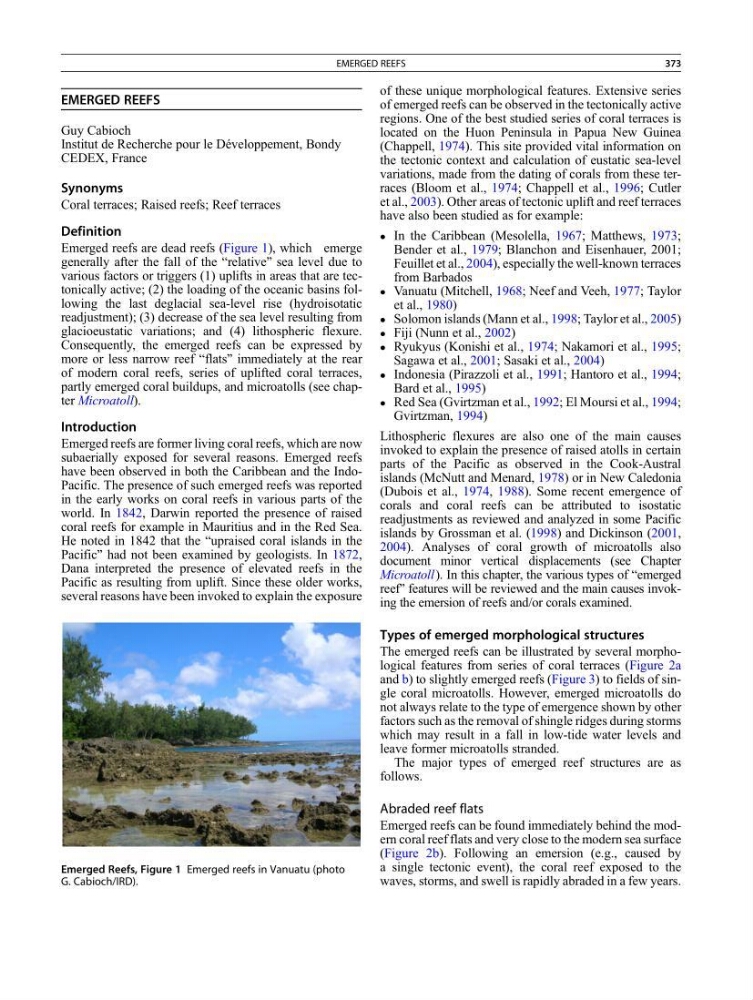
Emerged reefs are dead reefs (Figure 1), which emerge
generally after the fall of the “relative” sea level due to
various factors or triggers (1) uplifts in areas that are tectonically active; (2) the loading of the oceanic basins following the last deglacial sea-level rise (hydroisotatic
readjustment); (3) decrease of the sea level resulting from
glacioeustatic variations; and (4) lithospheric flexure.
Consequently, the emerged reefs can be expressed by
more or less narrow reef “flats” immediately at the rear
of modern coral reefs, series of uplifted coral terraces,
partly emerged coral buildups, and microatolls (see chapter Microatoll).
Introduction
Emerged reefs are former living coral reefs, which are now
subaerially exposed for several reasons. Emerged reefs
have been observed in both the Caribbean and the IndoPacific. The presence of such emerged reefs was reported
in the early works on coral reefs in various parts of the
world. In 1842, Darwin reported the presence of raised
coral reefs for example in Mauritius and in the Red Sea.
He noted in 1842 that the “upraised coral islands in the
Pacific” had not been examined by geologists. In 1872,
Dana interpreted the presence of elevated reefs in the
Pacific as resulting from uplift. Since these older works,
several reasons have been invoked to explain the exposure
of these unique morphological features. Extensive series
of emerged reefs can be observed in the tectonically active
regions. One of the best studied series of coral terraces is
located on the Huon Peninsula in Papua New Guinea
(Chappell, 1974). This site provided vital information on
the tectonic context and calculation of eustatic sea-level
variations, made from the dating of corals from these terraces (Bloom et al., 1974; Chappell et al., 1996; Cutler
et al., 2003). Other areas of tectonic uplift and reef terraces
have also been studied as for example:
In the Caribbean (Mesolella, 1967; Matthews, 1973;
Bender et al., 1979; Blanchon and Eisenhauer, 2001;
Feuillet et al., 2004), especially the well-known terraces
from Barbados
Vanuatu (Mitchell, 1968; Neef and Veeh, 1977; Taylor
et al., 1980)
Solomon islands (Mann et al., 1998; Taylor et al., 2005)
Fiji (Nunn et al., 2002)
Ryukyus (Konishi et al., 1974; Nakamori et al., 1995;
Sagawa et al., 2001; Sasaki et al., 2004)
Indonesia (Pirazzoli et al., 1991; Hantoro et al., 1994;
Bard et al., 1995)
Red Sea (Gvirtzman et al., 1992; El Moursi et al., 1994;
Gvirtzman, 1994)
Lithospheric flexures are also one of the main causes
invoked to explain the presence of raised atolls in certain
parts of the Pacific as observed in the Cook-Austral
islands (McNutt and Menard, 1978) or in New Caledonia
(Dubois et al., 1974, 1988). Some recent emergence of
corals and coral reefs can be attributed to isostatic
readjustments as reviewed and analyzed in some Pacific
islands by Grossman et al. (1998) and Dickinson (2001,
2004). Analyses of coral growth of microatolls also
document minor vertical displacements (see Chapter
Microatoll ). In this chapter, the various types of “emerged
reef” features will be reviewed and the main causes invoking the emersion of reefs and/or corals examined.
Types of emerged morphological structures
The emerged reefs can be illustrated by several morphological features from series of coral terraces (Figure 2a
and b) to slightly emerged reefs (Figure 3) to fields of single coral microatolls. However, emerged microatolls do
not always relate to the type of emergence shown by other
factors such as the removal of shingle ridges during storms
which may result in a fall in low-tide water levels and
leave former microatolls stranded.
The major types of emerged reef structures are as
follows.
Abraded reef flats
Emerged reefs can be found immediately behind the modern coral reef flats and very close to the modern sea surface
(Figure 2b). Following an emersion (e.g., caused by
a single tectonic event), the coral reef exposed to the
waves, storms, and swell is rapidly abraded in a few years.
Emerged Reefs, Figure 1 Emerged reefs in Vanuatu (photo
G. Cabioch/IRD).
EMERGED REEFS
373
Guy Cabioch
Institut de Recherche pour le Développement, Bondy
CEDEX, France
Synonyms
Coral terraces; Raised reefs; Reef terraces
Definition
Emerged reefs are dead reefs (Figure 1), which emerge
generally after the fall of the “relative” sea level due to
various factors or triggers (1) uplifts in areas that are tectonically active; (2) the loading of the oceanic basins following the last deglacial sea-level rise (hydroisotatic
readjustment); (3) decrease of the sea level resulting from
glacioeustatic variations; and (4) lithospheric flexure.
Consequently, the emerged reefs can be expressed by
more or less narrow reef “flats” immediately at the rear
of modern coral reefs, series of uplifted coral terraces,
partly emerged coral buildups, and microatolls (see chapter Microatoll).
Introduction
Emerged reefs are former living coral reefs, which are now
subaerially exposed for several reasons. Emerged reefs
have been observed in both the Caribbean and the IndoPacific. The presence of such emerged reefs was reported
in the early works on coral reefs in various parts of the
world. In 1842, Darwin reported the presence of raised
coral reefs for example in Mauritius and in the Red Sea.
He noted in 1842 that the “upraised coral islands in the
Pacific” had not been examined by geologists. In 1872,
Dana interpreted the presence of elevated reefs in the
Pacific as resulting from uplift. Since these older works,
several reasons have been invoked to explain the exposure
of these unique morphological features. Extensive series
of emerged reefs can be observed in the tectonically active
regions. One of the best studied series of coral terraces is
located on the Huon Peninsula in Papua New Guinea
(Chappell, 1974). This site provided vital information on
the tectonic context and calculation of eustatic sea-level
variations, made from the dating of corals from these terraces (Bloom et al., 1974; Chappell et al., 1996; Cutler
et al., 2003). Other areas of tectonic uplift and reef terraces
have also been studied as for example:
In the Caribbean (Mesolella, 1967; Matthews, 1973;
Bender et al., 1979; Blanchon and Eisenhauer, 2001;
Feuillet et al., 2004), especially the well-known terraces
from Barbados
Vanuatu (Mitchell, 1968; Neef and Veeh, 1977; Taylor
et al., 1980)
Solomon islands (Mann et al., 1998; Taylor et al., 2005)
Fiji (Nunn et al., 2002)
Ryukyus (Konishi et al., 1974; Nakamori et al., 1995;
Sagawa et al., 2001; Sasaki et al., 2004)
Indonesia (Pirazzoli et al., 1991; Hantoro et al., 1994;
Bard et al., 1995)
Red Sea (Gvirtzman et al., 1992; El Moursi et al., 1994;
Gvirtzman, 1994)
Lithospheric flexures are also one of the main causes
invoked to explain the presence of raised atolls in certain
parts of the Pacific as observed in the Cook-Austral
islands (McNutt and Menard, 1978) or in New Caledonia
(Dubois et al., 1974, 1988). Some recent emergence of
corals and coral reefs can be attributed to isostatic
readjustments as reviewed and analyzed in some Pacific
islands by Grossman et al. (1998) and Dickinson (2001,
2004). Analyses of coral growth of microatolls also
document minor vertical displacements (see Chapter
Microatoll ). In this chapter, the various types of “emerged
reef” features will be reviewed and the main causes invoking the emersion of reefs and/or corals examined.
Types of emerged morphological structures
The emerged reefs can be illustrated by several morphological features from series of coral terraces (Figure 2a
and b) to slightly emerged reefs (Figure 3) to fields of single coral microatolls. However, emerged microatolls do
not always relate to the type of emergence shown by other
factors such as the removal of shingle ridges during storms
which may result in a fall in low-tide water levels and
leave former microatolls stranded.
The major types of emerged reef structures are as
follows.
Abraded reef flats
Emerged reefs can be found immediately behind the modern coral reef flats and very close to the modern sea surface
(Figure 2b). Following an emersion (e.g., caused by
a single tectonic event), the coral reef exposed to the
waves, storms, and swell is rapidly abraded in a few years.
Emerged Reefs, Figure 1 Emerged reefs in Vanuatu (photo
G. Cabioch/IRD).
EMERGED REEFS
373