

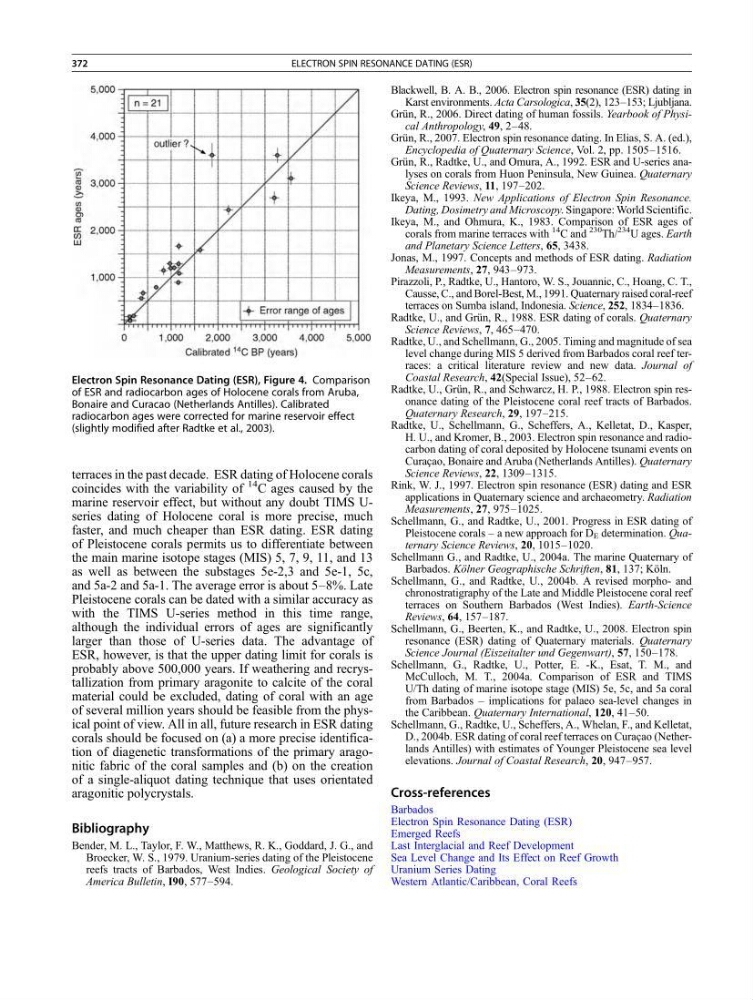
terraces in the past decade. ESR dating of Holocene corals
coincides with the variability of
14 C ages caused by the
marine reservoir effect, but without any doubt TIMS Useries dating of Holocene coral is more precise, much
faster, and much cheaper than ESR dating. ESR dating
of Pleistocene corals permits us to differentiate between
the main marine isotope stages (MIS) 5, 7, 9, 11, and 13
as well as between the substages 5e-2,3 and 5e-1, 5c,
and 5a-2 and 5a-1. The average error is about 5–8%. Late
Pleistocene corals can be dated with a similar accuracy as
with the TIMS U-series method in this time range,
although the individual errors of ages are significantly
larger than those of U-series data. The advantage of
ESR, however, is that the upper dating limit for corals is
probably above 500,000 years. If weathering and recrystallization from primary aragonite to calcite of the coral
material could be excluded, dating of coral with an age
of several million years should be feasible from the physical point of view. All in all, future research in ESR dating
corals should be focused on (a) a more precise identification of diagenetic transformations of the primary aragonitic fabric of the coral samples and (b) on the creation
of a single-aliquot dating technique that uses orientated
aragonitic polycrystals.
Bibliography
Bender, M. L., Taylor, F. W., Matthews, R. K., Goddard, J. G., and
Broecker, W. S., 1979. Uranium-series dating of the Pleistocene
reefs tracts of Barbados, West Indies. Geological Society of
America Bulletin, I90, 577–594.
Blackwell, B. A. B., 2006. Electron spin resonance (ESR) dating in
Karst environments. Acta Carsologica, 35(2), 123–153; Ljubljana.
Grün, R., 2006. Direct dating of human fossils. Yearbook of Physical Anthropology, 49, 2–48.
Grün, R., 2007. Electron spin resonance dating. In Elias, S. A. (ed.),
Encyclopedia of Quaternary Science, Vol. 2, pp. 1505–1516.
Grün, R., Radtke, U., and Omura, A., 1992. ESR and U-series analyses on corals from Huon Peninsula, New Guinea. Quaternary
Science Reviews, 11, 197–202.
Ikeya, M., 1993. New Applications of Electron Spin Resonance.
Dating, Dosimetry and Microscopy. Singapore: World Scientific.
Ikeya, M., and Ohmura, K., 1983. Comparison of ESR ages of
corals from marine terraces with
14 C and
230 Th/
234 U ages. Earth
and Planetary Science Letters, 65, 3438.
Jonas, M., 1997. Concepts and methods of ESR dating. Radiation
Measurements, 27, 943–973.
Pirazzoli, P., Radtke, U., Hantoro, W. S., Jouannic, C., Hoang, C. T.,
Causse, C., and Borel-Best, M., 1991. Quaternary raised coral-reef
terraces on Sumba island, Indonesia. Science, 252, 1834–1836.
Radtke, U., and Grün, R., 1988. ESR dating of corals. Quaternary
Science Reviews, 7, 465–470.
Radtke, U., and Schellmann, G., 2005. Timing and magnitude of sea
level change during MIS 5 derived from Barbados coral reef terraces: a critical literature review and new data. Journal of
Coastal Research, 42(Special Issue), 52–62.
Radtke, U., Grün, R., and Schwarcz, H. P., 1988. Electron spin resonance dating of the Pleistocene coral reef tracts of Barbados.
Quaternary Research, 29, 197–215.
Radtke, U., Schellmann, G., Scheffers, A., Kelletat, D., Kasper,
H. U., and Kromer, B., 2003. Electron spin resonance and radiocarbon dating of coral deposited by Holocene tsunami events on
Curaçao, Bonaire and Aruba (Netherlands Antilles). Quaternary
Science Reviews, 22, 1309–1315.
Rink, W. J., 1997. Electron spin resonance (ESR) dating and ESR
applications in Quaternary science and archaeometry. Radiation
Measurements, 27, 975–1025.
Schellmann, G., and Radtke, U., 2001. Progress in ESR dating of
Pleistocene corals – a new approach for D E determination. Quaternary Science Reviews, 20, 1015–1020.
Schellmann G., and Radtke, U., 2004a. The marine Quaternary of
Barbados. Kölner Geographische Schriften, 81, 137; Köln.
Schellmann, G., and Radtke, U., 2004b. A revised morpho- and
chronostratigraphy of the Late and Middle Pleistocene coral reef
terraces on Southern Barbados (West Indies). Earth-Science
Reviews, 64, 157–187.
Schellmann, G., Beerten, K., and Radtke, U., 2008. Electron spin
resonance (ESR) dating of Quaternary materials. Quaternary
Science Journal (Eiszeitalter und Gegenwart), 57, 150–178.
Schellmann, G., Radtke, U., Potter, E. -K., Esat, T. M., and
McCulloch, M. T., 2004a. Comparison of ESR and TIMS
U/Th dating of marine isotope stage (MIS) 5e, 5c, and 5a coral
from Barbados – implications for palaeo sea-level changes in
the Caribbean. Quaternary International, 120, 41–50.
Schellmann, G., Radtke, U., Scheffers, A., Whelan, F., and Kelletat,
D., 2004b. ESR dating of coral reef terraces on Curaçao (Netherlands Antilles) with estimates of Younger Pleistocene sea level
elevations. Journal of Coastal Research, 20, 947–957.
Cross-references
Barbados
Electron Spin Resonance Dating (ESR)
Emerged Reefs
Last Interglacial and Reef Development
Sea Level Change and Its Effect on Reef Growth
Uranium Series Dating
Western Atlantic/Caribbean, Coral Reefs
Electron Spin Resonance Dating (ESR), Figure 4. Comparison
of ESR and radiocarbon ages of Holocene corals from Aruba,
Bonaire and Curacao (Netherlands Antilles). Calibrated
radiocarbon ages were corrected for marine reservoir effect
(slightly modified after Radtke et al., 2003).
372
ELECTRON SPIN RESONANCE DATING (ESR)
coincides with the variability of
14 C ages caused by the
marine reservoir effect, but without any doubt TIMS Useries dating of Holocene coral is more precise, much
faster, and much cheaper than ESR dating. ESR dating
of Pleistocene corals permits us to differentiate between
the main marine isotope stages (MIS) 5, 7, 9, 11, and 13
as well as between the substages 5e-2,3 and 5e-1, 5c,
and 5a-2 and 5a-1. The average error is about 5–8%. Late
Pleistocene corals can be dated with a similar accuracy as
with the TIMS U-series method in this time range,
although the individual errors of ages are significantly
larger than those of U-series data. The advantage of
ESR, however, is that the upper dating limit for corals is
probably above 500,000 years. If weathering and recrystallization from primary aragonite to calcite of the coral
material could be excluded, dating of coral with an age
of several million years should be feasible from the physical point of view. All in all, future research in ESR dating
corals should be focused on (a) a more precise identification of diagenetic transformations of the primary aragonitic fabric of the coral samples and (b) on the creation
of a single-aliquot dating technique that uses orientated
aragonitic polycrystals.
Bibliography
Bender, M. L., Taylor, F. W., Matthews, R. K., Goddard, J. G., and
Broecker, W. S., 1979. Uranium-series dating of the Pleistocene
reefs tracts of Barbados, West Indies. Geological Society of
America Bulletin, I90, 577–594.
Blackwell, B. A. B., 2006. Electron spin resonance (ESR) dating in
Karst environments. Acta Carsologica, 35(2), 123–153; Ljubljana.
Grün, R., 2006. Direct dating of human fossils. Yearbook of Physical Anthropology, 49, 2–48.
Grün, R., 2007. Electron spin resonance dating. In Elias, S. A. (ed.),
Encyclopedia of Quaternary Science, Vol. 2, pp. 1505–1516.
Grün, R., Radtke, U., and Omura, A., 1992. ESR and U-series analyses on corals from Huon Peninsula, New Guinea. Quaternary
Science Reviews, 11, 197–202.
Ikeya, M., 1993. New Applications of Electron Spin Resonance.
Dating, Dosimetry and Microscopy. Singapore: World Scientific.
Ikeya, M., and Ohmura, K., 1983. Comparison of ESR ages of
corals from marine terraces with
14 C and
230 Th/
234 U ages. Earth
and Planetary Science Letters, 65, 3438.
Jonas, M., 1997. Concepts and methods of ESR dating. Radiation
Measurements, 27, 943–973.
Pirazzoli, P., Radtke, U., Hantoro, W. S., Jouannic, C., Hoang, C. T.,
Causse, C., and Borel-Best, M., 1991. Quaternary raised coral-reef
terraces on Sumba island, Indonesia. Science, 252, 1834–1836.
Radtke, U., and Grün, R., 1988. ESR dating of corals. Quaternary
Science Reviews, 7, 465–470.
Radtke, U., and Schellmann, G., 2005. Timing and magnitude of sea
level change during MIS 5 derived from Barbados coral reef terraces: a critical literature review and new data. Journal of
Coastal Research, 42(Special Issue), 52–62.
Radtke, U., Grün, R., and Schwarcz, H. P., 1988. Electron spin resonance dating of the Pleistocene coral reef tracts of Barbados.
Quaternary Research, 29, 197–215.
Radtke, U., Schellmann, G., Scheffers, A., Kelletat, D., Kasper,
H. U., and Kromer, B., 2003. Electron spin resonance and radiocarbon dating of coral deposited by Holocene tsunami events on
Curaçao, Bonaire and Aruba (Netherlands Antilles). Quaternary
Science Reviews, 22, 1309–1315.
Rink, W. J., 1997. Electron spin resonance (ESR) dating and ESR
applications in Quaternary science and archaeometry. Radiation
Measurements, 27, 975–1025.
Schellmann, G., and Radtke, U., 2001. Progress in ESR dating of
Pleistocene corals – a new approach for D E determination. Quaternary Science Reviews, 20, 1015–1020.
Schellmann G., and Radtke, U., 2004a. The marine Quaternary of
Barbados. Kölner Geographische Schriften, 81, 137; Köln.
Schellmann, G., and Radtke, U., 2004b. A revised morpho- and
chronostratigraphy of the Late and Middle Pleistocene coral reef
terraces on Southern Barbados (West Indies). Earth-Science
Reviews, 64, 157–187.
Schellmann, G., Beerten, K., and Radtke, U., 2008. Electron spin
resonance (ESR) dating of Quaternary materials. Quaternary
Science Journal (Eiszeitalter und Gegenwart), 57, 150–178.
Schellmann, G., Radtke, U., Potter, E. -K., Esat, T. M., and
McCulloch, M. T., 2004a. Comparison of ESR and TIMS
U/Th dating of marine isotope stage (MIS) 5e, 5c, and 5a coral
from Barbados – implications for palaeo sea-level changes in
the Caribbean. Quaternary International, 120, 41–50.
Schellmann, G., Radtke, U., Scheffers, A., Whelan, F., and Kelletat,
D., 2004b. ESR dating of coral reef terraces on Curaçao (Netherlands Antilles) with estimates of Younger Pleistocene sea level
elevations. Journal of Coastal Research, 20, 947–957.
Cross-references
Barbados
Electron Spin Resonance Dating (ESR)
Emerged Reefs
Last Interglacial and Reef Development
Sea Level Change and Its Effect on Reef Growth
Uranium Series Dating
Western Atlantic/Caribbean, Coral Reefs
Electron Spin Resonance Dating (ESR), Figure 4. Comparison
of ESR and radiocarbon ages of Holocene corals from Aruba,
Bonaire and Curacao (Netherlands Antilles). Calibrated
radiocarbon ages were corrected for marine reservoir effect
(slightly modified after Radtke et al., 2003).
372
ELECTRON SPIN RESONANCE DATING (ESR)