

chemistry, or water quality (Woodley et al., 1981;
Done, 1992; Hughes et al., 1994; Eakin, 1996)
Feedbacks
There are eco-morphodynamic feedbacks that are temporally specific and those that cascade across timescales.
Both provide a degree of self-organization to geomorphic
development. For instance, at millennial timescales sealevel change controls the patterning of reef growth. In
turn, the reef structure modulates wave and current processes (Gourlay, 1988; Symonds et al., 1995; Kench and
Brander, 2006b) that govern the structure of ecological
communities (Chappell, 1980; Done, 1982), reef morphology (Yamano et al., 2003), sedimentation processes,
and short-term morphological development of reefassociated landforms (Sheppard et al., 2005).
The eco-morphodynamic framework also indicates that
feedbacks are non-linear with significant time lags
existing for changes to propagate through the geomorphic
system. For instance, ecological transitions may occur in
response to short-term bleaching episodes, anthropogenic
stress or biological disease (Liddell and Ohlhorst, 1993;
Eakin, 1996). Depending on the magnitude of change in
the ecological system (e.g., the severity and spatial extent
of coral mortality and the rate of recolonisation by corals),
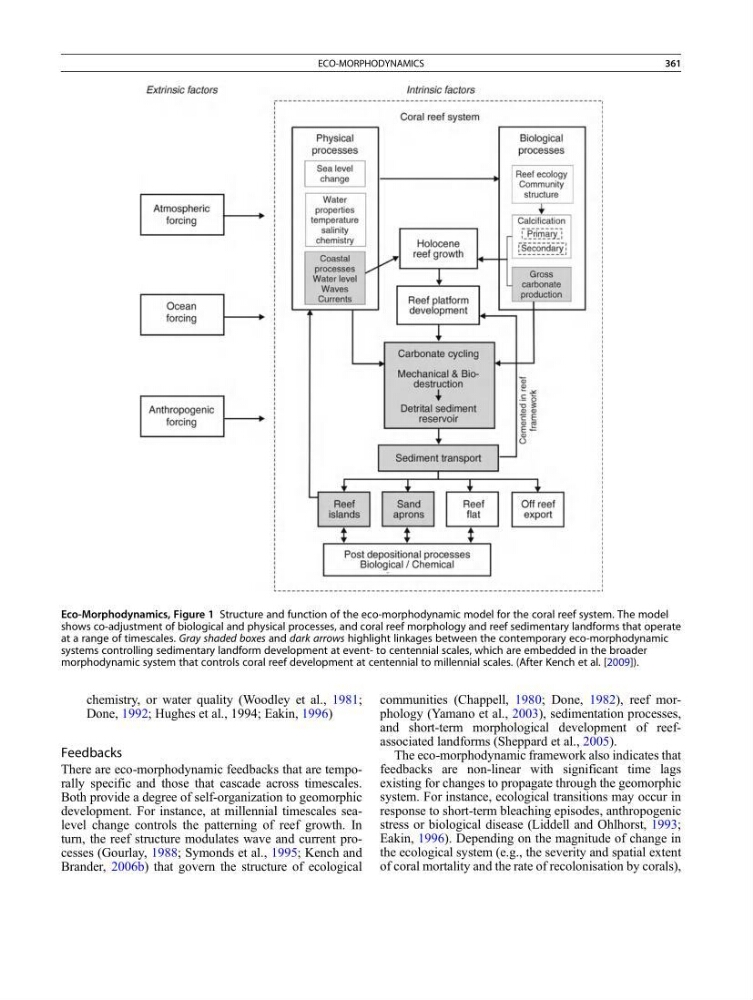
Eco-Morphodynamics, Figure 1 Structure and function of the eco-morphodynamic model for the coral reef system. The model
shows co-adjustment of biological and physical processes, and coral reef morphology and reef sedimentary landforms that operate
at a range of timescales. Gray shaded boxes and dark arrows highlight linkages between the contemporary eco-morphodynamic
systems controlling sedimentary landform development at event- to centennial scales, which are embedded in the broader
morphodynamic system that controls coral reef development at centennial to millennial scales. (After Kench et al. [2009]).
ECO-MORPHODYNAMICS
361
Done, 1992; Hughes et al., 1994; Eakin, 1996)
Feedbacks
There are eco-morphodynamic feedbacks that are temporally specific and those that cascade across timescales.
Both provide a degree of self-organization to geomorphic
development. For instance, at millennial timescales sealevel change controls the patterning of reef growth. In
turn, the reef structure modulates wave and current processes (Gourlay, 1988; Symonds et al., 1995; Kench and
Brander, 2006b) that govern the structure of ecological
communities (Chappell, 1980; Done, 1982), reef morphology (Yamano et al., 2003), sedimentation processes,
and short-term morphological development of reefassociated landforms (Sheppard et al., 2005).
The eco-morphodynamic framework also indicates that
feedbacks are non-linear with significant time lags
existing for changes to propagate through the geomorphic
system. For instance, ecological transitions may occur in
response to short-term bleaching episodes, anthropogenic
stress or biological disease (Liddell and Ohlhorst, 1993;
Eakin, 1996). Depending on the magnitude of change in
the ecological system (e.g., the severity and spatial extent
of coral mortality and the rate of recolonisation by corals),
Eco-Morphodynamics, Figure 1 Structure and function of the eco-morphodynamic model for the coral reef system. The model
shows co-adjustment of biological and physical processes, and coral reef morphology and reef sedimentary landforms that operate
at a range of timescales. Gray shaded boxes and dark arrows highlight linkages between the contemporary eco-morphodynamic
systems controlling sedimentary landform development at event- to centennial scales, which are embedded in the broader
morphodynamic system that controls coral reef development at centennial to millennial scales. (After Kench et al. [2009]).
ECO-MORPHODYNAMICS
361