

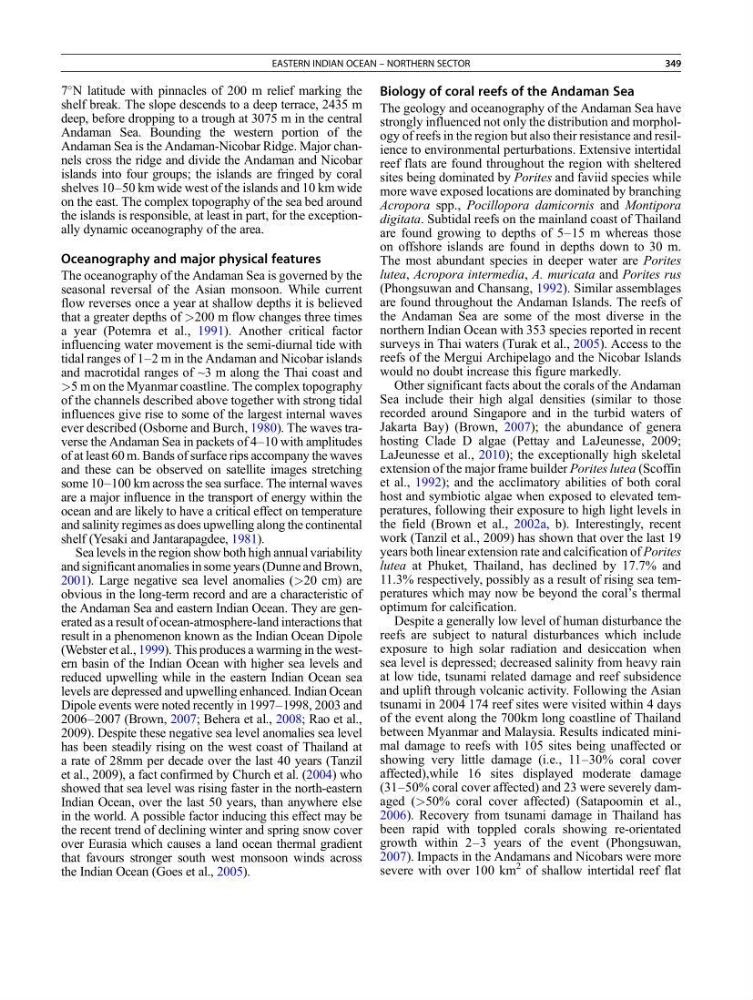
7
N latitude with pinnacles of 200 m relief marking the
shelf break. The slope descends to a deep terrace, 2435 m
deep, before dropping to a trough at 3075 m in the central
Andaman Sea. Bounding the western portion of the
Andaman Sea is the Andaman-Nicobar Ridge. Major channels cross the ridge and divide the Andaman and Nicobar
islands into four groups; the islands are fringed by coral
shelves 10–50 km wide west of the islands and 10 km wide
on the east. The complex topography of the sea bed around
the islands is responsible, at least in part, for the exceptionally dynamic oceanography of the area.
Oceanography and major physical features
The oceanography of the Andaman Sea is governed by the
seasonal reversal of the Asian monsoon. While current
flow reverses once a year at shallow depths it is believed
that a greater depths of >200 m flow changes three times
a year (Potemra et al., 1991). Another critical factor
influencing water movement is the semi-diurnal tide with
tidal ranges of 1–2 m in the Andaman and Nicobar islands
and macrotidal ranges of ~3 m along the Thai coast and
>5 m on the Myanmar coastline. The complex topography
of the channels described above together with strong tidal
influences give rise to some of the largest internal waves
ever described (Osborne and Burch, 1980). The waves traverse the Andaman Sea in packets of 4–10 with amplitudes
of at least 60 m. Bands of surface rips accompany the waves
and these can be observed on satellite images stretching
some 10–100 km across the sea surface. The internal waves
are a major influence in the transport of energy within the
ocean and are likely to have a critical effect on temperature
and salinity regimes as does upwelling along the continental
shelf (Yesaki and Jantarapagdee, 1981).
Sea levels in the region show both high annual variability
and significant anomalies in some years (Dunne and Brown,
2001). Large negative sea level anomalies (>20 cm) are
obvious in the long-term record and are a characteristic of
the Andaman Sea and eastern Indian Ocean. They are generated as a result of ocean-atmosphere-land interactions that
result in a phenomenon known as the Indian Ocean Dipole
(Webster et al., 1999). This produces a warming in the western basin of the Indian Ocean with higher sea levels and
reduced upwelling while in the eastern Indian Ocean sea
levels are depressed and upwelling enhanced. Indian Ocean
Dipole events were noted recently in 1997–1998, 2003 and
2006–2007 (Brown, 2007; Behera et al., 2008; Rao et al.,
2009). Despite these negative sea level anomalies sea level
has been steadily rising on the west coast of Thailand at
a rate of 28mm per decade over the last 40 years (Tanzil
et al., 2009), a fact confirmed by Church et al. (2004) who
showed that sea level was rising faster in the north-eastern
Indian Ocean, over the last 50 years, than anywhere else
in the world. A possible factor inducing this effect may be
the recent trend of declining winter and spring snow cover
over Eurasia which causes a land ocean thermal gradient
that favours stronger south west monsoon winds across
the Indian Ocean (Goes et al., 2005).
Biology of coral reefs of the Andaman Sea
The geology and oceanography of the Andaman Sea have
strongly influenced not only the distribution and morphology of reefs in the region but also their resistance and resilience to environmental perturbations. Extensive intertidal
reef flats are found throughout the region with sheltered
sites being dominated by Porites and faviid species while
more wave exposed locations are dominated by branching
Acropora spp., Pocillopora damicornis and Montipora
digitata. Subtidal reefs on the mainland coast of Thailand
are found growing to depths of 5–15 m whereas those
on offshore islands are found in depths down to 30 m.
The most abundant species in deeper water are Porites
lutea, Acropora intermedia, A. muricata and Porites rus
(Phongsuwan and Chansang, 1992). Similar assemblages
are found throughout the Andaman Islands. The reefs of
the Andaman Sea are some of the most diverse in the
northern Indian Ocean with 353 species reported in recent
surveys in Thai waters (Turak et al., 2005). Access to the
reefs of the Mergui Archipelago and the Nicobar Islands
would no doubt increase this figure markedly.
Other significant facts about the corals of the Andaman
Sea include their high algal densities (similar to those
recorded around Singapore and in the turbid waters of
Jakarta Bay) (Brown, 2007); the abundance of genera
hosting Clade D algae (Pettay and LaJeunesse, 2009;
LaJeunesse et al., 2010); the exceptionally high skeletal
extension of the major frame builder Porites lutea (Scoffin
et al., 1992); and the acclimatory abilities of both coral
host and symbiotic algae when exposed to elevated temperatures, following their exposure to high light levels in
the field (Brown et al., 2002a, b). Interestingly, recent
work (Tanzil et al., 2009) has shown that over the last 19
years both linear extension rate and calcification of Porites
lutea at Phuket, Thailand, has declined by 17.7% and
11.3% respectively, possibly as a result of rising sea temperatures which may now be beyond the coral’s thermal
optimum for calcification.
Despite a generally low level of human disturbance the
reefs are subject to natural disturbances which include
exposure to high solar radiation and desiccation when
sea level is depressed; decreased salinity from heavy rain
at low tide, tsunami related damage and reef subsidence
and uplift through volcanic activity. Following the Asian
tsunami in 2004 174 reef sites were visited within 4 days
of the event along the 700km long coastline of Thailand
between Myanmar and Malaysia. Results indicated minimal damage to reefs with 105 sites being unaffected or
showing very little damage (i.e., 11–30% coral cover
affected),while 16 sites displayed moderate damage
(31–50% coral cover affected) and 23 were severely damaged (>50% coral cover affected) (Satapoomin et al.,
2006). Recovery from tsunami damage in Thailand has
been rapid with toppled corals showing re-orientated
growth within 2–3 years of the event (Phongsuwan,
2007). Impacts in the Andamans and Nicobars were more
severe with over 100 km
2 of shallow intertidal reef flat
EASTERN INDIAN OCEAN – NORTHERN SECTOR
349
N latitude with pinnacles of 200 m relief marking the
shelf break. The slope descends to a deep terrace, 2435 m
deep, before dropping to a trough at 3075 m in the central
Andaman Sea. Bounding the western portion of the
Andaman Sea is the Andaman-Nicobar Ridge. Major channels cross the ridge and divide the Andaman and Nicobar
islands into four groups; the islands are fringed by coral
shelves 10–50 km wide west of the islands and 10 km wide
on the east. The complex topography of the sea bed around
the islands is responsible, at least in part, for the exceptionally dynamic oceanography of the area.
Oceanography and major physical features
The oceanography of the Andaman Sea is governed by the
seasonal reversal of the Asian monsoon. While current
flow reverses once a year at shallow depths it is believed
that a greater depths of >200 m flow changes three times
a year (Potemra et al., 1991). Another critical factor
influencing water movement is the semi-diurnal tide with
tidal ranges of 1–2 m in the Andaman and Nicobar islands
and macrotidal ranges of ~3 m along the Thai coast and
>5 m on the Myanmar coastline. The complex topography
of the channels described above together with strong tidal
influences give rise to some of the largest internal waves
ever described (Osborne and Burch, 1980). The waves traverse the Andaman Sea in packets of 4–10 with amplitudes
of at least 60 m. Bands of surface rips accompany the waves
and these can be observed on satellite images stretching
some 10–100 km across the sea surface. The internal waves
are a major influence in the transport of energy within the
ocean and are likely to have a critical effect on temperature
and salinity regimes as does upwelling along the continental
shelf (Yesaki and Jantarapagdee, 1981).
Sea levels in the region show both high annual variability
and significant anomalies in some years (Dunne and Brown,
2001). Large negative sea level anomalies (>20 cm) are
obvious in the long-term record and are a characteristic of
the Andaman Sea and eastern Indian Ocean. They are generated as a result of ocean-atmosphere-land interactions that
result in a phenomenon known as the Indian Ocean Dipole
(Webster et al., 1999). This produces a warming in the western basin of the Indian Ocean with higher sea levels and
reduced upwelling while in the eastern Indian Ocean sea
levels are depressed and upwelling enhanced. Indian Ocean
Dipole events were noted recently in 1997–1998, 2003 and
2006–2007 (Brown, 2007; Behera et al., 2008; Rao et al.,
2009). Despite these negative sea level anomalies sea level
has been steadily rising on the west coast of Thailand at
a rate of 28mm per decade over the last 40 years (Tanzil
et al., 2009), a fact confirmed by Church et al. (2004) who
showed that sea level was rising faster in the north-eastern
Indian Ocean, over the last 50 years, than anywhere else
in the world. A possible factor inducing this effect may be
the recent trend of declining winter and spring snow cover
over Eurasia which causes a land ocean thermal gradient
that favours stronger south west monsoon winds across
the Indian Ocean (Goes et al., 2005).
Biology of coral reefs of the Andaman Sea
The geology and oceanography of the Andaman Sea have
strongly influenced not only the distribution and morphology of reefs in the region but also their resistance and resilience to environmental perturbations. Extensive intertidal
reef flats are found throughout the region with sheltered
sites being dominated by Porites and faviid species while
more wave exposed locations are dominated by branching
Acropora spp., Pocillopora damicornis and Montipora
digitata. Subtidal reefs on the mainland coast of Thailand
are found growing to depths of 5–15 m whereas those
on offshore islands are found in depths down to 30 m.
The most abundant species in deeper water are Porites
lutea, Acropora intermedia, A. muricata and Porites rus
(Phongsuwan and Chansang, 1992). Similar assemblages
are found throughout the Andaman Islands. The reefs of
the Andaman Sea are some of the most diverse in the
northern Indian Ocean with 353 species reported in recent
surveys in Thai waters (Turak et al., 2005). Access to the
reefs of the Mergui Archipelago and the Nicobar Islands
would no doubt increase this figure markedly.
Other significant facts about the corals of the Andaman
Sea include their high algal densities (similar to those
recorded around Singapore and in the turbid waters of
Jakarta Bay) (Brown, 2007); the abundance of genera
hosting Clade D algae (Pettay and LaJeunesse, 2009;
LaJeunesse et al., 2010); the exceptionally high skeletal
extension of the major frame builder Porites lutea (Scoffin
et al., 1992); and the acclimatory abilities of both coral
host and symbiotic algae when exposed to elevated temperatures, following their exposure to high light levels in
the field (Brown et al., 2002a, b). Interestingly, recent
work (Tanzil et al., 2009) has shown that over the last 19
years both linear extension rate and calcification of Porites
lutea at Phuket, Thailand, has declined by 17.7% and
11.3% respectively, possibly as a result of rising sea temperatures which may now be beyond the coral’s thermal
optimum for calcification.
Despite a generally low level of human disturbance the
reefs are subject to natural disturbances which include
exposure to high solar radiation and desiccation when
sea level is depressed; decreased salinity from heavy rain
at low tide, tsunami related damage and reef subsidence
and uplift through volcanic activity. Following the Asian
tsunami in 2004 174 reef sites were visited within 4 days
of the event along the 700km long coastline of Thailand
between Myanmar and Malaysia. Results indicated minimal damage to reefs with 105 sites being unaffected or
showing very little damage (i.e., 11–30% coral cover
affected),while 16 sites displayed moderate damage
(31–50% coral cover affected) and 23 were severely damaged (>50% coral cover affected) (Satapoomin et al.,
2006). Recovery from tsunami damage in Thailand has
been rapid with toppled corals showing re-orientated
growth within 2–3 years of the event (Phongsuwan,
2007). Impacts in the Andamans and Nicobars were more
severe with over 100 km
2 of shallow intertidal reef flat
EASTERN INDIAN OCEAN – NORTHERN SECTOR
349