

and compete with corals for resources (Done, 1999; Done
et al., 2007). Human-influenced deterioration of conditions suitable for survival and/or settlement of Acropora,
or favoring survival and population increase of other benthic organisms such as the coral genus Porites, soft corals,
and algae, are thought to be involved in the gradual deterioration of Acropora communities in many parts of the
world and to threaten the survival of the rarer or more narrowly distributed species of this genus (McClanahan et al.,
2008). Many rare species may be threatened by
diminishing habitats (Carpenter et al. 2008), although it
has been suggested that some rare species with small
global population sizes are actually unidirectional hybrids,
and that this contributes to increased genetic variability
and adaptive potential, making them less vulnerable to
extinction (Richards et al., 2008). In the Caribbean, the
two major Acropora species A. cervicornis and A. palmata
have undergone massive population loss over recent
decades in many locations as a result of exposure to repetitive hurricanes, coral diseases, changes in water quality,
and outbreaks of other reef organisms (Bythell et al.,
1993; Williams et al., 1999) and such rapid declines
appear to be unprecedented in the past 4,000 years
(Aronson and Precht, 1997).
Sexual and asexual reproduction
Species of Acropora reproduce sexually by developing
gametes (eggs and sperm) along the mesenteries (radial
dividing structures) within the polyps. In Acropora polyps
have both sexes (hermaphrodite), with certain mesenteries
bearing eggs and others sperm (Wallace, 1985) (Figure 4).
Fertilization takes place externally, after the gametes are
released into the water column, often during mass
spawning events involving many species. The fertilized
eggs develop into ciliated larvae known as planulae,
which spend some days in the water before being ready
to settle on reef surface to begin a new colony. Planulae
remain viable for days to weeks and may be transported
long distances and settle away from the home reef. This
contrasts with sexual reproduction in the sister genus
Isopora, where sperm is released but the eggs stay within
the polyp, where they are fertilized by sperm from other
colonies and develop into larvae which are released ready
to settle on the reef. The two contrasting modes of reproduction may have different consequences for the genera
after loss of the adult corals in a population: for Acropora,
the possibility of recruitment of larvae from healthy reefs
is greater. This has been seen after mass bleaching of
Acropora, for example, in the Maldives (Wallace and
Zahir, 2007) and Socotra (western Yemen), where
Acropora, Figure 4 Egg sperm bundles of Acropora tenuis
leaving polyps and ascending into the water column, during
a mass spawning event on the Great Barrier Reef, Australia.
(Photo: Z. Florian.)
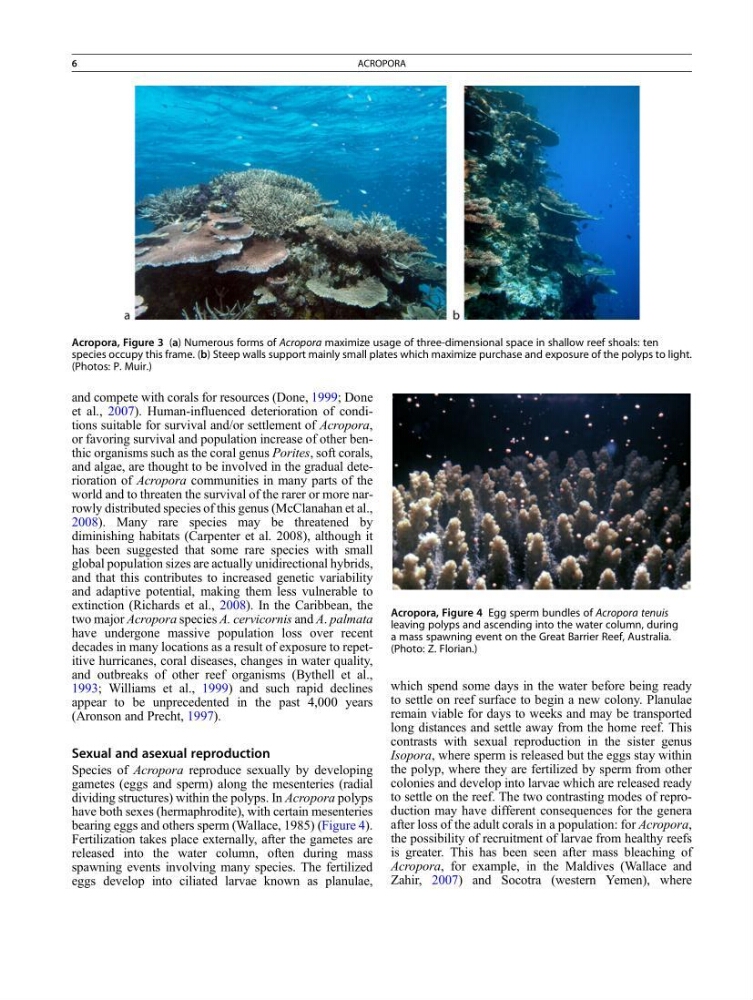
Acropora, Figure 3 (a) Numerous forms of Acropora maximize usage of three-dimensional space in shallow reef shoals: ten
species occupy this frame. (b) Steep walls support mainly small plates which maximize purchase and exposure of the polyps to light.
(Photos: P. Muir.)
6
ACROPORA
et al., 2007). Human-influenced deterioration of conditions suitable for survival and/or settlement of Acropora,
or favoring survival and population increase of other benthic organisms such as the coral genus Porites, soft corals,
and algae, are thought to be involved in the gradual deterioration of Acropora communities in many parts of the
world and to threaten the survival of the rarer or more narrowly distributed species of this genus (McClanahan et al.,
2008). Many rare species may be threatened by
diminishing habitats (Carpenter et al. 2008), although it
has been suggested that some rare species with small
global population sizes are actually unidirectional hybrids,
and that this contributes to increased genetic variability
and adaptive potential, making them less vulnerable to
extinction (Richards et al., 2008). In the Caribbean, the
two major Acropora species A. cervicornis and A. palmata
have undergone massive population loss over recent
decades in many locations as a result of exposure to repetitive hurricanes, coral diseases, changes in water quality,
and outbreaks of other reef organisms (Bythell et al.,
1993; Williams et al., 1999) and such rapid declines
appear to be unprecedented in the past 4,000 years
(Aronson and Precht, 1997).
Sexual and asexual reproduction
Species of Acropora reproduce sexually by developing
gametes (eggs and sperm) along the mesenteries (radial
dividing structures) within the polyps. In Acropora polyps
have both sexes (hermaphrodite), with certain mesenteries
bearing eggs and others sperm (Wallace, 1985) (Figure 4).
Fertilization takes place externally, after the gametes are
released into the water column, often during mass
spawning events involving many species. The fertilized
eggs develop into ciliated larvae known as planulae,
which spend some days in the water before being ready
to settle on reef surface to begin a new colony. Planulae
remain viable for days to weeks and may be transported
long distances and settle away from the home reef. This
contrasts with sexual reproduction in the sister genus
Isopora, where sperm is released but the eggs stay within
the polyp, where they are fertilized by sperm from other
colonies and develop into larvae which are released ready
to settle on the reef. The two contrasting modes of reproduction may have different consequences for the genera
after loss of the adult corals in a population: for Acropora,
the possibility of recruitment of larvae from healthy reefs
is greater. This has been seen after mass bleaching of
Acropora, for example, in the Maldives (Wallace and
Zahir, 2007) and Socotra (western Yemen), where
Acropora, Figure 4 Egg sperm bundles of Acropora tenuis
leaving polyps and ascending into the water column, during
a mass spawning event on the Great Barrier Reef, Australia.
(Photo: Z. Florian.)
Acropora, Figure 3 (a) Numerous forms of Acropora maximize usage of three-dimensional space in shallow reef shoals: ten
species occupy this frame. (b) Steep walls support mainly small plates which maximize purchase and exposure of the polyps to light.
(Photos: P. Muir.)
6
ACROPORA