

Aïssaoui et al., 1986; Buddemeier and Oberdorfer, 1986;
Carrière, 1987).
Petrographical and geological approach
Although the petrographical and geochemical characteristics of dolomites in Quaternary reefs are known to be
highly variable, the change from a calcium carbonate to
a mixed Ca–Mg carbonate required a source of Mg ions,
which is reasonably regarded as provided by the marine
water. On the other hand, the fact that marine waters alone
cannot produce massive dolomitization of the reef complex is evidenced by two basic petrographical observations: (1) the dolomitization is often associated with
previous dissolution features linked to meteoric waters
and (2) the most external parts of modern reef platform
is not dolomitized (Aïssaoui, 1986).
Diagenetic alteration – crystalline modifications
Calcitization of aragonite
The recrystallization from aragonite to calcite may concern either aragonite cements (Sandberg, 1984; Aïssaoui,
1985) or biogenic aragonites (James, 1974; Pingitore,
1976; Gvirtzman and Friedman, 1977; Sandberg, 1984;
Dullo, 1986). In both cases, the transformation involves
at very small scale, a prior discrete dissolution process of
the aragonite precursor, followed by a precipitation of calcite within the newly created secondary voids, both processes may occur concomitantly at very short distances
(a few microns to tens of microns) from each other. The
overall transformation operates as a migrating front of dissolution–precipitation. While this appears obvious in the
case of aragonite cement, in some biogenic aragonite the
transformation may be further controlled by the textural
and compositional differences of the skeletal structures,
making hence the recognition of a geometrically simple
front of dissolution–precipitation difficult.
These concomitant discrete processes of dissolution–
precipitation strongly differ from the transformation at
solid state characteristic of metamorphic conditions.
Transformation of HMC to LMC
In the cored material from Mururoa Atoll, several types of
magnesian calcite cements having different Mg values
have been described (Aïssaoui and Purser, 1985; Aïssaoui,
1986). The type 2 cement has variable Mg values, always
equal or lower than the type 1 cement. The type 2 cement
has been interpreted as resulting from the gradual diagenetic transformation of the early marine fibrous HMC
cement (Aïssaoui and Purser, 1985). In the deeper
parts of the atoll rim, the early fibrous or radiaxial calcite
cements have even lower Mg values (less than 3% mol
MgCO 3 ) (Berbey, 1989). This gradual change of Mg
content likely results from diagenetic processes involving
partial micro-dissolution of HMC, as suggested by
Berbey (1989), and/or Ca–Mg substitution in the calcite
lattice.
Dolomitization
Dolomitization may affect either bioclasts, or sediment, or
early diagenetic cements, in particular HMC cements.
Dolomite can replace calcite or aragonite precursors. The
gradual development of dolomite to the detriment of the
calcite or aragonite occurs through a migrating front of
dissolution–precipitation leading to a progressive digestion of the calcite or aragonite precursor by dolomite
(Gebelin et al., 1980; Aïssaoui, 1986).
Skeletal diagenesis
Skeletal carbonates, including those occurring in reef
facies, are known to be highly susceptible to diagenesis
and often undergo rapid and discrete diagenetic changes
at a very early stage either postmortem or even already
during the life of the organism. These first steps of diagenesis in skeletal carbonates are represented by discrete textural changes, micro-dissolution features and isomineral
recrystallization. They have been evidenced both within
biogenic aragonite (Macintyre and Reid, 1995; Perrin
and Cuif, 2001; Perrin, 2004) and magnesian calcite skeletons (Macintyre and Reid, 1998; Reid and Macintyre,
1998; Hover et al., 2001). These rapid changes are
strongly favored by two main features: the early degradation of intraskeletal organic matrix and the micronic size
of individual biocrystals (Robbins and Ostrom, 1995;
Perrin and Smith, 2007b).
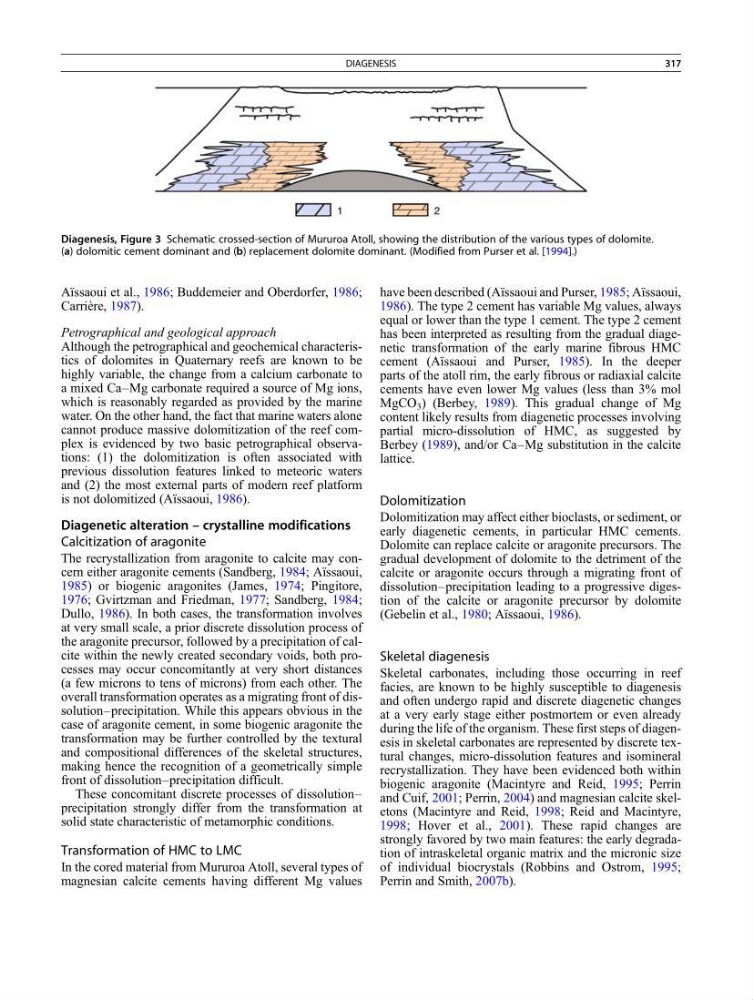
Diagenesis, Figure 3 Schematic crossed-section of Mururoa Atoll, showing the distribution of the various types of dolomite.
(a) dolomitic cement dominant and (b) replacement dolomite dominant. (Modified from Purser et al. [1994].)
DIAGENESIS
317
Carrière, 1987).
Petrographical and geological approach
Although the petrographical and geochemical characteristics of dolomites in Quaternary reefs are known to be
highly variable, the change from a calcium carbonate to
a mixed Ca–Mg carbonate required a source of Mg ions,
which is reasonably regarded as provided by the marine
water. On the other hand, the fact that marine waters alone
cannot produce massive dolomitization of the reef complex is evidenced by two basic petrographical observations: (1) the dolomitization is often associated with
previous dissolution features linked to meteoric waters
and (2) the most external parts of modern reef platform
is not dolomitized (Aïssaoui, 1986).
Diagenetic alteration – crystalline modifications
Calcitization of aragonite
The recrystallization from aragonite to calcite may concern either aragonite cements (Sandberg, 1984; Aïssaoui,
1985) or biogenic aragonites (James, 1974; Pingitore,
1976; Gvirtzman and Friedman, 1977; Sandberg, 1984;
Dullo, 1986). In both cases, the transformation involves
at very small scale, a prior discrete dissolution process of
the aragonite precursor, followed by a precipitation of calcite within the newly created secondary voids, both processes may occur concomitantly at very short distances
(a few microns to tens of microns) from each other. The
overall transformation operates as a migrating front of dissolution–precipitation. While this appears obvious in the
case of aragonite cement, in some biogenic aragonite the
transformation may be further controlled by the textural
and compositional differences of the skeletal structures,
making hence the recognition of a geometrically simple
front of dissolution–precipitation difficult.
These concomitant discrete processes of dissolution–
precipitation strongly differ from the transformation at
solid state characteristic of metamorphic conditions.
Transformation of HMC to LMC
In the cored material from Mururoa Atoll, several types of
magnesian calcite cements having different Mg values
have been described (Aïssaoui and Purser, 1985; Aïssaoui,
1986). The type 2 cement has variable Mg values, always
equal or lower than the type 1 cement. The type 2 cement
has been interpreted as resulting from the gradual diagenetic transformation of the early marine fibrous HMC
cement (Aïssaoui and Purser, 1985). In the deeper
parts of the atoll rim, the early fibrous or radiaxial calcite
cements have even lower Mg values (less than 3% mol
MgCO 3 ) (Berbey, 1989). This gradual change of Mg
content likely results from diagenetic processes involving
partial micro-dissolution of HMC, as suggested by
Berbey (1989), and/or Ca–Mg substitution in the calcite
lattice.
Dolomitization
Dolomitization may affect either bioclasts, or sediment, or
early diagenetic cements, in particular HMC cements.
Dolomite can replace calcite or aragonite precursors. The
gradual development of dolomite to the detriment of the
calcite or aragonite occurs through a migrating front of
dissolution–precipitation leading to a progressive digestion of the calcite or aragonite precursor by dolomite
(Gebelin et al., 1980; Aïssaoui, 1986).
Skeletal diagenesis
Skeletal carbonates, including those occurring in reef
facies, are known to be highly susceptible to diagenesis
and often undergo rapid and discrete diagenetic changes
at a very early stage either postmortem or even already
during the life of the organism. These first steps of diagenesis in skeletal carbonates are represented by discrete textural changes, micro-dissolution features and isomineral
recrystallization. They have been evidenced both within
biogenic aragonite (Macintyre and Reid, 1995; Perrin
and Cuif, 2001; Perrin, 2004) and magnesian calcite skeletons (Macintyre and Reid, 1998; Reid and Macintyre,
1998; Hover et al., 2001). These rapid changes are
strongly favored by two main features: the early degradation of intraskeletal organic matrix and the micronic size
of individual biocrystals (Robbins and Ostrom, 1995;
Perrin and Smith, 2007b).
Diagenesis, Figure 3 Schematic crossed-section of Mururoa Atoll, showing the distribution of the various types of dolomite.
(a) dolomitic cement dominant and (b) replacement dolomite dominant. (Modified from Purser et al. [1994].)
DIAGENESIS
317