

overfishing, and coral mining for limestone also have an
impact on Acropora (Fabricius, 2005; Fabricius and
Wolanski, 2000; Brown, 1997).
Nomenclatural issues
Until the late nineteenth century Acropora was known
mostly as Madrepora, a broadly applied name, which is
now restricted to a genus of non-zooxanthellate deepwater
corals. The name Acropora was stabilized by a decision of
the International Code of Nomenclature in the midtwentieth century (Boschma, 1961; China, 1983), which
also ruled on a type species, A. muricata (Linneaus,
1758). A dilemma concerning the nature and provenance
of this species, described by Linnaeus as being from the
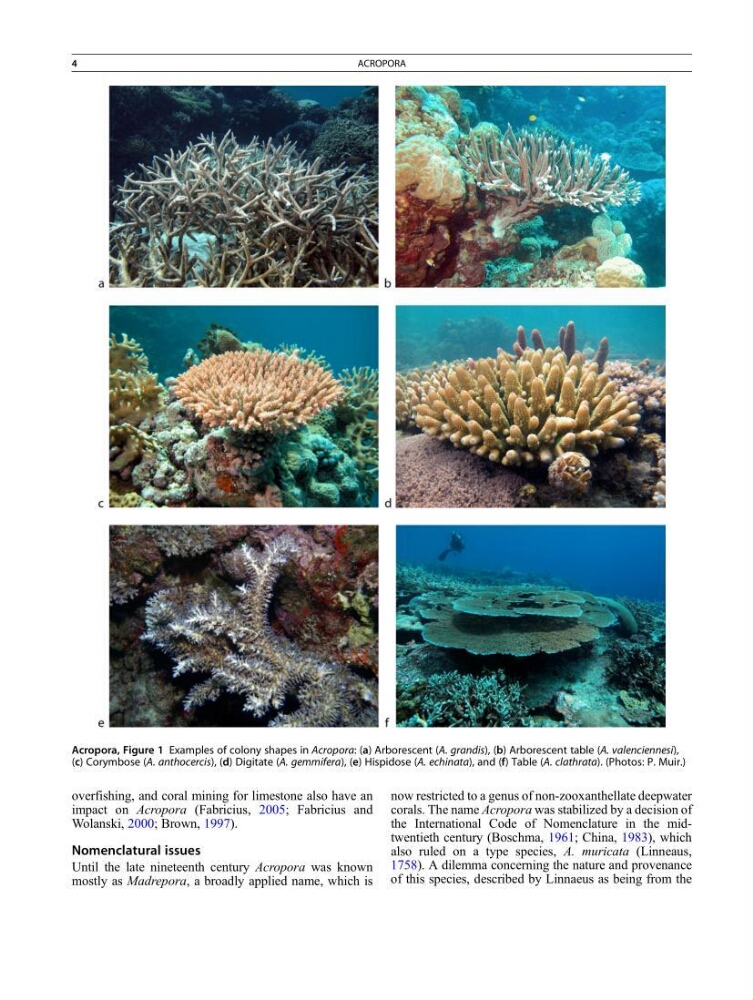
Acropora, Figure 1 Examples of colony shapes in Acropora: (a) Arborescent (A. grandis), (b) Arborescent table (A. valenciennesi),
(c) Corymbose (A. anthocercis), (d) Digitate (A. gemmifera), (e) Hispidose (A. echinata), and (f) Table (A. clathrata). (Photos: P. Muir.)
4
ACROPORA
impact on Acropora (Fabricius, 2005; Fabricius and
Wolanski, 2000; Brown, 1997).
Nomenclatural issues
Until the late nineteenth century Acropora was known
mostly as Madrepora, a broadly applied name, which is
now restricted to a genus of non-zooxanthellate deepwater
corals. The name Acropora was stabilized by a decision of
the International Code of Nomenclature in the midtwentieth century (Boschma, 1961; China, 1983), which
also ruled on a type species, A. muricata (Linneaus,
1758). A dilemma concerning the nature and provenance
of this species, described by Linnaeus as being from the
Acropora, Figure 1 Examples of colony shapes in Acropora: (a) Arborescent (A. grandis), (b) Arborescent table (A. valenciennesi),
(c) Corymbose (A. anthocercis), (d) Digitate (A. gemmifera), (e) Hispidose (A. echinata), and (f) Table (A. clathrata). (Photos: P. Muir.)
4
ACROPORA