

CORE PLUGS
Eric G. Matson
Australian Institute of Marine Science, Townsville, QLD,
Australia
Definition
Many massive corals contain annual density bands in their
calcium carbonate skeletons, similar to tree rings. Growing at ~1–2 cm/year coral bommies
1 several meters in
height can contain several hundred years of continuous
coral growth. The annual density bands (visible when
slices from coral are X-rayed) provide the chronological
control for the extraction of a wealth of high-resolution
coral growth and coral paleoclimatic records. These make
a substantial contribution to understanding the nature and
causes of climate variability and change, in the shallowwater tropical ocean regions, prior to the advent of extensive observational records and complement similar
records obtained from tree rings, ice cores, and documentary sources.
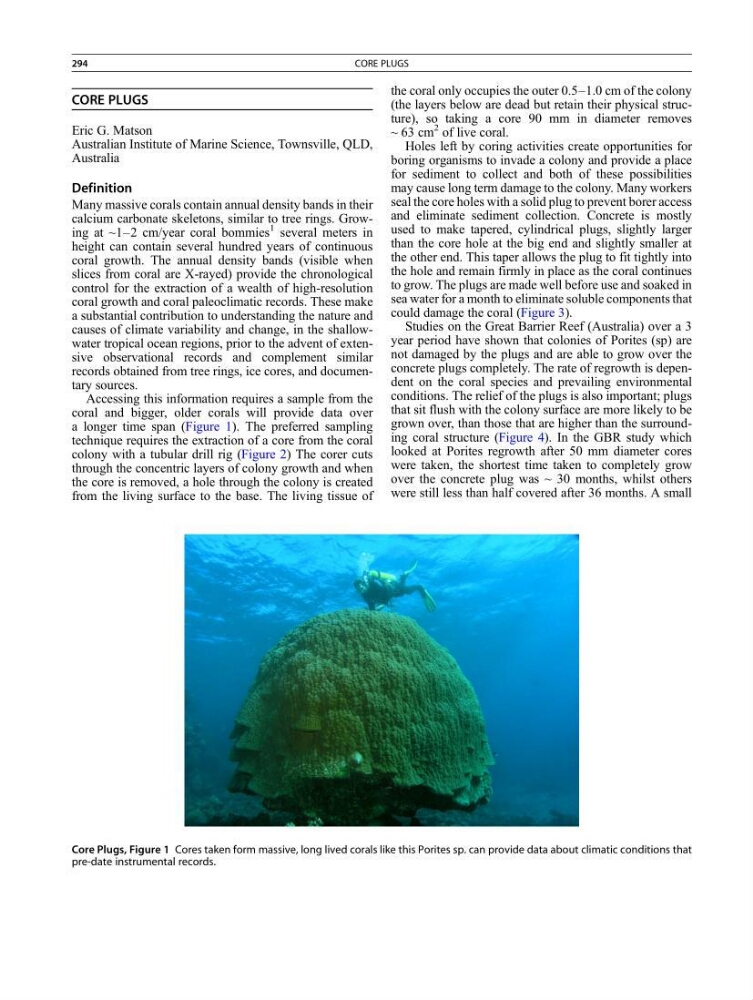
Accessing this information requires a sample from the
coral and bigger, older corals will provide data over
a longer time span (Figure 1). The preferred sampling
technique requires the extraction of a core from the coral
colony with a tubular drill rig (Figure 2) The corer cuts
through the concentric layers of colony growth and when
the core is removed, a hole through the colony is created
from the living surface to the base. The living tissue of
the coral only occupies the outer 0.5–1.0 cm of the colony
(the layers below are dead but retain their physical structure), so taking a core 90 mm in diameter removes
~ 63 cm
2 of live coral.
Holes left by coring activities create opportunities for
boring organisms to invade a colony and provide a place
for sediment to collect and both of these possibilities
may cause long term damage to the colony. Many workers
seal the core holes with a solid plug to prevent borer access
and eliminate sediment collection. Concrete is mostly
used to make tapered, cylindrical plugs, slightly larger
than the core hole at the big end and slightly smaller at
the other end. This taper allows the plug to fit tightly into
the hole and remain firmly in place as the coral continues
to grow. The plugs are made well before use and soaked in
sea water for a month to eliminate soluble components that
could damage the coral (Figure 3).
Studies on the Great Barrier Reef (Australia) over a 3
year period have shown that colonies of Porites (sp) are
not damaged by the plugs and are able to grow over the
concrete plugs completely. The rate of regrowth is dependent on the coral species and prevailing environmental
conditions. The relief of the plugs is also important; plugs
that sit flush with the colony surface are more likely to be
grown over, than those that are higher than the surrounding coral structure (Figure 4). In the GBR study which
looked at Porites regrowth after 50 mm diameter cores
were taken, the shortest time taken to completely grow
over the concrete plug was ~ 30 months, whilst others
were still less than half covered after 36 months. A small
Core Plugs, Figure 1 Cores taken form massive, long lived corals like this Porites sp. can provide data about climatic conditions that
pre-date instrumental records.
294
CORE PLUGS
Eric G. Matson
Australian Institute of Marine Science, Townsville, QLD,
Australia
Definition
Many massive corals contain annual density bands in their
calcium carbonate skeletons, similar to tree rings. Growing at ~1–2 cm/year coral bommies
1 several meters in
height can contain several hundred years of continuous
coral growth. The annual density bands (visible when
slices from coral are X-rayed) provide the chronological
control for the extraction of a wealth of high-resolution
coral growth and coral paleoclimatic records. These make
a substantial contribution to understanding the nature and
causes of climate variability and change, in the shallowwater tropical ocean regions, prior to the advent of extensive observational records and complement similar
records obtained from tree rings, ice cores, and documentary sources.
Accessing this information requires a sample from the
coral and bigger, older corals will provide data over
a longer time span (Figure 1). The preferred sampling
technique requires the extraction of a core from the coral
colony with a tubular drill rig (Figure 2) The corer cuts
through the concentric layers of colony growth and when
the core is removed, a hole through the colony is created
from the living surface to the base. The living tissue of
the coral only occupies the outer 0.5–1.0 cm of the colony
(the layers below are dead but retain their physical structure), so taking a core 90 mm in diameter removes
~ 63 cm
2 of live coral.
Holes left by coring activities create opportunities for
boring organisms to invade a colony and provide a place
for sediment to collect and both of these possibilities
may cause long term damage to the colony. Many workers
seal the core holes with a solid plug to prevent borer access
and eliminate sediment collection. Concrete is mostly
used to make tapered, cylindrical plugs, slightly larger
than the core hole at the big end and slightly smaller at
the other end. This taper allows the plug to fit tightly into
the hole and remain firmly in place as the coral continues
to grow. The plugs are made well before use and soaked in
sea water for a month to eliminate soluble components that
could damage the coral (Figure 3).
Studies on the Great Barrier Reef (Australia) over a 3
year period have shown that colonies of Porites (sp) are
not damaged by the plugs and are able to grow over the
concrete plugs completely. The rate of regrowth is dependent on the coral species and prevailing environmental
conditions. The relief of the plugs is also important; plugs
that sit flush with the colony surface are more likely to be
grown over, than those that are higher than the surrounding coral structure (Figure 4). In the GBR study which
looked at Porites regrowth after 50 mm diameter cores
were taken, the shortest time taken to completely grow
over the concrete plug was ~ 30 months, whilst others
were still less than half covered after 36 months. A small
Core Plugs, Figure 1 Cores taken form massive, long lived corals like this Porites sp. can provide data about climatic conditions that
pre-date instrumental records.
294
CORE PLUGS