

happen when large tracts of ocean become anoxic, hydrogen sulphide concentrations become toxic, pH alters
beyond tolerable limits for calcification, or other contaminants make the water uninhabitable.
Rates of growth and erosion
Growth rates of coral colonies and of reefs are very different subjects because (1) reefs are made of a much denser
material than are coral skeletons, (2) there are gaps
between coral colonies that must be in-filled to make solid
limestone and (3) reef accretion is the rate of growth minus
the rate of erosion – the latter is commonly greater, especially in marginal habitats. This is the main reason why
reefs do not form wherever coral grows.
Coral growth rates
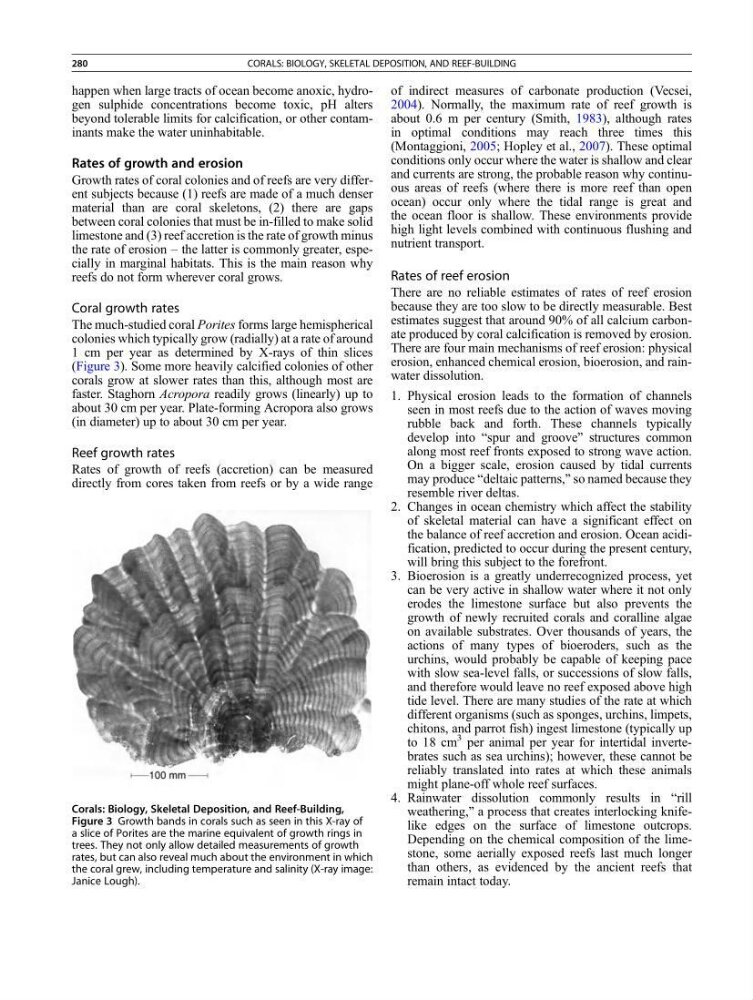
The much-studied coral Porites forms large hemispherical
colonies which typically grow (radially) at a rate of around
1 cm per year as determined by X-rays of thin slices
(Figure 3). Some more heavily calcified colonies of other
corals grow at slower rates than this, although most are
faster. Staghorn Acropora readily grows (linearly) up to
about 30 cm per year. Plate-forming Acropora also grows
(in diameter) up to about 30 cm per year.
Reef growth rates
Rates of growth of reefs (accretion) can be measured
directly from cores taken from reefs or by a wide range
of indirect measures of carbonate production (Vecsei,
2004). Normally, the maximum rate of reef growth is
about 0.6 m per century (Smith, 1983), although rates
in optimal conditions may reach three times this
(Montaggioni, 2005; Hopley et al., 2007). These optimal
conditions only occur where the water is shallow and clear
and currents are strong, the probable reason why continuous areas of reefs (where there is more reef than open
ocean) occur only where the tidal range is great and
the ocean floor is shallow. These environments provide
high light levels combined with continuous flushing and
nutrient transport.
Rates of reef erosion
There are no reliable estimates of rates of reef erosion
because they are too slow to be directly measurable. Best
estimates suggest that around 90% of all calcium carbonate produced by coral calcification is removed by erosion.
There are four main mechanisms of reef erosion: physical
erosion, enhanced chemical erosion, bioerosion, and rainwater dissolution.
1. Physical erosion leads to the formation of channels
seen in most reefs due to the action of waves moving
rubble back and forth. These channels typically
develop into “spur and groove” structures common
along most reef fronts exposed to strong wave action.
On a bigger scale, erosion caused by tidal currents
may produce “deltaic patterns,” so named because they
resemble river deltas.
2. Changes in ocean chemistry which affect the stability
of skeletal material can have a significant effect on
the balance of reef accretion and erosion. Ocean acidification, predicted to occur during the present century,
will bring this subject to the forefront.
3. Bioerosion is a greatly underrecognized process, yet
can be very active in shallow water where it not only
erodes the limestone surface but also prevents the
growth of newly recruited corals and coralline algae
on available substrates. Over thousands of years, the
actions of many types of bioeroders, such as the
urchins, would probably be capable of keeping pace
with slow sea-level falls, or successions of slow falls,
and therefore would leave no reef exposed above high
tide level. There are many studies of the rate at which
different organisms (such as sponges, urchins, limpets,
chitons, and parrot fish) ingest limestone (typically up
to 18 cm
3 per animal per year for intertidal invertebrates such as sea urchins); however, these cannot be
reliably translated into rates at which these animals
might plane-off whole reef surfaces.
4. Rainwater dissolution commonly results in “rill
weathering,” a process that creates interlocking knifelike edges on the surface of limestone outcrops.
Depending on the chemical composition of the limestone, some aerially exposed reefs last much longer
than others, as evidenced by the ancient reefs that
remain intact today.
Corals: Biology, Skeletal Deposition, and Reef-Building,
Figure 3 Growth bands in corals such as seen in this X-ray of
a slice of Porites are the marine equivalent of growth rings in
trees. They not only allow detailed measurements of growth
rates, but can also reveal much about the environment in which
the coral grew, including temperature and salinity (X-ray image:
Janice Lough).
280
CORALS: BIOLOGY, SKELETAL DEPOSITION, AND REEF-BUILDING
beyond tolerable limits for calcification, or other contaminants make the water uninhabitable.
Rates of growth and erosion
Growth rates of coral colonies and of reefs are very different subjects because (1) reefs are made of a much denser
material than are coral skeletons, (2) there are gaps
between coral colonies that must be in-filled to make solid
limestone and (3) reef accretion is the rate of growth minus
the rate of erosion – the latter is commonly greater, especially in marginal habitats. This is the main reason why
reefs do not form wherever coral grows.
Coral growth rates
The much-studied coral Porites forms large hemispherical
colonies which typically grow (radially) at a rate of around
1 cm per year as determined by X-rays of thin slices
(Figure 3). Some more heavily calcified colonies of other
corals grow at slower rates than this, although most are
faster. Staghorn Acropora readily grows (linearly) up to
about 30 cm per year. Plate-forming Acropora also grows
(in diameter) up to about 30 cm per year.
Reef growth rates
Rates of growth of reefs (accretion) can be measured
directly from cores taken from reefs or by a wide range
of indirect measures of carbonate production (Vecsei,
2004). Normally, the maximum rate of reef growth is
about 0.6 m per century (Smith, 1983), although rates
in optimal conditions may reach three times this
(Montaggioni, 2005; Hopley et al., 2007). These optimal
conditions only occur where the water is shallow and clear
and currents are strong, the probable reason why continuous areas of reefs (where there is more reef than open
ocean) occur only where the tidal range is great and
the ocean floor is shallow. These environments provide
high light levels combined with continuous flushing and
nutrient transport.
Rates of reef erosion
There are no reliable estimates of rates of reef erosion
because they are too slow to be directly measurable. Best
estimates suggest that around 90% of all calcium carbonate produced by coral calcification is removed by erosion.
There are four main mechanisms of reef erosion: physical
erosion, enhanced chemical erosion, bioerosion, and rainwater dissolution.
1. Physical erosion leads to the formation of channels
seen in most reefs due to the action of waves moving
rubble back and forth. These channels typically
develop into “spur and groove” structures common
along most reef fronts exposed to strong wave action.
On a bigger scale, erosion caused by tidal currents
may produce “deltaic patterns,” so named because they
resemble river deltas.
2. Changes in ocean chemistry which affect the stability
of skeletal material can have a significant effect on
the balance of reef accretion and erosion. Ocean acidification, predicted to occur during the present century,
will bring this subject to the forefront.
3. Bioerosion is a greatly underrecognized process, yet
can be very active in shallow water where it not only
erodes the limestone surface but also prevents the
growth of newly recruited corals and coralline algae
on available substrates. Over thousands of years, the
actions of many types of bioeroders, such as the
urchins, would probably be capable of keeping pace
with slow sea-level falls, or successions of slow falls,
and therefore would leave no reef exposed above high
tide level. There are many studies of the rate at which
different organisms (such as sponges, urchins, limpets,
chitons, and parrot fish) ingest limestone (typically up
to 18 cm
3 per animal per year for intertidal invertebrates such as sea urchins); however, these cannot be
reliably translated into rates at which these animals
might plane-off whole reef surfaces.
4. Rainwater dissolution commonly results in “rill
weathering,” a process that creates interlocking knifelike edges on the surface of limestone outcrops.
Depending on the chemical composition of the limestone, some aerially exposed reefs last much longer
than others, as evidenced by the ancient reefs that
remain intact today.
Corals: Biology, Skeletal Deposition, and Reef-Building,
Figure 3 Growth bands in corals such as seen in this X-ray of
a slice of Porites are the marine equivalent of growth rings in
trees. They not only allow detailed measurements of growth
rates, but can also reveal much about the environment in which
the coral grew, including temperature and salinity (X-ray image:
Janice Lough).
280
CORALS: BIOLOGY, SKELETAL DEPOSITION, AND REEF-BUILDING