

includes both hermatypic and ahermatypic corals from the
four major coral reefs of India. Venkataraman et al. (2003)
identified 15 families, 60 genera and 208 species of
Scleractinia (reef building and hermatypic corals) from
the four major reefal areas of India such as Gulf of
Kachchh (36 species), Lakshadweep (91 species), Gulf
of Mannar and Palk Bay (82 species), and Andaman and
Nicobar Islands (177 species).
The diversity of scleractinian corals in Gulf of Kachchh
is very poor when compared to all the other three major
regions of India. Families such as Asterocoeniidae,
Pocilloporidae, Euphyllidae, Oculinidae, Agariciidae,
Fungiidae, and Trachyphylliidae are totally absent. Species such as Siderastrea savignayana and Acanthastrea
hillae are reported only from Gulf of Kachchh. Twelve
families, 34 genera and 91 species are reported from the
Lakshadweep Islands. Families such as Astrocoeniidae,
Pectiniidae, and Trachyphylliidae are absent. Among the
60 genera recorded in India, only 34 are reported so far
from Lakshadweep. Thirteen families, 27 genera and 82
species are reported from the Gulf of Mannar and Palk
Bay. From the Andaman and Nicobar Islands, 15 families,
57 genera, 177 species are reported. All the fifteen families reported from India are represented in these islands.
Algae
Marine algae or seaweeds form an important reef resource
in India. A recent publication on the compilation of all the
new records of marine algae of India shows that benthic
marine algal flora of Indian coasts comprises 844 species
under 217 genera including forms and varieties (Oza and
Zaidi, 2000). Out of these, the maximum number have
been recorded from the Gulf of Mannar (302), followed
by 202 species from the Gulf of Kachchh, 159 species
from the Malvan coast, 89 species from the Lakshadweep
group of Islands and 82 from Goa. In India, seaweeds are
exploited and used as raw materials for the production of
agar, alginates and seaweed liquid fertilizer. Data on seaweed landings in Tamil Nadu from 1978 to 2000 reveal
that the quantity (dry wt) extracted in a year during this
period varied from 102 to 541 t for Gelidiella acerosa,
108–982 t for Gracilaria edulis, 2–96 t from G. crassa,
3–110 t for G. foliifera, and 129–830 t for G. verrucosa
(Ramalingam, 2000).
Sea grass
Indian coral reefs embrace only 6 genera and 14 species of
sea grasses. Distribution of sea grasses along the Indian
coast varies with varying species diversity viz. Gulf of
Mannar 13 species, Gulf of Kachchh and Lakshadweep
7 species and Andaman and Nicobar reefs 9 species
(Kannan et al., 1999). All the 6 genera of sea grasses with
11 species are recorded from the Palk bay region. Of the
11 species, C. serrulata, H. ovalis ovalis, K. pinifolia,
and S. isoetifolium are the most widely distributed. Out
of the 14 species of sea grasses, nine species occur in the
Andaman and Nicobar Islands.
Other marine fauna
Other marine fauna illustrate the great diversity of India’s
coral reef biota. Some 451 species of sponges from 169
genera have been recorded (Pattanayak and Buddhadeb,
2001). Dominated by Desmospongia, greatest diversity
is found in the Gulf of Mannar and Palk Bay. Four turtle
species (leather back, Hawksbill, green and Olive ridley)
have been observed nesting in the Andaman and Nicobar
Islands, (Basker, 1984). Dolphins are common in
many areas and dugong in areas of sea grass. More than
1,000 coral reef fish species are found with greatest
diversity in the Andaman and Nicobar Islands. There are
3,570 species of marine molluscs (Subba Rao, 1998),
almost 3,000 species of Crustacea (Venkataraman and
Krishnamoorthy, 1998) and 765 species of echinoderms,
257 in the Andaman and Nicobar Islands alone (James,
1987).
Threats to coral reefs
Coral reef resources have traditionally been a major source
of food for local inhabitants and of major economic value
in terms of commercial exploitation. The human exploitation of marine resources has increased dramatically over
the last few decades for both reasons of commercial and
subsistence living. Coral reef ecosystems of India have
been exploited for a very long time, but it is only in the last
century that the rate of exploitation has increased dramatically due to the increase in the human population. Except
for some of the Andaman-Nicobar Islands, no pristine area
exists today.
Varied human activities which are a cause for concern
over and above the natural disturbances include, runoff
and sedimentation from developmental activities (projects), eutrophication from sewage and agriculture, physical impact of maritime activities, dredging, collecting, and
destructive fishing practices, pollution from industrial
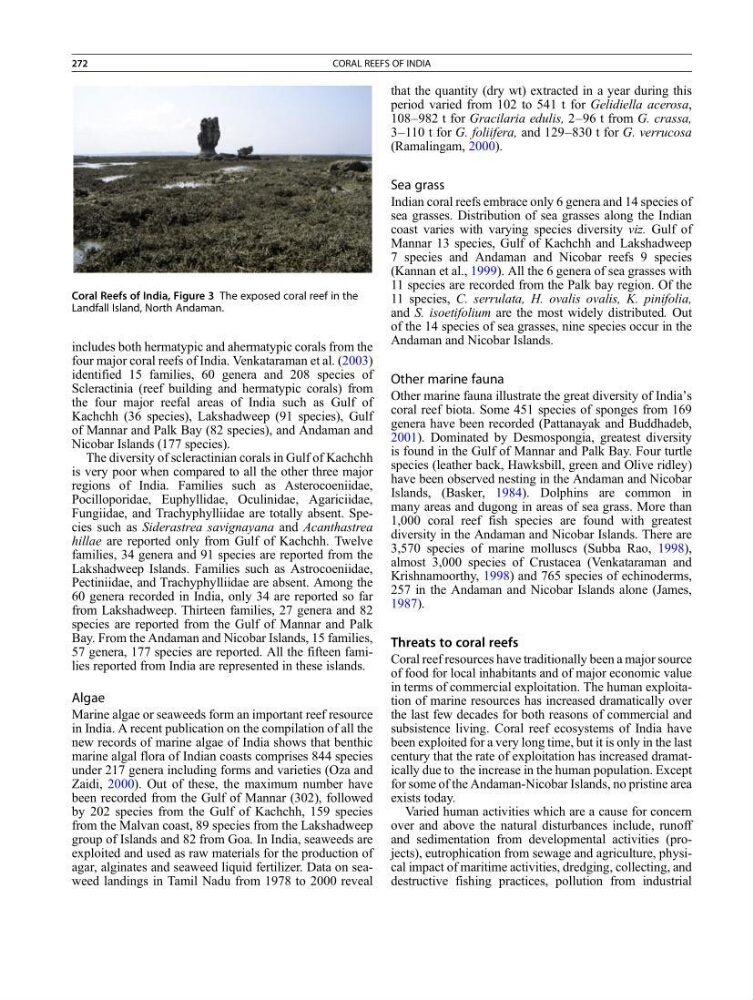
Coral Reefs of India, Figure 3 The exposed coral reef in the
Landfall Island, North Andaman.
272
CORAL REEFS OF INDIA
four major coral reefs of India. Venkataraman et al. (2003)
identified 15 families, 60 genera and 208 species of
Scleractinia (reef building and hermatypic corals) from
the four major reefal areas of India such as Gulf of
Kachchh (36 species), Lakshadweep (91 species), Gulf
of Mannar and Palk Bay (82 species), and Andaman and
Nicobar Islands (177 species).
The diversity of scleractinian corals in Gulf of Kachchh
is very poor when compared to all the other three major
regions of India. Families such as Asterocoeniidae,
Pocilloporidae, Euphyllidae, Oculinidae, Agariciidae,
Fungiidae, and Trachyphylliidae are totally absent. Species such as Siderastrea savignayana and Acanthastrea
hillae are reported only from Gulf of Kachchh. Twelve
families, 34 genera and 91 species are reported from the
Lakshadweep Islands. Families such as Astrocoeniidae,
Pectiniidae, and Trachyphylliidae are absent. Among the
60 genera recorded in India, only 34 are reported so far
from Lakshadweep. Thirteen families, 27 genera and 82
species are reported from the Gulf of Mannar and Palk
Bay. From the Andaman and Nicobar Islands, 15 families,
57 genera, 177 species are reported. All the fifteen families reported from India are represented in these islands.
Algae
Marine algae or seaweeds form an important reef resource
in India. A recent publication on the compilation of all the
new records of marine algae of India shows that benthic
marine algal flora of Indian coasts comprises 844 species
under 217 genera including forms and varieties (Oza and
Zaidi, 2000). Out of these, the maximum number have
been recorded from the Gulf of Mannar (302), followed
by 202 species from the Gulf of Kachchh, 159 species
from the Malvan coast, 89 species from the Lakshadweep
group of Islands and 82 from Goa. In India, seaweeds are
exploited and used as raw materials for the production of
agar, alginates and seaweed liquid fertilizer. Data on seaweed landings in Tamil Nadu from 1978 to 2000 reveal
that the quantity (dry wt) extracted in a year during this
period varied from 102 to 541 t for Gelidiella acerosa,
108–982 t for Gracilaria edulis, 2–96 t from G. crassa,
3–110 t for G. foliifera, and 129–830 t for G. verrucosa
(Ramalingam, 2000).
Sea grass
Indian coral reefs embrace only 6 genera and 14 species of
sea grasses. Distribution of sea grasses along the Indian
coast varies with varying species diversity viz. Gulf of
Mannar 13 species, Gulf of Kachchh and Lakshadweep
7 species and Andaman and Nicobar reefs 9 species
(Kannan et al., 1999). All the 6 genera of sea grasses with
11 species are recorded from the Palk bay region. Of the
11 species, C. serrulata, H. ovalis ovalis, K. pinifolia,
and S. isoetifolium are the most widely distributed. Out
of the 14 species of sea grasses, nine species occur in the
Andaman and Nicobar Islands.
Other marine fauna
Other marine fauna illustrate the great diversity of India’s
coral reef biota. Some 451 species of sponges from 169
genera have been recorded (Pattanayak and Buddhadeb,
2001). Dominated by Desmospongia, greatest diversity
is found in the Gulf of Mannar and Palk Bay. Four turtle
species (leather back, Hawksbill, green and Olive ridley)
have been observed nesting in the Andaman and Nicobar
Islands, (Basker, 1984). Dolphins are common in
many areas and dugong in areas of sea grass. More than
1,000 coral reef fish species are found with greatest
diversity in the Andaman and Nicobar Islands. There are
3,570 species of marine molluscs (Subba Rao, 1998),
almost 3,000 species of Crustacea (Venkataraman and
Krishnamoorthy, 1998) and 765 species of echinoderms,
257 in the Andaman and Nicobar Islands alone (James,
1987).
Threats to coral reefs
Coral reef resources have traditionally been a major source
of food for local inhabitants and of major economic value
in terms of commercial exploitation. The human exploitation of marine resources has increased dramatically over
the last few decades for both reasons of commercial and
subsistence living. Coral reef ecosystems of India have
been exploited for a very long time, but it is only in the last
century that the rate of exploitation has increased dramatically due to the increase in the human population. Except
for some of the Andaman-Nicobar Islands, no pristine area
exists today.
Varied human activities which are a cause for concern
over and above the natural disturbances include, runoff
and sedimentation from developmental activities (projects), eutrophication from sewage and agriculture, physical impact of maritime activities, dredging, collecting, and
destructive fishing practices, pollution from industrial
Coral Reefs of India, Figure 3 The exposed coral reef in the
Landfall Island, North Andaman.
272
CORAL REEFS OF INDIA