

the earthquake but also by the tsunami surge. A subsidence of 1–2 m affected the Nicobar Islands with the maximum down-throw at Indira Point near Great Nicobar. Out
of the total area of the Nancowry group of islands, 15.64%
of the area has undergone major changes. Nearly 6.8% of
the area is submerged and 8.9% of area damaged. Maximum change (more than 42%) has been observed in Trinket Island. More than 23% of Katchall and 9% of Camorta
and Nancowri and Tarasa groups have undergone major
changes. This resulted in a rise in sea-level, inundating
the coastal settlements and narrowing the beaches of the
islands. Measurements made at Aerial Bay (Diglipur)
and Rangat revealed retreat of sea level to the extent of
1.3 m at Campbell Bay, 1.0 m at Chattam Island, 0.8–
1.0 m in Aerial Bay and 0.4–0.6 m at Rangat. Land surveys at Diglipur and Mayabunder jetties (North Andaman)
confirm a vertical uplift of the land up to 1.2 m from the
pre-earthquake levels; exposed piles of the jetties, coral
reefs and the receded waterline at these jetties stand as testimony to this change (Figure 3).
The coral reefs of Andaman and Nicobar Islands have
been damaged by the impact of the recent tsunami and physical removal of other coral reef associated flora and fauna.
The tsunami waves increased the sediment load which has
smothered and killed sediment sensitive corals and sea
grasses. There is significant contamination of coral reefs
and coastal waters by run-off from the land, with large quantities of waste and pollutants, debris, soil, and organic matter.
Nesting beaches for the five species of globally threatened
marine turtles in the Andaman and Nicobar Islands and on
the east coast of India have also been damaged.
Coral reef associated biodiversity
Scleractinian corals
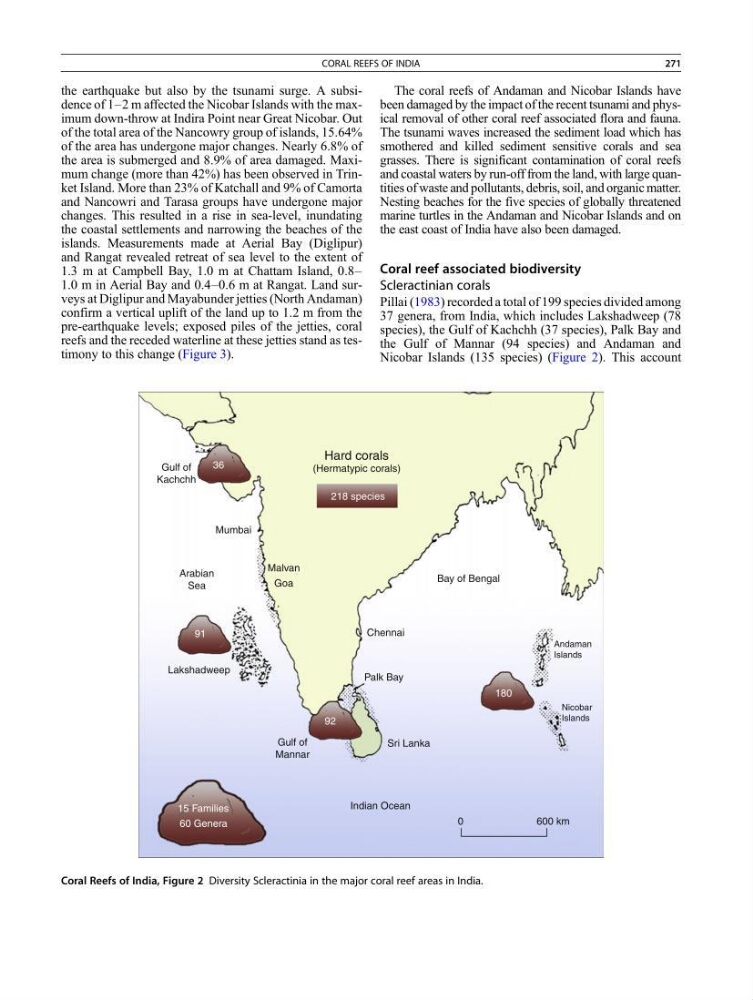
Pillai (1983) recorded a total of 199 species divided among
37 genera, from India, which includes Lakshadweep (78
species), the Gulf of Kachchh (37 species), Palk Bay and
the Gulf of Mannar (94 species) and Andaman and
Nicobar Islands (135 species) (Figure 2). This account
Gulf of
Mannar
Lakshadweep
Arabian
Sea
Gulf of
Kachchh
Indian Ocean
0
600 km
Nicobar
Islands
Andaman
Islands
Bay of Bengal
218 species
Hard corals
(Hermatypic corals)
Mumbai
Malvan
Goa
Chennai
Palk Bay
Sri Lanka
36
91
92
180
15 Families
60 Genera
Coral Reefs of India, Figure 2 Diversity Scleractinia in the major coral reef areas in India.
CORAL REEFS OF INDIA
271
of the total area of the Nancowry group of islands, 15.64%
of the area has undergone major changes. Nearly 6.8% of
the area is submerged and 8.9% of area damaged. Maximum change (more than 42%) has been observed in Trinket Island. More than 23% of Katchall and 9% of Camorta
and Nancowri and Tarasa groups have undergone major
changes. This resulted in a rise in sea-level, inundating
the coastal settlements and narrowing the beaches of the
islands. Measurements made at Aerial Bay (Diglipur)
and Rangat revealed retreat of sea level to the extent of
1.3 m at Campbell Bay, 1.0 m at Chattam Island, 0.8–
1.0 m in Aerial Bay and 0.4–0.6 m at Rangat. Land surveys at Diglipur and Mayabunder jetties (North Andaman)
confirm a vertical uplift of the land up to 1.2 m from the
pre-earthquake levels; exposed piles of the jetties, coral
reefs and the receded waterline at these jetties stand as testimony to this change (Figure 3).
The coral reefs of Andaman and Nicobar Islands have
been damaged by the impact of the recent tsunami and physical removal of other coral reef associated flora and fauna.
The tsunami waves increased the sediment load which has
smothered and killed sediment sensitive corals and sea
grasses. There is significant contamination of coral reefs
and coastal waters by run-off from the land, with large quantities of waste and pollutants, debris, soil, and organic matter.
Nesting beaches for the five species of globally threatened
marine turtles in the Andaman and Nicobar Islands and on
the east coast of India have also been damaged.
Coral reef associated biodiversity
Scleractinian corals
Pillai (1983) recorded a total of 199 species divided among
37 genera, from India, which includes Lakshadweep (78
species), the Gulf of Kachchh (37 species), Palk Bay and
the Gulf of Mannar (94 species) and Andaman and
Nicobar Islands (135 species) (Figure 2). This account
Gulf of
Mannar
Lakshadweep
Arabian
Sea
Gulf of
Kachchh
Indian Ocean
0
600 km
Nicobar
Islands
Andaman
Islands
Bay of Bengal
218 species
Hard corals
(Hermatypic corals)
Mumbai
Malvan
Goa
Chennai
Palk Bay
Sri Lanka
36
91
92
180
15 Families
60 Genera
Coral Reefs of India, Figure 2 Diversity Scleractinia in the major coral reef areas in India.
CORAL REEFS OF INDIA
271