

sediment to the cay during this period of change
declining significantly. This may be due to
a reduction in the ability of waves to transport sediment to a focal point (see Climate Change: Impact of
Sea Level Rise on Reef Flat Zonation and Productivity) or to the stabilizing effect of reef flat sea grass or
macroalgae (e.g., at Green Island GBR where eutrophication in the 1950s and 1960s caused an expansion
of sea grass on the adjacent reef flat which prevented
delivery of sand to the cay, see Hopley, 1982, pp.
333–335. Erosion of the cay has taken place
subsequently).
(g) Platform height. A fall in relative sea level since a cay
first formed (due to hydroisostatic or other causes) can
leave a cay “perched” on its reef flat. The effect is to
greatly reduce the power of waves to deliver sediment
which is now limited to only a small part of the tidal
cycle. An erosional phase may result though a rise in
sea level may have the opposite effect (see Climate
Change: Impact of Sea Level Rise on Reef Flat Zonation and Productivity). Kench and Brander (2006)
give some Australian examples.
(h) Meteorological conditions. Cay location and morphology are strongly influenced by ambient weather
conditions including storms which occur on
a regular basis, producing short-term cycles of erosion
and aggradation. However, there are many examples
of changing wind strengths and direction causing longer term changes to reef islands as wave refraction
patterns across the reef flat are modified and the orientation of an island changes or its location is changed
so that it now loses sand over the reef edge (see
Hopley et al., 2007, Chapter 13.5.3).
Coral cay dynamics
Coral cays, composed of largely unconsolidated sediments, are classic natural systems in a state of dynamic
equilibrium. Any change to the cay formation process –
weather conditions, sediment budgets, reef morphology,
or ecology – will produce an immediate response in the
cay. Sediments are easily moved and high-energy events
such as storms or tsunami can produce major changes.
However, small but significant changes are constantly taking place, over single tidal cycles, seasonally, over periods
of years to decades in response to climate fluctuations, or
in response to high-energy events. Each of these time
scales is examined below with the majority of examples
coming from the GBR where many islands of all types
have been the subject of monitoring programs and
a comparative study of all 300 islands within the Marine
Park has been undertaken (Aston, 1995).
(a) Tidal cycle changes
Hopley (1981, 1982) measured beach profiles around
islands and sediment movement on the adjacent reef
flat using sediment traps (Hopley, 1981) at three
contrasting sites on the GBR over periods of high
spring tides of up to 5 days. The sites were at Wheeler
cay (a small unvegetated sand cay) (Figure 3a), Bushy
Island (a maturely vegetated cay with Pisonia forest)
(Figure 3c), and Three Isles cay (the leeward vegetated sand cay of a major low wooded island). Results
were much as expected, with the largest changes to the
beach and greatest sediment movement on the adjacent reef at unvegetated Wheeler Reef and smallest
at the partially protected low wooded island site of
Three Isles cay (Table 2).
(b) Seasonal changes
Monsoonal climates produce significant changes to
coral cays. This is illustrated by Coconut (Poruma)
Island in Torres Strait, a narrow island of about
40 ha (Figure 8). Bi-monthly surveys at 21 sites in
1996–1997 recorded great mobility in the terminal
spits with an annual pattern of erosion during the summer north-westerly monsoon, but with a return of
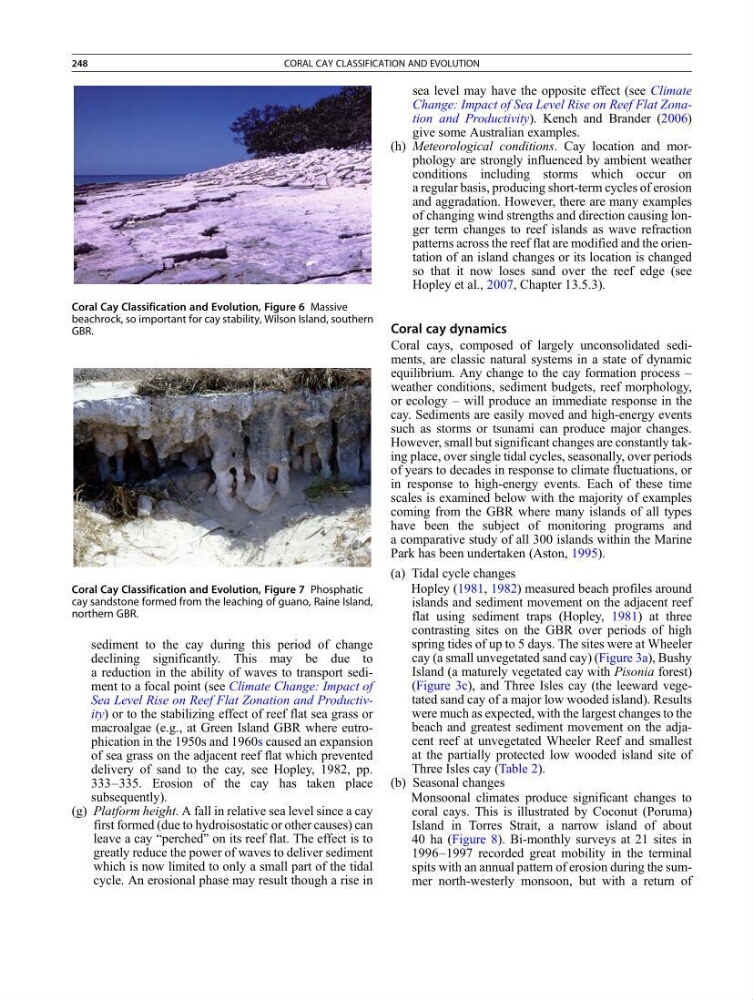
Coral Cay Classification and Evolution, Figure 6 Massive
beachrock, so important for cay stability, Wilson Island, southern
GBR.
Coral Cay Classification and Evolution, Figure 7 Phosphatic
cay sandstone formed from the leaching of guano, Raine Island,
northern GBR.
248
CORAL CAY CLASSIFICATION AND EVOLUTION
declining significantly. This may be due to
a reduction in the ability of waves to transport sediment to a focal point (see Climate Change: Impact of
Sea Level Rise on Reef Flat Zonation and Productivity) or to the stabilizing effect of reef flat sea grass or
macroalgae (e.g., at Green Island GBR where eutrophication in the 1950s and 1960s caused an expansion
of sea grass on the adjacent reef flat which prevented
delivery of sand to the cay, see Hopley, 1982, pp.
333–335. Erosion of the cay has taken place
subsequently).
(g) Platform height. A fall in relative sea level since a cay
first formed (due to hydroisostatic or other causes) can
leave a cay “perched” on its reef flat. The effect is to
greatly reduce the power of waves to deliver sediment
which is now limited to only a small part of the tidal
cycle. An erosional phase may result though a rise in
sea level may have the opposite effect (see Climate
Change: Impact of Sea Level Rise on Reef Flat Zonation and Productivity). Kench and Brander (2006)
give some Australian examples.
(h) Meteorological conditions. Cay location and morphology are strongly influenced by ambient weather
conditions including storms which occur on
a regular basis, producing short-term cycles of erosion
and aggradation. However, there are many examples
of changing wind strengths and direction causing longer term changes to reef islands as wave refraction
patterns across the reef flat are modified and the orientation of an island changes or its location is changed
so that it now loses sand over the reef edge (see
Hopley et al., 2007, Chapter 13.5.3).
Coral cay dynamics
Coral cays, composed of largely unconsolidated sediments, are classic natural systems in a state of dynamic
equilibrium. Any change to the cay formation process –
weather conditions, sediment budgets, reef morphology,
or ecology – will produce an immediate response in the
cay. Sediments are easily moved and high-energy events
such as storms or tsunami can produce major changes.
However, small but significant changes are constantly taking place, over single tidal cycles, seasonally, over periods
of years to decades in response to climate fluctuations, or
in response to high-energy events. Each of these time
scales is examined below with the majority of examples
coming from the GBR where many islands of all types
have been the subject of monitoring programs and
a comparative study of all 300 islands within the Marine
Park has been undertaken (Aston, 1995).
(a) Tidal cycle changes
Hopley (1981, 1982) measured beach profiles around
islands and sediment movement on the adjacent reef
flat using sediment traps (Hopley, 1981) at three
contrasting sites on the GBR over periods of high
spring tides of up to 5 days. The sites were at Wheeler
cay (a small unvegetated sand cay) (Figure 3a), Bushy
Island (a maturely vegetated cay with Pisonia forest)
(Figure 3c), and Three Isles cay (the leeward vegetated sand cay of a major low wooded island). Results
were much as expected, with the largest changes to the
beach and greatest sediment movement on the adjacent reef at unvegetated Wheeler Reef and smallest
at the partially protected low wooded island site of
Three Isles cay (Table 2).
(b) Seasonal changes
Monsoonal climates produce significant changes to
coral cays. This is illustrated by Coconut (Poruma)
Island in Torres Strait, a narrow island of about
40 ha (Figure 8). Bi-monthly surveys at 21 sites in
1996–1997 recorded great mobility in the terminal
spits with an annual pattern of erosion during the summer north-westerly monsoon, but with a return of
Coral Cay Classification and Evolution, Figure 6 Massive
beachrock, so important for cay stability, Wilson Island, southern
GBR.
Coral Cay Classification and Evolution, Figure 7 Phosphatic
cay sandstone formed from the leaching of guano, Raine Island,
northern GBR.
248
CORAL CAY CLASSIFICATION AND EVOLUTION