

the presence of phosphatic cay sandstone (Figure 7) is
indicative of mature vegetation and is an obvious source
of nutrients for the higher plants (see Phosphatic Cay
Sandstone).
The origin of the vegetation on islands that may be hundreds or even thousands of kilometers from continents or
other coral islands and the structured similarity of the
cay vegetation worldwide were enigmatic to early
explorers and naturalists. However, it soon became apparent that the seeds of many of the plants float and reach
remote shores via ocean currents. Other seeds are ingested
by birds and excreted on the island, or attached to plumage, sometimes causing the mortality of the bird. In both
cases, the seeds are deposited with an organic fertilizer.
More recently, exotic plants have been brought to islands
by early settlers (e.g., Polynesian voyagers) and in some
instances became dominant over the original preexisting
vegetation. However, the harsh environment of coral cays
with strong environmental influences such as climate,
water availability, soil, and nutrient limitations enforces
pantropical controls on the success or otherwise of cay
plants and is the ultimate reason for the structural similarity of coral cay vegetation worldwide.
Physiognomic similarities conceal what is a very complex flora. For example, atolls thousands of kilometers
into the Pacific and Indian Oceans have plant lists ranging
up to almost 300 species [Table 1; e.g., Kiribati, 290 species (Thaman, 1987)], even though nearly all coral cays
and low reef islands are less than 6,000 years old. Also
in spite of the isolation of many reef islands, they have
very few endemic plants. The number of plant species is
dependent on:
(a) Island size (even for isolated atoll motus, this is an
important factor)
(b) Remoteness from other islands or most importantly
continental land masses
(c) The period of human occupation (and introduction of
exotics)
(d) The frequency of disturbances which can range from
natural events such as cyclones or tsunamis to human
disruptions for coconut plantations or nuclear weapon
testing
Dispersal distance from other land masses may not be
based on present geography, but instead could reflect land
configuration and the distribution of island “stepping
stones” present during glacial low sea levels. For example,
on the northern GBR at the maximum of the last glacial the
whole continental shelf was dry and mainland carbonate
dominated shorelines would have stretched, for example,
across the Gulf of Papua allowing the retention of a wide
range of plants currently found on the cays. Present day
reefs that are further off shore would, at that time, have
been high limestone islands and whilst, for a short period,
they may have been little or no land in the form of islands
on the continental shelf, as reefs were initially drowned by
the post glacial sea level (see Holocene High Energy
Window), the nearby mainland would have been a permanent source of floating seeds carried out to the offshore
evolving cays. Today, the islands of this area have 380
species of plants (Fosberg and Stoddart, 1991). In contrast, the reefs and islands of the southern GBR would
have remained isolated from continental Australia, even
at the maximum low sea-level stage. Today, these islands
(the Bunker-Capricorn Group) support only 80 species,
between 22 and 40 on individual islands (Stoddart and
Fosberg, 1991).
The range of substrate types is also important in determining the number of species present on an island. Sand
and shingle substrates have contrasting species lists but
these are expanded if different types of cemented substrate
such as conglomerate or phosphatic cay sandstone occur.
This was one of the conclusions of Sauer (1982) in his
comprehensive review of vegetation on the Cayman
Islands with a focus on the unconsolidated carbonate sediments, the vegetation of which is equivalent to that of
Caribbean cays. His conclusions are applicable across
other Atlantic and Indo-Pacific reef islands.
Sauer noted the importance of introduced species that
can contribute 50% of cay flora (Table 1). Indigenous
cay flora have very poor defensive mechanisms and are
easily displaced. For example, on Mopelia atoll in the
Society Islands, 50 of 85 species are introductions (Sachet,
1983). However, introduced species, unless cultivated,
can also quickly disappear. During World War II, 129 species were introduced to Canton atoll, but by 1973 only 14
persisted. Sauer also examined the distribution of coral
island plants, noting that while endemics were few, the
flora of Atlantic islands had many commonalities as did
that of the Indo-Pacific. There is also a distinctive pantropical element. The best known of these is the coconut tree,
Cocos nucifera, but away from its source area of Southeast Asia, it is an introduction on most islands. Pantropical
species are mostly dispersed as float seeds with the ability
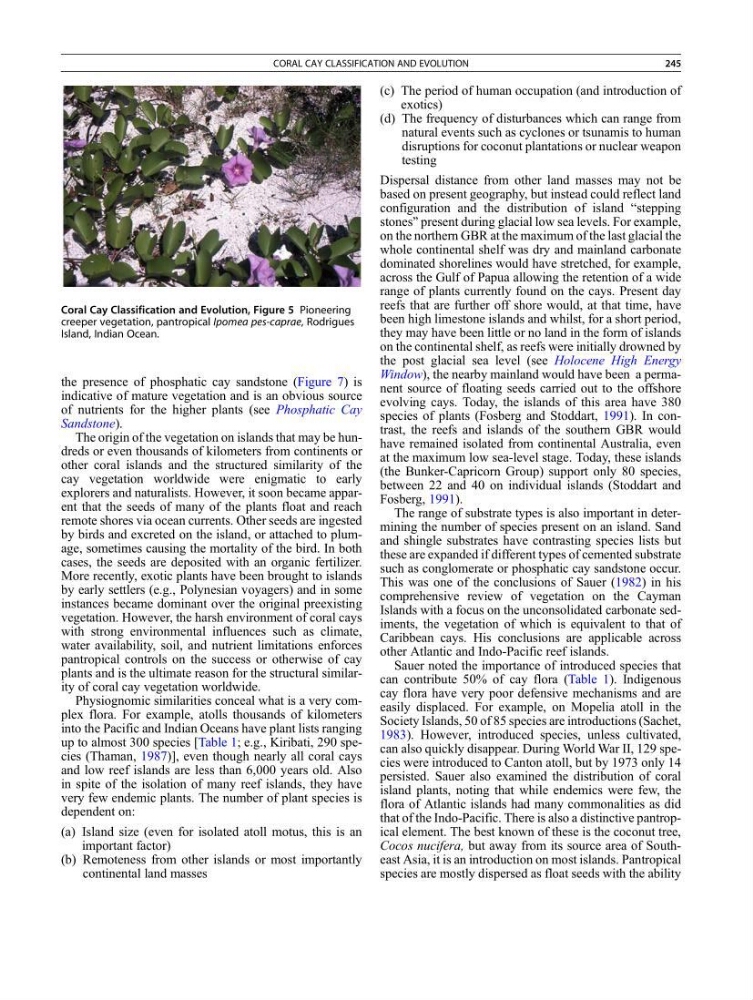
Coral Cay Classification and Evolution, Figure 5 Pioneering
creeper vegetation, pantropical Ipomea pes-caprae, Rodrigues
Island, Indian Ocean.
CORAL CAY CLASSIFICATION AND EVOLUTION
245
indicative of mature vegetation and is an obvious source
of nutrients for the higher plants (see Phosphatic Cay
Sandstone).
The origin of the vegetation on islands that may be hundreds or even thousands of kilometers from continents or
other coral islands and the structured similarity of the
cay vegetation worldwide were enigmatic to early
explorers and naturalists. However, it soon became apparent that the seeds of many of the plants float and reach
remote shores via ocean currents. Other seeds are ingested
by birds and excreted on the island, or attached to plumage, sometimes causing the mortality of the bird. In both
cases, the seeds are deposited with an organic fertilizer.
More recently, exotic plants have been brought to islands
by early settlers (e.g., Polynesian voyagers) and in some
instances became dominant over the original preexisting
vegetation. However, the harsh environment of coral cays
with strong environmental influences such as climate,
water availability, soil, and nutrient limitations enforces
pantropical controls on the success or otherwise of cay
plants and is the ultimate reason for the structural similarity of coral cay vegetation worldwide.
Physiognomic similarities conceal what is a very complex flora. For example, atolls thousands of kilometers
into the Pacific and Indian Oceans have plant lists ranging
up to almost 300 species [Table 1; e.g., Kiribati, 290 species (Thaman, 1987)], even though nearly all coral cays
and low reef islands are less than 6,000 years old. Also
in spite of the isolation of many reef islands, they have
very few endemic plants. The number of plant species is
dependent on:
(a) Island size (even for isolated atoll motus, this is an
important factor)
(b) Remoteness from other islands or most importantly
continental land masses
(c) The period of human occupation (and introduction of
exotics)
(d) The frequency of disturbances which can range from
natural events such as cyclones or tsunamis to human
disruptions for coconut plantations or nuclear weapon
testing
Dispersal distance from other land masses may not be
based on present geography, but instead could reflect land
configuration and the distribution of island “stepping
stones” present during glacial low sea levels. For example,
on the northern GBR at the maximum of the last glacial the
whole continental shelf was dry and mainland carbonate
dominated shorelines would have stretched, for example,
across the Gulf of Papua allowing the retention of a wide
range of plants currently found on the cays. Present day
reefs that are further off shore would, at that time, have
been high limestone islands and whilst, for a short period,
they may have been little or no land in the form of islands
on the continental shelf, as reefs were initially drowned by
the post glacial sea level (see Holocene High Energy
Window), the nearby mainland would have been a permanent source of floating seeds carried out to the offshore
evolving cays. Today, the islands of this area have 380
species of plants (Fosberg and Stoddart, 1991). In contrast, the reefs and islands of the southern GBR would
have remained isolated from continental Australia, even
at the maximum low sea-level stage. Today, these islands
(the Bunker-Capricorn Group) support only 80 species,
between 22 and 40 on individual islands (Stoddart and
Fosberg, 1991).
The range of substrate types is also important in determining the number of species present on an island. Sand
and shingle substrates have contrasting species lists but
these are expanded if different types of cemented substrate
such as conglomerate or phosphatic cay sandstone occur.
This was one of the conclusions of Sauer (1982) in his
comprehensive review of vegetation on the Cayman
Islands with a focus on the unconsolidated carbonate sediments, the vegetation of which is equivalent to that of
Caribbean cays. His conclusions are applicable across
other Atlantic and Indo-Pacific reef islands.
Sauer noted the importance of introduced species that
can contribute 50% of cay flora (Table 1). Indigenous
cay flora have very poor defensive mechanisms and are
easily displaced. For example, on Mopelia atoll in the
Society Islands, 50 of 85 species are introductions (Sachet,
1983). However, introduced species, unless cultivated,
can also quickly disappear. During World War II, 129 species were introduced to Canton atoll, but by 1973 only 14
persisted. Sauer also examined the distribution of coral
island plants, noting that while endemics were few, the
flora of Atlantic islands had many commonalities as did
that of the Indo-Pacific. There is also a distinctive pantropical element. The best known of these is the coconut tree,
Cocos nucifera, but away from its source area of Southeast Asia, it is an introduction on most islands. Pantropical
species are mostly dispersed as float seeds with the ability
Coral Cay Classification and Evolution, Figure 5 Pioneering
creeper vegetation, pantropical Ipomea pes-caprae, Rodrigues
Island, Indian Ocean.
CORAL CAY CLASSIFICATION AND EVOLUTION
245