

a great proportion of the reef top, usually between 25 and
50% but up to as much as 75% (Stoddart et al., 1978a).
The majority of “classic” low wooded islands on the
GBR occur on relatively small planar reefs on the inner
shelf (e.g., Low Wooded Island – 87.9 ha), but they can
occur on larger reefs (e.g., West Hope Island – 315 ha)
(Stoddart et al., 1978a). Shingle ramparts that grade
upward from the reef flat and have steep leeward faces
are encountered at varying distances from the windward
margin. These ramparts frequently parallel the reef edge,
but shingle tongues may trail toward the reef interior
(see Shingle Ridges). Mangrove stands develop in the relatively protected area behind the shingle ramparts and
may eventually expand to cover much of the reef flat.
The degree of mangrove colonization was considered to
reflect the stage of island development by some workers
(Steers, 1937; Fairbridge and Teichert, 1947), but others
contend the degree of protection afforded by windward
structures is responsible (Stoddart et al., 1978c; 1982).
Stoddart (1980) suggested that once the protection is
provided, the extent and rate of spread of reef top mangroves varies markedly between reefs, and the mangroves
are in fact opportunistic colonizers. Organic muds occur
beneath the mangroves on some islands but elsewhere
the mangroves grow over sandy reef flats. Fields of
emergent fossil microatolls document the higher midHolocene sea level and later regression experienced by
the planar reefs on which low wooded islands on the
GBR have formed (McLean et al., 1978; Chappell et al.,
1983) (see Mid-Holocene).
The leeward sandy cays are morphologically diverse.
Some are small, ephemeral, and unvegetated but larger
vegetated cays replete with terraced morphology also
occur (e.g., Ingram Island). The characteristic complexity
of low wooded islands ensures that they are
a heterogenous group. Stoddart et al. (1978a) distinguished four low wooded island types, low wooded island
with limited reef top mangroves and a separate sand cay
are most numerous. Low wooded island with reef top mangroves extending between windward shingle and leeward
sand cays are also common, with Bewick Island on the
northern GBR the type-example. “Turtle-type” low
wooded islands lack the central reef flat, with shingle
ramparts and conglomerates extending to the leeward cays
(Figure 1). They are generally restricted to small reef platforms (<60 ha) where they occupy a large proportion of
the reef flat. The final class described by Stoddart et al.
(1978a) includes those that could not be assigned to the
groups above. Hannah Island, a sand cay completely
encircled by mangroves, provides an example.
A chronology for reef flat formation and low wooded
island accretion on the GBR has been established by
radiocarbon dating (see Hopley et al., 2007 for summary).
The dates suggest that (1) many low wooded islands
formed under higher sea-level conditions prior to 3,000
years ago; (2) there is no consistent pattern in the timing
and order of shingle and sand cay development on different reefs; and (3) many low wooded islands were in place
or substantially developed by the mid-Holocene and exist
in similar form today, suggesting stability in the longer
term. However, comparison of the detailed maps of Low
Isles and Three Isles in 1928–1929 (Spender, 1930) with
those produced later show modifications to ramparts,
mangroves and cays, indicating that change may be constantly taking place (Stoddart et al., 1978b; Frank and Jell,
2006). Although the most detailed descriptions of these
islands come from the inner northern GBR, equivalents
occur in other reef provinces and include Salt and Pigeon
Cays in Jamaica, and the Snake Cays in Belize, where they
are referred to as “moat islands.”
Reef-island vegetation
Vegetation plays an important role in the evolution of
coral cays, being integral to all classification schemes,
and showing important changes through time (see Coral
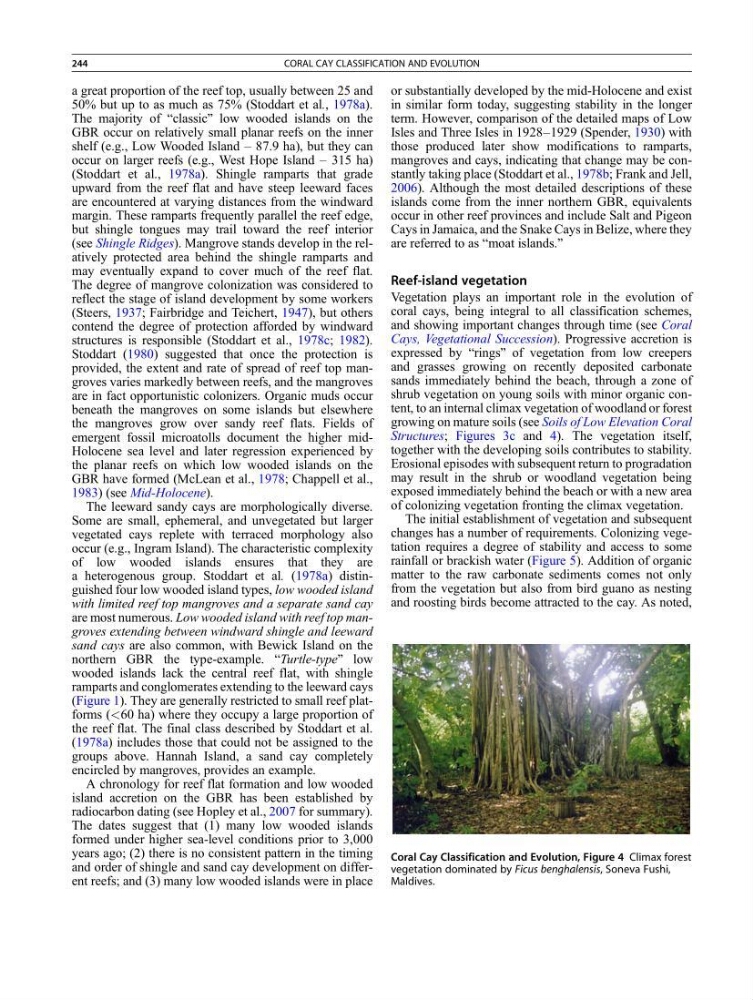
Cays, Vegetational Succession). Progressive accretion is
expressed by “rings” of vegetation from low creepers
and grasses growing on recently deposited carbonate
sands immediately behind the beach, through a zone of
shrub vegetation on young soils with minor organic content, to an internal climax vegetation of woodland or forest
growing on mature soils (see Soils of Low Elevation Coral
Structures; Figures 3c and 4). The vegetation itself,
together with the developing soils contributes to stability.
Erosional episodes with subsequent return to progradation
may result in the shrub or woodland vegetation being
exposed immediately behind the beach or with a new area
of colonizing vegetation fronting the climax vegetation.
The initial establishment of vegetation and subsequent
changes has a number of requirements. Colonizing vegetation requires a degree of stability and access to some
rainfall or brackish water (Figure 5). Addition of organic
matter to the raw carbonate sediments comes not only
from the vegetation but also from bird guano as nesting
and roosting birds become attracted to the cay. As noted,
Coral Cay Classification and Evolution, Figure 4 Climax forest
vegetation dominated by Ficus benghalensis, Soneva Fushi,
Maldives.
244
CORAL CAY CLASSIFICATION AND EVOLUTION
50% but up to as much as 75% (Stoddart et al., 1978a).
The majority of “classic” low wooded islands on the
GBR occur on relatively small planar reefs on the inner
shelf (e.g., Low Wooded Island – 87.9 ha), but they can
occur on larger reefs (e.g., West Hope Island – 315 ha)
(Stoddart et al., 1978a). Shingle ramparts that grade
upward from the reef flat and have steep leeward faces
are encountered at varying distances from the windward
margin. These ramparts frequently parallel the reef edge,
but shingle tongues may trail toward the reef interior
(see Shingle Ridges). Mangrove stands develop in the relatively protected area behind the shingle ramparts and
may eventually expand to cover much of the reef flat.
The degree of mangrove colonization was considered to
reflect the stage of island development by some workers
(Steers, 1937; Fairbridge and Teichert, 1947), but others
contend the degree of protection afforded by windward
structures is responsible (Stoddart et al., 1978c; 1982).
Stoddart (1980) suggested that once the protection is
provided, the extent and rate of spread of reef top mangroves varies markedly between reefs, and the mangroves
are in fact opportunistic colonizers. Organic muds occur
beneath the mangroves on some islands but elsewhere
the mangroves grow over sandy reef flats. Fields of
emergent fossil microatolls document the higher midHolocene sea level and later regression experienced by
the planar reefs on which low wooded islands on the
GBR have formed (McLean et al., 1978; Chappell et al.,
1983) (see Mid-Holocene).
The leeward sandy cays are morphologically diverse.
Some are small, ephemeral, and unvegetated but larger
vegetated cays replete with terraced morphology also
occur (e.g., Ingram Island). The characteristic complexity
of low wooded islands ensures that they are
a heterogenous group. Stoddart et al. (1978a) distinguished four low wooded island types, low wooded island
with limited reef top mangroves and a separate sand cay
are most numerous. Low wooded island with reef top mangroves extending between windward shingle and leeward
sand cays are also common, with Bewick Island on the
northern GBR the type-example. “Turtle-type” low
wooded islands lack the central reef flat, with shingle
ramparts and conglomerates extending to the leeward cays
(Figure 1). They are generally restricted to small reef platforms (<60 ha) where they occupy a large proportion of
the reef flat. The final class described by Stoddart et al.
(1978a) includes those that could not be assigned to the
groups above. Hannah Island, a sand cay completely
encircled by mangroves, provides an example.
A chronology for reef flat formation and low wooded
island accretion on the GBR has been established by
radiocarbon dating (see Hopley et al., 2007 for summary).
The dates suggest that (1) many low wooded islands
formed under higher sea-level conditions prior to 3,000
years ago; (2) there is no consistent pattern in the timing
and order of shingle and sand cay development on different reefs; and (3) many low wooded islands were in place
or substantially developed by the mid-Holocene and exist
in similar form today, suggesting stability in the longer
term. However, comparison of the detailed maps of Low
Isles and Three Isles in 1928–1929 (Spender, 1930) with
those produced later show modifications to ramparts,
mangroves and cays, indicating that change may be constantly taking place (Stoddart et al., 1978b; Frank and Jell,
2006). Although the most detailed descriptions of these
islands come from the inner northern GBR, equivalents
occur in other reef provinces and include Salt and Pigeon
Cays in Jamaica, and the Snake Cays in Belize, where they
are referred to as “moat islands.”
Reef-island vegetation
Vegetation plays an important role in the evolution of
coral cays, being integral to all classification schemes,
and showing important changes through time (see Coral
Cays, Vegetational Succession). Progressive accretion is
expressed by “rings” of vegetation from low creepers
and grasses growing on recently deposited carbonate
sands immediately behind the beach, through a zone of
shrub vegetation on young soils with minor organic content, to an internal climax vegetation of woodland or forest
growing on mature soils (see Soils of Low Elevation Coral
Structures; Figures 3c and 4). The vegetation itself,
together with the developing soils contributes to stability.
Erosional episodes with subsequent return to progradation
may result in the shrub or woodland vegetation being
exposed immediately behind the beach or with a new area
of colonizing vegetation fronting the climax vegetation.
The initial establishment of vegetation and subsequent
changes has a number of requirements. Colonizing vegetation requires a degree of stability and access to some
rainfall or brackish water (Figure 5). Addition of organic
matter to the raw carbonate sediments comes not only
from the vegetation but also from bird guano as nesting
and roosting birds become attracted to the cay. As noted,
Coral Cay Classification and Evolution, Figure 4 Climax forest
vegetation dominated by Ficus benghalensis, Soneva Fushi,
Maldives.
244
CORAL CAY CLASSIFICATION AND EVOLUTION