

one season and sand during the other (e.g., this process
accounts for mixed sand and shingle cays in Torres Strait).
Alternatively, shingle may be deposited during storms,
with sand deposition during regular weather conditions.
The latter mode appears to explain the sediment pattern
of Lady Musgrave Island on the southern GBR. There,
shingle ridges have been episodically deposited by storm
waves, with sand accumulating around the margins during
normal trade wind weather. Mixed cays also develop where
the character of sediments produced on the reef or delivered
to the focal point of accumulation change through time, as
may occur when reef geometry is modified or changing
a
c
b
d
e
f
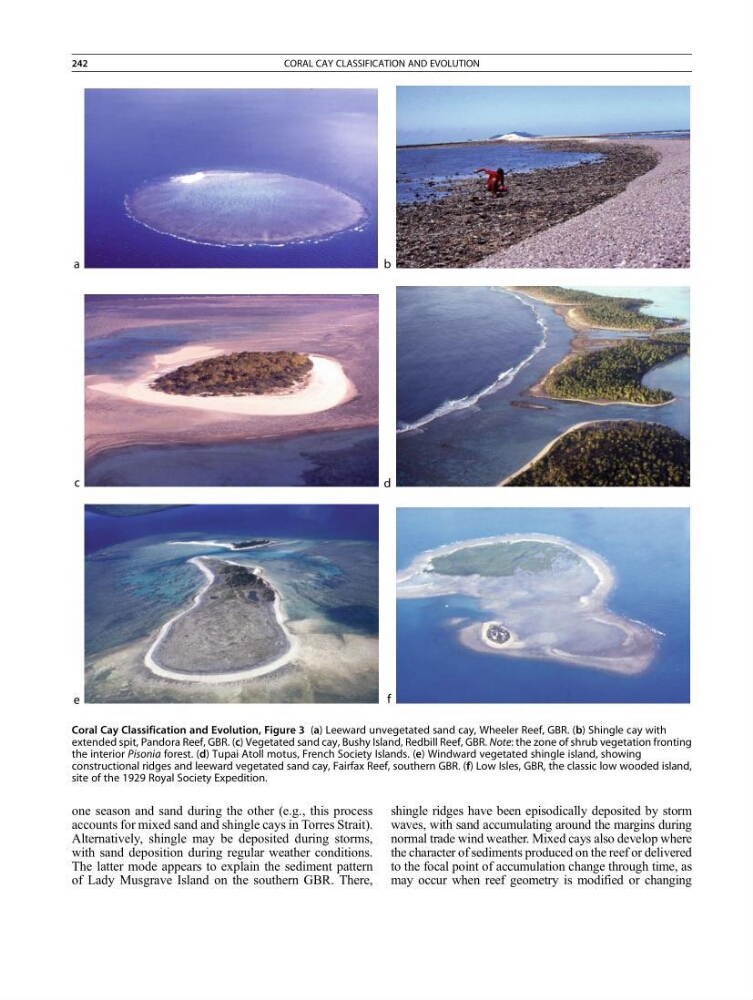
Coral Cay Classification and Evolution, Figure 3 (a) Leeward unvegetated sand cay, Wheeler Reef, GBR. (b) Shingle cay with
extended spit, Pandora Reef, GBR. (c) Vegetated sand cay, Bushy Island, Redbill Reef, GBR. Note: the zone of shrub vegetation fronting
the interior Pisonia forest. (d) Tupai Atoll motus, French Society Islands. (e) Windward vegetated shingle island, showing
constructional ridges and leeward vegetated sand cay, Fairfax Reef, southern GBR. (f) Low Isles, GBR, the classic low wooded island,
site of the 1929 Royal Society Expedition.
242
CORAL CAY CLASSIFICATION AND EVOLUTION
accounts for mixed sand and shingle cays in Torres Strait).
Alternatively, shingle may be deposited during storms,
with sand deposition during regular weather conditions.
The latter mode appears to explain the sediment pattern
of Lady Musgrave Island on the southern GBR. There,
shingle ridges have been episodically deposited by storm
waves, with sand accumulating around the margins during
normal trade wind weather. Mixed cays also develop where
the character of sediments produced on the reef or delivered
to the focal point of accumulation change through time, as
may occur when reef geometry is modified or changing
a
c
b
d
e
f
Coral Cay Classification and Evolution, Figure 3 (a) Leeward unvegetated sand cay, Wheeler Reef, GBR. (b) Shingle cay with
extended spit, Pandora Reef, GBR. (c) Vegetated sand cay, Bushy Island, Redbill Reef, GBR. Note: the zone of shrub vegetation fronting
the interior Pisonia forest. (d) Tupai Atoll motus, French Society Islands. (e) Windward vegetated shingle island, showing
constructional ridges and leeward vegetated sand cay, Fairfax Reef, southern GBR. (f) Low Isles, GBR, the classic low wooded island,
site of the 1929 Royal Society Expedition.
242
CORAL CAY CLASSIFICATION AND EVOLUTION