

high-energy storms and form as shingle ramparts coalesce.
Unvegetated shingle cays can remain reasonably intact
between storms, and cementation of basal sediments can
occur, forming bassett edges (cemented lower parts of
shingle ridges), which steeply dip away from the reef front
(see Bassett Edges). However, bassett edges preserved
after ramparts are eroded occur like outcrops of beach rock
on many reef flats, suggesting that unvegetated shingle
cays have also limited longevity (Hopley, 1982). Compact
unvegetated shingle cays are generally restricted to small
reefs, but vary from relatively mobile mounds of shingle
and rubble through to complex structures with some
degree of cementation.
Vegetated cays
Eventually some unvegetated cays achieve sufficient stability for vegetation to successfully establish and this vegetation may confer additional stability (see Section Reefisland vegetation). As for unvegetated cays, vegetated cay
sediments range from pure sand to shingle, and shapes
range from linear to compact (see Vegetated Cays).
Vegetated sand cays
Vegetated cays are usually more stable than unvegetated
cays, but can still change morphology and position. For
example, in the Caribbean, Hurricane Hattie in 1961
completely removed St. George’s East Cay that was
110-m long and 0.3 ha in size (Stoddart et al., 1982).
Hopley (1982) argued that compact vegetated cays
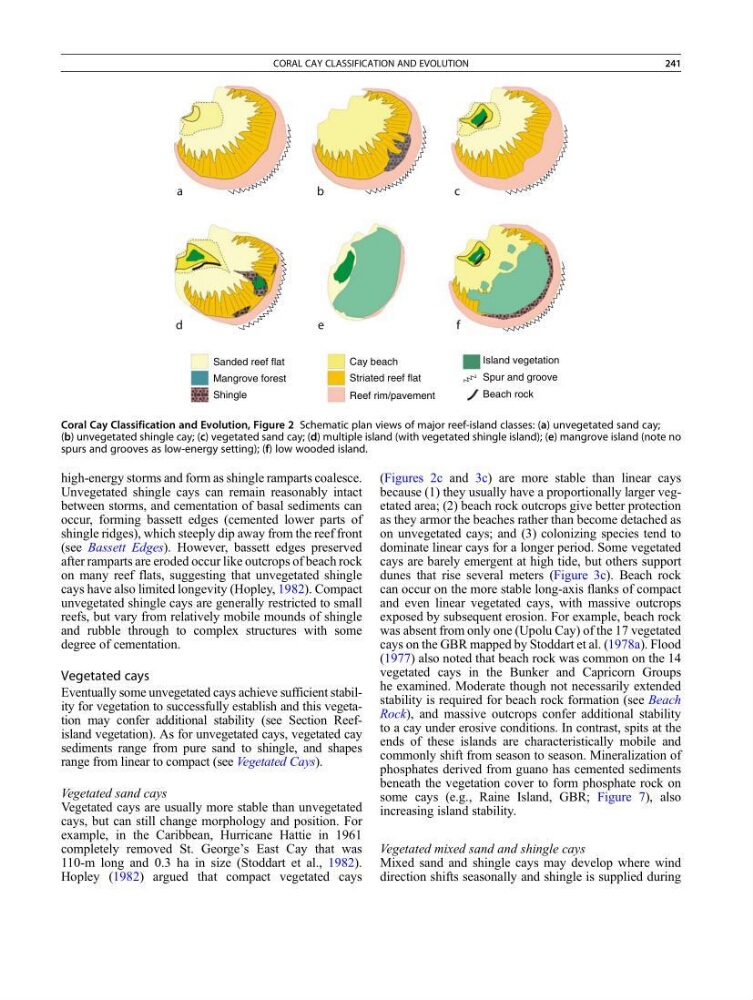
(Figures 2c and 3c) are more stable than linear cays
because (1) they usually have a proportionally larger vegetated area; (2) beach rock outcrops give better protection
as they armor the beaches rather than become detached as
on unvegetated cays; and (3) colonizing species tend to
dominate linear cays for a longer period. Some vegetated
cays are barely emergent at high tide, but others support
dunes that rise several meters (Figure 3c). Beach rock
can occur on the more stable long-axis flanks of compact
and even linear vegetated cays, with massive outcrops
exposed by subsequent erosion. For example, beach rock
was absent from only one (Upolu Cay) of the 17 vegetated
cays on the GBR mapped by Stoddart et al. (1978a). Flood
(1977) also noted that beach rock was common on the 14
vegetated cays in the Bunker and Capricorn Groups
he examined. Moderate though not necessarily extended
stability is required for beach rock formation (see Beach
Rock), and massive outcrops confer additional stability
to a cay under erosive conditions. In contrast, spits at the
ends of these islands are characteristically mobile and
commonly shift from season to season. Mineralization of
phosphates derived from guano has cemented sediments
beneath the vegetation cover to form phosphate rock on
some cays (e.g., Raine Island, GBR; Figure 7), also
increasing island stability.
Vegetated mixed sand and shingle cays
Mixed sand and shingle cays may develop where wind
direction shifts seasonally and shingle is supplied during
Sanded reef flat
Mangrove forest
Shingle
Cay beach
Striated reef flat
Reef rim/pavement
Island vegetation
Spur and groove
Beach rock
a
b
c
d
e
f
Coral Cay Classification and Evolution, Figure 2 Schematic plan views of major reef-island classes: (a) unvegetated sand cay;
(b) unvegetated shingle cay; (c) vegetated sand cay; (d) multiple island (with vegetated shingle island); (e) mangrove island (note no
spurs and grooves as low-energy setting); (f) low wooded island.
CORAL CAY CLASSIFICATION AND EVOLUTION
241
Unvegetated shingle cays can remain reasonably intact
between storms, and cementation of basal sediments can
occur, forming bassett edges (cemented lower parts of
shingle ridges), which steeply dip away from the reef front
(see Bassett Edges). However, bassett edges preserved
after ramparts are eroded occur like outcrops of beach rock
on many reef flats, suggesting that unvegetated shingle
cays have also limited longevity (Hopley, 1982). Compact
unvegetated shingle cays are generally restricted to small
reefs, but vary from relatively mobile mounds of shingle
and rubble through to complex structures with some
degree of cementation.
Vegetated cays
Eventually some unvegetated cays achieve sufficient stability for vegetation to successfully establish and this vegetation may confer additional stability (see Section Reefisland vegetation). As for unvegetated cays, vegetated cay
sediments range from pure sand to shingle, and shapes
range from linear to compact (see Vegetated Cays).
Vegetated sand cays
Vegetated cays are usually more stable than unvegetated
cays, but can still change morphology and position. For
example, in the Caribbean, Hurricane Hattie in 1961
completely removed St. George’s East Cay that was
110-m long and 0.3 ha in size (Stoddart et al., 1982).
Hopley (1982) argued that compact vegetated cays
(Figures 2c and 3c) are more stable than linear cays
because (1) they usually have a proportionally larger vegetated area; (2) beach rock outcrops give better protection
as they armor the beaches rather than become detached as
on unvegetated cays; and (3) colonizing species tend to
dominate linear cays for a longer period. Some vegetated
cays are barely emergent at high tide, but others support
dunes that rise several meters (Figure 3c). Beach rock
can occur on the more stable long-axis flanks of compact
and even linear vegetated cays, with massive outcrops
exposed by subsequent erosion. For example, beach rock
was absent from only one (Upolu Cay) of the 17 vegetated
cays on the GBR mapped by Stoddart et al. (1978a). Flood
(1977) also noted that beach rock was common on the 14
vegetated cays in the Bunker and Capricorn Groups
he examined. Moderate though not necessarily extended
stability is required for beach rock formation (see Beach
Rock), and massive outcrops confer additional stability
to a cay under erosive conditions. In contrast, spits at the
ends of these islands are characteristically mobile and
commonly shift from season to season. Mineralization of
phosphates derived from guano has cemented sediments
beneath the vegetation cover to form phosphate rock on
some cays (e.g., Raine Island, GBR; Figure 7), also
increasing island stability.
Vegetated mixed sand and shingle cays
Mixed sand and shingle cays may develop where wind
direction shifts seasonally and shingle is supplied during
Sanded reef flat
Mangrove forest
Shingle
Cay beach
Striated reef flat
Reef rim/pavement
Island vegetation
Spur and groove
Beach rock
a
b
c
d
e
f
Coral Cay Classification and Evolution, Figure 2 Schematic plan views of major reef-island classes: (a) unvegetated sand cay;
(b) unvegetated shingle cay; (c) vegetated sand cay; (d) multiple island (with vegetated shingle island); (e) mangrove island (note no
spurs and grooves as low-energy setting); (f) low wooded island.
CORAL CAY CLASSIFICATION AND EVOLUTION
241