

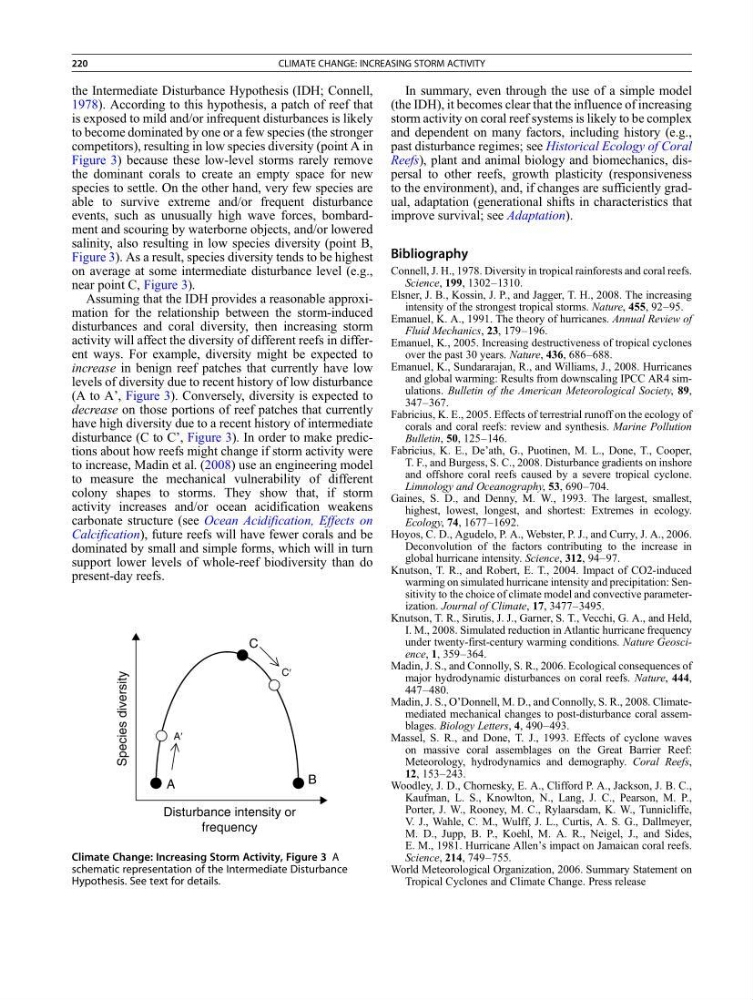
the Intermediate Disturbance Hypothesis (IDH; Connell,
1978). According to this hypothesis, a patch of reef that
is exposed to mild and/or infrequent disturbances is likely
to become dominated by one or a few species (the stronger
competitors), resulting in low species diversity (point A in
Figure 3) because these low-level storms rarely remove
the dominant corals to create an empty space for new
species to settle. On the other hand, very few species are
able to survive extreme and/or frequent disturbance
events, such as unusually high wave forces, bombardment and scouring by waterborne objects, and/or lowered
salinity, also resulting in low species diversity (point B,
Figure 3). As a result, species diversity tends to be highest
on average at some intermediate disturbance level (e.g.,
near point C, Figure 3).
Assuming that the IDH provides a reasonable approximation for the relationship between the storm-induced
disturbances and coral diversity, then increasing storm
activity will affect the diversity of different reefs in different ways. For example, diversity might be expected to
increase in benign reef patches that currently have low
levels of diversity due to recent history of low disturbance
(A to A’, Figure 3). Conversely, diversity is expected to
decrease on those portions of reef patches that currently
have high diversity due to a recent history of intermediate
disturbance (C to C’, Figure 3). In order to make predictions about how reefs might change if storm activity were
to increase, Madin et al. (2008) use an engineering model
to measure the mechanical vulnerability of different
colony shapes to storms. They show that, if storm
activity increases and/or ocean acidification weakens
carbonate structure (see Ocean Acidification, Effects on
Calcification), future reefs will have fewer corals and be
dominated by small and simple forms, which will in turn
support lower levels of whole-reef biodiversity than do
present-day reefs.
In summary, even through the use of a simple model
(the IDH), it becomes clear that the influence of increasing
storm activity on coral reef systems is likely to be complex
and dependent on many factors, including history (e.g.,
past disturbance regimes; see Historical Ecology of Coral
Reefs), plant and animal biology and biomechanics, dispersal to other reefs, growth plasticity (responsiveness
to the environment), and, if changes are sufficiently gradual, adaptation (generational shifts in characteristics that
improve survival; see Adaptation).
Bibliography
Connell, J. H., 1978. Diversity in tropical rainforests and coral reefs.
Science, 199, 1302–1310.
Elsner, J. B., Kossin, J. P., and Jagger, T. H., 2008. The increasing
intensity of the strongest tropical storms. Nature, 455, 92–95.
Emanuel, K. A., 1991. The theory of hurricanes. Annual Review of
Fluid Mechanics, 23, 179–196.
Emanuel, K., 2005. Increasing destructiveness of tropical cyclones
over the past 30 years. Nature, 436, 686–688.
Emanuel, K., Sundararajan, R., and Williams, J., 2008. Hurricanes
and global warming: Results from downscaling IPCC AR4 simulations. Bulletin of the American Meteorological Society, 89,
347–367.
Fabricius, K. E., 2005. Effects of terrestrial runoff on the ecology of
corals and coral reefs: review and synthesis. Marine Pollution
Bulletin, 50, 125–146.
Fabricius, K. E., De’ath, G., Puotinen, M. L., Done, T., Cooper,
T. F., and Burgess, S. C., 2008. Disturbance gradients on inshore
and offshore coral reefs caused by a severe tropical cyclone.
Limnology and Oceanography, 53, 690–704.
Gaines, S. D., and Denny, M. W., 1993. The largest, smallest,
highest, lowest, longest, and shortest: Extremes in ecology.
Ecology, 74, 1677–1692.
Hoyos, C. D., Agudelo, P. A., Webster, P. J., and Curry, J. A., 2006.
Deconvolution of the factors contributing to the increase in
global hurricane intensity. Science, 312, 94–97.
Knutson, T. R., and Robert, E. T., 2004. Impact of CO2-induced
warming on simulated hurricane intensity and precipitation: Sensitivity to the choice of climate model and convective parameterization. Journal of Climate, 17, 3477–3495.
Knutson, T. R., Sirutis, J. J., Garner, S. T., Vecchi, G. A., and Held,
I. M., 2008. Simulated reduction in Atlantic hurricane frequency
under twenty-first-century warming conditions. Nature Geoscience, 1, 359–364.
Madin, J. S., and Connolly, S. R., 2006. Ecological consequences of
major hydrodynamic disturbances on coral reefs. Nature, 444,
447–480.
Madin, J. S., O’Donnell, M. D., and Connolly, S. R., 2008. Climatemediated mechanical changes to post-disturbance coral assemblages. Biology Letters, 4, 490–493.
Massel, S. R., and Done, T. J., 1993. Effects of cyclone waves
on massive coral assemblages on the Great Barrier Reef:
Meteorology, hydrodynamics and demography. Coral Reefs,
12, 153–243.
Woodley, J. D., Chornesky, E. A., Clifford P. A., Jackson, J. B. C.,
Kaufman, L. S., Knowlton, N., Lang, J. C., Pearson, M. P.,
Porter, J. W., Rooney, M. C., Rylaarsdam, K. W., Tunnicliffe,
V. J., Wahle, C. M., Wulff, J. L., Curtis, A. S. G., Dallmeyer,
M. D., Jupp, B. P., Koehl, M. A. R., Neigel, J., and Sides,
E. M., 1981. Hurricane Allen’s impact on Jamaican coral reefs.
Science, 214, 749–755.
World Meteorological Organization, 2006. Summary Statement on
Tropical Cyclones and Climate Change. Press release
Climate Change: Increasing Storm Activity, Figure 3 A
schematic representation of the Intermediate Disturbance
Hypothesis. See text for details.
220
CLIMATE CHANGE: INCREASING STORM ACTIVITY
1978). According to this hypothesis, a patch of reef that
is exposed to mild and/or infrequent disturbances is likely
to become dominated by one or a few species (the stronger
competitors), resulting in low species diversity (point A in
Figure 3) because these low-level storms rarely remove
the dominant corals to create an empty space for new
species to settle. On the other hand, very few species are
able to survive extreme and/or frequent disturbance
events, such as unusually high wave forces, bombardment and scouring by waterborne objects, and/or lowered
salinity, also resulting in low species diversity (point B,
Figure 3). As a result, species diversity tends to be highest
on average at some intermediate disturbance level (e.g.,
near point C, Figure 3).
Assuming that the IDH provides a reasonable approximation for the relationship between the storm-induced
disturbances and coral diversity, then increasing storm
activity will affect the diversity of different reefs in different ways. For example, diversity might be expected to
increase in benign reef patches that currently have low
levels of diversity due to recent history of low disturbance
(A to A’, Figure 3). Conversely, diversity is expected to
decrease on those portions of reef patches that currently
have high diversity due to a recent history of intermediate
disturbance (C to C’, Figure 3). In order to make predictions about how reefs might change if storm activity were
to increase, Madin et al. (2008) use an engineering model
to measure the mechanical vulnerability of different
colony shapes to storms. They show that, if storm
activity increases and/or ocean acidification weakens
carbonate structure (see Ocean Acidification, Effects on
Calcification), future reefs will have fewer corals and be
dominated by small and simple forms, which will in turn
support lower levels of whole-reef biodiversity than do
present-day reefs.
In summary, even through the use of a simple model
(the IDH), it becomes clear that the influence of increasing
storm activity on coral reef systems is likely to be complex
and dependent on many factors, including history (e.g.,
past disturbance regimes; see Historical Ecology of Coral
Reefs), plant and animal biology and biomechanics, dispersal to other reefs, growth plasticity (responsiveness
to the environment), and, if changes are sufficiently gradual, adaptation (generational shifts in characteristics that
improve survival; see Adaptation).
Bibliography
Connell, J. H., 1978. Diversity in tropical rainforests and coral reefs.
Science, 199, 1302–1310.
Elsner, J. B., Kossin, J. P., and Jagger, T. H., 2008. The increasing
intensity of the strongest tropical storms. Nature, 455, 92–95.
Emanuel, K. A., 1991. The theory of hurricanes. Annual Review of
Fluid Mechanics, 23, 179–196.
Emanuel, K., 2005. Increasing destructiveness of tropical cyclones
over the past 30 years. Nature, 436, 686–688.
Emanuel, K., Sundararajan, R., and Williams, J., 2008. Hurricanes
and global warming: Results from downscaling IPCC AR4 simulations. Bulletin of the American Meteorological Society, 89,
347–367.
Fabricius, K. E., 2005. Effects of terrestrial runoff on the ecology of
corals and coral reefs: review and synthesis. Marine Pollution
Bulletin, 50, 125–146.
Fabricius, K. E., De’ath, G., Puotinen, M. L., Done, T., Cooper,
T. F., and Burgess, S. C., 2008. Disturbance gradients on inshore
and offshore coral reefs caused by a severe tropical cyclone.
Limnology and Oceanography, 53, 690–704.
Gaines, S. D., and Denny, M. W., 1993. The largest, smallest,
highest, lowest, longest, and shortest: Extremes in ecology.
Ecology, 74, 1677–1692.
Hoyos, C. D., Agudelo, P. A., Webster, P. J., and Curry, J. A., 2006.
Deconvolution of the factors contributing to the increase in
global hurricane intensity. Science, 312, 94–97.
Knutson, T. R., and Robert, E. T., 2004. Impact of CO2-induced
warming on simulated hurricane intensity and precipitation: Sensitivity to the choice of climate model and convective parameterization. Journal of Climate, 17, 3477–3495.
Knutson, T. R., Sirutis, J. J., Garner, S. T., Vecchi, G. A., and Held,
I. M., 2008. Simulated reduction in Atlantic hurricane frequency
under twenty-first-century warming conditions. Nature Geoscience, 1, 359–364.
Madin, J. S., and Connolly, S. R., 2006. Ecological consequences of
major hydrodynamic disturbances on coral reefs. Nature, 444,
447–480.
Madin, J. S., O’Donnell, M. D., and Connolly, S. R., 2008. Climatemediated mechanical changes to post-disturbance coral assemblages. Biology Letters, 4, 490–493.
Massel, S. R., and Done, T. J., 1993. Effects of cyclone waves
on massive coral assemblages on the Great Barrier Reef:
Meteorology, hydrodynamics and demography. Coral Reefs,
12, 153–243.
Woodley, J. D., Chornesky, E. A., Clifford P. A., Jackson, J. B. C.,
Kaufman, L. S., Knowlton, N., Lang, J. C., Pearson, M. P.,
Porter, J. W., Rooney, M. C., Rylaarsdam, K. W., Tunnicliffe,
V. J., Wahle, C. M., Wulff, J. L., Curtis, A. S. G., Dallmeyer,
M. D., Jupp, B. P., Koehl, M. A. R., Neigel, J., and Sides,
E. M., 1981. Hurricane Allen’s impact on Jamaican coral reefs.
Science, 214, 749–755.
World Meteorological Organization, 2006. Summary Statement on
Tropical Cyclones and Climate Change. Press release
Climate Change: Increasing Storm Activity, Figure 3 A
schematic representation of the Intermediate Disturbance
Hypothesis. See text for details.
220
CLIMATE CHANGE: INCREASING STORM ACTIVITY