

et al. (2008) show that, while there is no trend in frequency
nor the average maximum wind speed of yearly cyclones,
the upper quantiles of maximum wind speeds indeed
increase from year to year. That is, in each year a similar
number of tropical storms reach “cyclonic” status and
the maximum wind speeds generated by storms are similar
on average; however, the maximum winds speeds of the
largest storms are increasing. Simulations by Knutson
and Robert (2004) support this idea, finding that warming
induced by greenhouse gas entrapment may lead to
increasing occurrence of highly destructive category 5
storms. Furthermore, Hoyos et al. (2006) link the increasing trend in number of category 4 and 5 hurricanes for the
period 1970–2004 directly to the trend in sea surface temperatures. However, Emanuel et al. (2008) concludes in a
reanalysis of data from his 2005 study that the increase in
power dissipation in recent decades cannot be completely
attributed to global warming.
In summary, despite the growing evidence that the
distribution of tropical storm intensities per year has
stretched upward, the link between increasing storm activity and global warming remains unclear. The World Meteorological Organization (2006) state in a press release that
“though there is evidence both for and against the existence of a detectable anthropogenic signal in the tropical
cyclone climate record to date, no firm conclusion can
be made on this point” and that “no individual tropical
cyclone can be directly attributed to climate change.”
Conclusions: consequences for coral reefs
Storms have a number of direct and indirect effects on
coral reefs. Direct effects include mechanical damage
and sedimentation to corals and reef structures by waves,
storm surges, and currents, as well as lowered salinity by
torrential rainfall (Woodley et al., 1981; Massel and Done,
1993; Madin and Connolly, 2006; Fabricius et al., 2008).
Indirect effects include pollution and sedimentation
caused by terrestrial runoff (Fabricius, 2005). Storms also
have sub-lethal effects on the reef-building corals, such as
physiological stresses that can lead to decreased growth,
competitive ability, and reproduction as well as increased
susceptibility to disease and bleaching.
One way to conceptually illustrate the influence of increasing storm activity on coral reef biodiversity is via
Climate Change: Increasing Storm Activity, Figure 2 A
schematic of the general inverse relationship (bottom solid line)
between storm intensity and frequency, the two components of
storm activity. Increasing storm activity would result in the
relationship moving outwards (top solid line). See text for details.
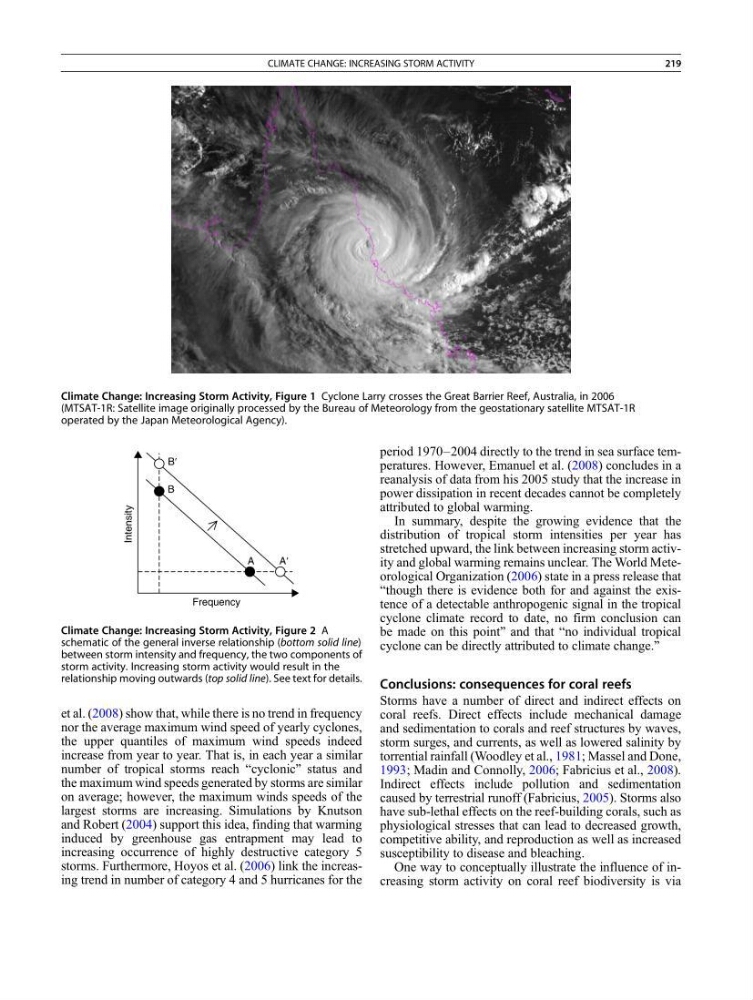
Climate Change: Increasing Storm Activity, Figure 1 Cyclone Larry crosses the Great Barrier Reef, Australia, in 2006
(MTSAT-1R: Satellite image originally processed by the Bureau of Meteorology from the geostationary satellite MTSAT-1R
operated by the Japan Meteorological Agency).
CLIMATE CHANGE: INCREASING STORM ACTIVITY
219
nor the average maximum wind speed of yearly cyclones,
the upper quantiles of maximum wind speeds indeed
increase from year to year. That is, in each year a similar
number of tropical storms reach “cyclonic” status and
the maximum wind speeds generated by storms are similar
on average; however, the maximum winds speeds of the
largest storms are increasing. Simulations by Knutson
and Robert (2004) support this idea, finding that warming
induced by greenhouse gas entrapment may lead to
increasing occurrence of highly destructive category 5
storms. Furthermore, Hoyos et al. (2006) link the increasing trend in number of category 4 and 5 hurricanes for the
period 1970–2004 directly to the trend in sea surface temperatures. However, Emanuel et al. (2008) concludes in a
reanalysis of data from his 2005 study that the increase in
power dissipation in recent decades cannot be completely
attributed to global warming.
In summary, despite the growing evidence that the
distribution of tropical storm intensities per year has
stretched upward, the link between increasing storm activity and global warming remains unclear. The World Meteorological Organization (2006) state in a press release that
“though there is evidence both for and against the existence of a detectable anthropogenic signal in the tropical
cyclone climate record to date, no firm conclusion can
be made on this point” and that “no individual tropical
cyclone can be directly attributed to climate change.”
Conclusions: consequences for coral reefs
Storms have a number of direct and indirect effects on
coral reefs. Direct effects include mechanical damage
and sedimentation to corals and reef structures by waves,
storm surges, and currents, as well as lowered salinity by
torrential rainfall (Woodley et al., 1981; Massel and Done,
1993; Madin and Connolly, 2006; Fabricius et al., 2008).
Indirect effects include pollution and sedimentation
caused by terrestrial runoff (Fabricius, 2005). Storms also
have sub-lethal effects on the reef-building corals, such as
physiological stresses that can lead to decreased growth,
competitive ability, and reproduction as well as increased
susceptibility to disease and bleaching.
One way to conceptually illustrate the influence of increasing storm activity on coral reef biodiversity is via
Climate Change: Increasing Storm Activity, Figure 2 A
schematic of the general inverse relationship (bottom solid line)
between storm intensity and frequency, the two components of
storm activity. Increasing storm activity would result in the
relationship moving outwards (top solid line). See text for details.
Climate Change: Increasing Storm Activity, Figure 1 Cyclone Larry crosses the Great Barrier Reef, Australia, in 2006
(MTSAT-1R: Satellite image originally processed by the Bureau of Meteorology from the geostationary satellite MTSAT-1R
operated by the Japan Meteorological Agency).
CLIMATE CHANGE: INCREASING STORM ACTIVITY
219