

can thus be viewed as an interplay between community
states (and thus net carbonate production rates) and sealevel position. It follows from this that different sea-level
histories in different regions should be reflected in different
accretion rate histories. For example, because Caribbean
reefs have only recently reached present sea level (e.g.,
Toscano and Macintyre, 2003), the Late Holocene period
has been characterised by vertical framework accretion
and positive carbonate budgets. In contrast, sea levels in
the Western Indo-Pacific region were attained ~ 6,000 years
ago (with some reefs also then subjected to somewhat
higher than present levels and subsequent sea-level fall
e.g., Smithers et al., 2006). Thus in the Indo-Pacific, the
Late Holocene period has been associated with dramatically
reduced rates of carbonate production and vertical accretion
(Hopley et al., 2007).
Using carbonate budgets to monitor changes in reef
“health”
As outlined above, the balance between processes producing CaCO 3 and those removing it or converting it to sediment exerts an important influence on net rates of reef
carbonate production and accumulation at a range of scales
in time and space. Transitions in the rates at which any of
the individual, or combined processes (either constructive
or destructive) operate consequently have important implications for reef structures and reef-associated sedimentary
landforms because they may shift the balance of the carbonate budget. Such changes may be driven either by direct
anthropogenic activities (see Done, 1999; Hallock, 2001),
or by climate-change induced shifts in sea level, temperature or seawater chemistry. All have the potential to modify
the ecological functioning of reefs - changes that are
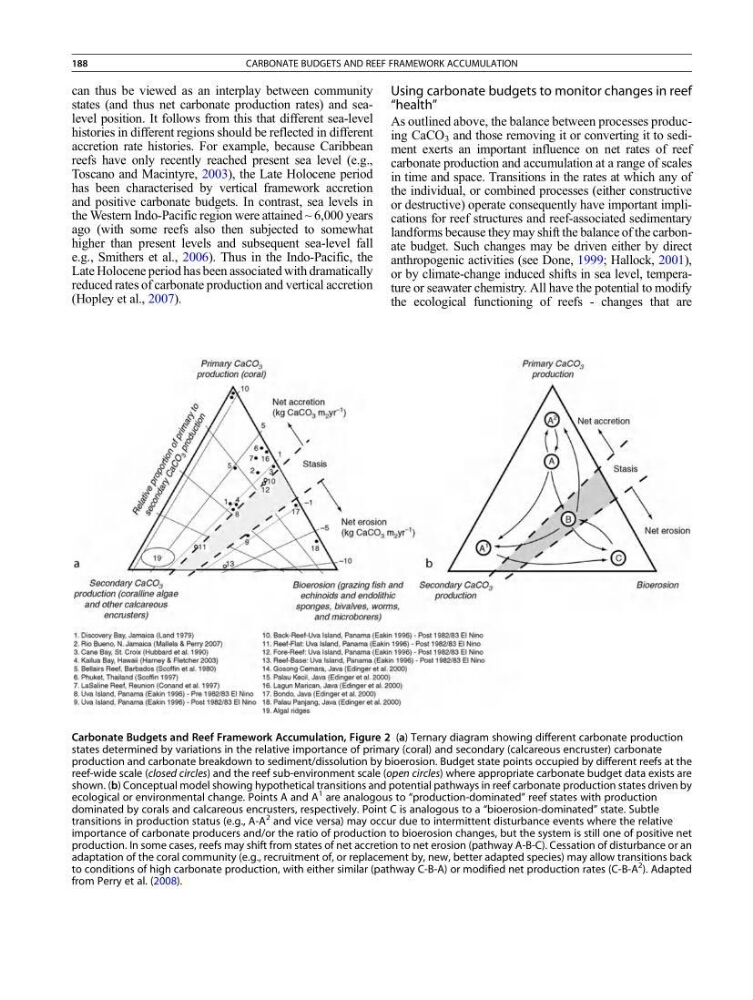
Carbonate Budgets and Reef Framework Accumulation, Figure 2 (a) Ternary diagram showing different carbonate production
states determined by variations in the relative importance of primary (coral) and secondary (calcareous encruster) carbonate
production and carbonate breakdown to sediment/dissolution by bioerosion. Budget state points occupied by different reefs at the
reef-wide scale (closed circles) and the reef sub-environment scale (open circles) where appropriate carbonate budget data exists are
shown. (b) Conceptual model showing hypothetical transitions and potential pathways in reef carbonate production states driven by
ecological or environmental change. Points A and A
1 are analogous to “production-dominated” reef states with production
dominated by corals and calcareous encrusters, respectively. Point C is analogous to a “bioerosion-dominated” state. Subtle
transitions in production status (e.g., A-A
2 and vice versa) may occur due to intermittent disturbance events where the relative
importance of carbonate producers and/or the ratio of production to bioerosion changes, but the system is still one of positive net
production. In some cases, reefs may shift from states of net accretion to net erosion (pathway A-B-C). Cessation of disturbance or an
adaptation of the coral community (e.g., recruitment of, or replacement by, new, better adapted species) may allow transitions back
to conditions of high carbonate production, with either similar (pathway C-B-A) or modified net production rates (C-B-A
2 ). Adapted
from Perry et al. (2008).
188
CARBONATE BUDGETS AND REEF FRAMEWORK ACCUMULATION
states (and thus net carbonate production rates) and sealevel position. It follows from this that different sea-level
histories in different regions should be reflected in different
accretion rate histories. For example, because Caribbean
reefs have only recently reached present sea level (e.g.,
Toscano and Macintyre, 2003), the Late Holocene period
has been characterised by vertical framework accretion
and positive carbonate budgets. In contrast, sea levels in
the Western Indo-Pacific region were attained ~ 6,000 years
ago (with some reefs also then subjected to somewhat
higher than present levels and subsequent sea-level fall
e.g., Smithers et al., 2006). Thus in the Indo-Pacific, the
Late Holocene period has been associated with dramatically
reduced rates of carbonate production and vertical accretion
(Hopley et al., 2007).
Using carbonate budgets to monitor changes in reef
“health”
As outlined above, the balance between processes producing CaCO 3 and those removing it or converting it to sediment exerts an important influence on net rates of reef
carbonate production and accumulation at a range of scales
in time and space. Transitions in the rates at which any of
the individual, or combined processes (either constructive
or destructive) operate consequently have important implications for reef structures and reef-associated sedimentary
landforms because they may shift the balance of the carbonate budget. Such changes may be driven either by direct
anthropogenic activities (see Done, 1999; Hallock, 2001),
or by climate-change induced shifts in sea level, temperature or seawater chemistry. All have the potential to modify
the ecological functioning of reefs - changes that are
Carbonate Budgets and Reef Framework Accumulation, Figure 2 (a) Ternary diagram showing different carbonate production
states determined by variations in the relative importance of primary (coral) and secondary (calcareous encruster) carbonate
production and carbonate breakdown to sediment/dissolution by bioerosion. Budget state points occupied by different reefs at the
reef-wide scale (closed circles) and the reef sub-environment scale (open circles) where appropriate carbonate budget data exists are
shown. (b) Conceptual model showing hypothetical transitions and potential pathways in reef carbonate production states driven by
ecological or environmental change. Points A and A
1 are analogous to “production-dominated” reef states with production
dominated by corals and calcareous encrusters, respectively. Point C is analogous to a “bioerosion-dominated” state. Subtle
transitions in production status (e.g., A-A
2 and vice versa) may occur due to intermittent disturbance events where the relative
importance of carbonate producers and/or the ratio of production to bioerosion changes, but the system is still one of positive net
production. In some cases, reefs may shift from states of net accretion to net erosion (pathway A-B-C). Cessation of disturbance or an
adaptation of the coral community (e.g., recruitment of, or replacement by, new, better adapted species) may allow transitions back
to conditions of high carbonate production, with either similar (pathway C-B-A) or modified net production rates (C-B-A
2 ). Adapted
from Perry et al. (2008).
188
CARBONATE BUDGETS AND REEF FRAMEWORK ACCUMULATION