

Definition
Boulder beaches occur along many of the world’s coasts.
Their presence and formation is a function of sediment
availability and wave energy. Both storm waves and tsunami may be responsible for deposition of boulder
beaches but differentiating which of the two may have
been responsible, principally, at any one location can be
difficult (Nott, 2004). It is common for boulder beaches
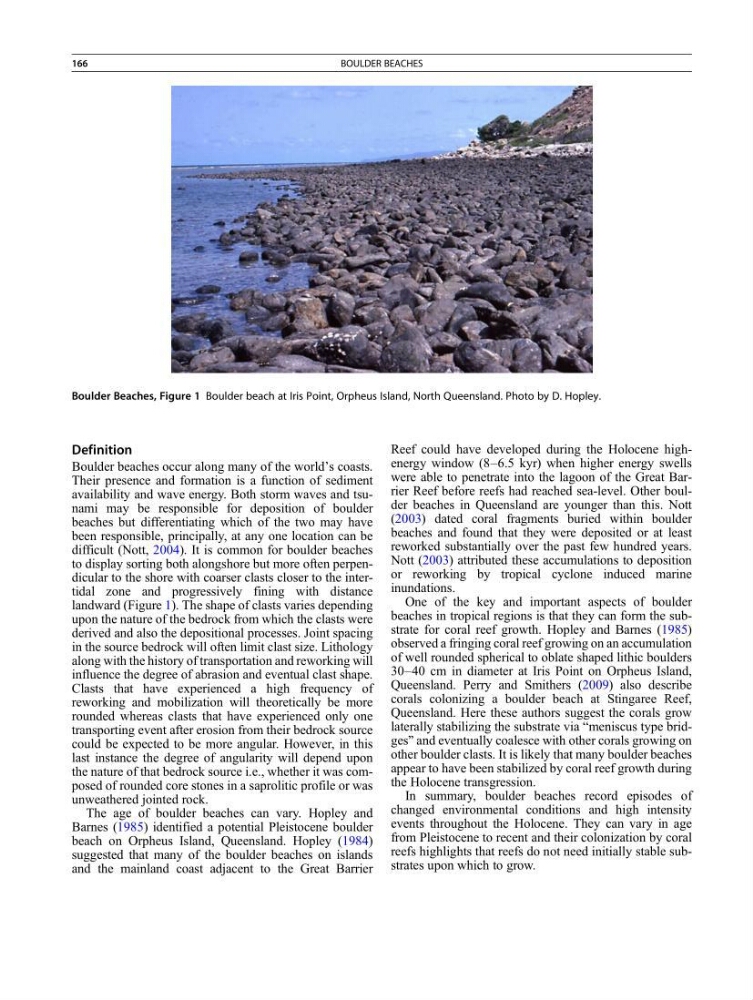
to display sorting both alongshore but more often perpendicular to the shore with coarser clasts closer to the intertidal zone and progressively fining with distance
landward (Figure 1). The shape of clasts varies depending
upon the nature of the bedrock from which the clasts were
derived and also the depositional processes. Joint spacing
in the source bedrock will often limit clast size. Lithology
along with the history of transportation and reworking will
influence the degree of abrasion and eventual clast shape.
Clasts that have experienced a high frequency of
reworking and mobilization will theoretically be more
rounded whereas clasts that have experienced only one
transporting event after erosion from their bedrock source
could be expected to be more angular. However, in this
last instance the degree of angularity will depend upon
the nature of that bedrock source i.e., whether it was composed of rounded core stones in a saprolitic profile or was
unweathered jointed rock.
The age of boulder beaches can vary. Hopley and
Barnes (1985) identified a potential Pleistocene boulder
beach on Orpheus Island, Queensland. Hopley (1984)
suggested that many of the boulder beaches on islands
and the mainland coast adjacent to the Great Barrier
Reef could have developed during the Holocene highenergy window (8–6.5 kyr) when higher energy swells
were able to penetrate into the lagoon of the Great Barrier Reef before reefs had reached sea-level. Other boulder beaches in Queensland are younger than this. Nott
(2003) dated coral fragments buried within boulder
beaches and found that they were deposited or at least
reworked substantially over the past few hundred years.
Nott (2003) attributed these accumulations to deposition
or reworking by tropical cyclone induced marine
inundations.
One of the key and important aspects of boulder
beaches in tropical regions is that they can form the substrate for coral reef growth. Hopley and Barnes (1985)
observed a fringing coral reef growing on an accumulation
of well rounded spherical to oblate shaped lithic boulders
30–40 cm in diameter at Iris Point on Orpheus Island,
Queensland. Perry and Smithers (2009) also describe
corals colonizing a boulder beach at Stingaree Reef,
Queensland. Here these authors suggest the corals grow
laterally stabilizing the substrate via “meniscus type bridges” and eventually coalesce with other corals growing on
other boulder clasts. It is likely that many boulder beaches
appear to have been stabilized by coral reef growth during
the Holocene transgression.
In summary, boulder beaches record episodes of
changed environmental conditions and high intensity
events throughout the Holocene. They can vary in age
from Pleistocene to recent and their colonization by coral
reefs highlights that reefs do not need initially stable substrates upon which to grow.
Boulder Beaches, Figure 1 Boulder beach at Iris Point, Orpheus Island, North Queensland. Photo by D. Hopley.
166
BOULDER BEACHES
Boulder beaches occur along many of the world’s coasts.
Their presence and formation is a function of sediment
availability and wave energy. Both storm waves and tsunami may be responsible for deposition of boulder
beaches but differentiating which of the two may have
been responsible, principally, at any one location can be
difficult (Nott, 2004). It is common for boulder beaches
to display sorting both alongshore but more often perpendicular to the shore with coarser clasts closer to the intertidal zone and progressively fining with distance
landward (Figure 1). The shape of clasts varies depending
upon the nature of the bedrock from which the clasts were
derived and also the depositional processes. Joint spacing
in the source bedrock will often limit clast size. Lithology
along with the history of transportation and reworking will
influence the degree of abrasion and eventual clast shape.
Clasts that have experienced a high frequency of
reworking and mobilization will theoretically be more
rounded whereas clasts that have experienced only one
transporting event after erosion from their bedrock source
could be expected to be more angular. However, in this
last instance the degree of angularity will depend upon
the nature of that bedrock source i.e., whether it was composed of rounded core stones in a saprolitic profile or was
unweathered jointed rock.
The age of boulder beaches can vary. Hopley and
Barnes (1985) identified a potential Pleistocene boulder
beach on Orpheus Island, Queensland. Hopley (1984)
suggested that many of the boulder beaches on islands
and the mainland coast adjacent to the Great Barrier
Reef could have developed during the Holocene highenergy window (8–6.5 kyr) when higher energy swells
were able to penetrate into the lagoon of the Great Barrier Reef before reefs had reached sea-level. Other boulder beaches in Queensland are younger than this. Nott
(2003) dated coral fragments buried within boulder
beaches and found that they were deposited or at least
reworked substantially over the past few hundred years.
Nott (2003) attributed these accumulations to deposition
or reworking by tropical cyclone induced marine
inundations.
One of the key and important aspects of boulder
beaches in tropical regions is that they can form the substrate for coral reef growth. Hopley and Barnes (1985)
observed a fringing coral reef growing on an accumulation
of well rounded spherical to oblate shaped lithic boulders
30–40 cm in diameter at Iris Point on Orpheus Island,
Queensland. Perry and Smithers (2009) also describe
corals colonizing a boulder beach at Stingaree Reef,
Queensland. Here these authors suggest the corals grow
laterally stabilizing the substrate via “meniscus type bridges” and eventually coalesce with other corals growing on
other boulder clasts. It is likely that many boulder beaches
appear to have been stabilized by coral reef growth during
the Holocene transgression.
In summary, boulder beaches record episodes of
changed environmental conditions and high intensity
events throughout the Holocene. They can vary in age
from Pleistocene to recent and their colonization by coral
reefs highlights that reefs do not need initially stable substrates upon which to grow.
Boulder Beaches, Figure 1 Boulder beach at Iris Point, Orpheus Island, North Queensland. Photo by D. Hopley.
166
BOULDER BEACHES