

Blowholes can occur on coasts that are composed of a
range of lithologies, and there are a number of swelldominated coasts on which these regular spouts of spray
are a tourist attraction. Lava tubes and dykes can give rise
to suitable fissures on volcanic coasts, such as the Taga or
Alofaaga Blowholes on Savai’i in Samoa, or Halano
Blowhole on Oahu and a blowhole at Nakalele Point on
Maui in the Hawaiian Islands. Blowholes are also associated
with Tertiary limestones on reef coasts. Where the coast is
not protected by a modern reef, spectacular blowholes occur,
for example, on the southern shore of Tongatapu, the principal island in the Kingdom of Tonga, and at the eastern end of
Grand Cayman, the largest island in the Cayman Islands.
BLUE HOLE
Eberhard Gischler
Institut für Geowissenschaften, Frankfurt am Main,
Germany
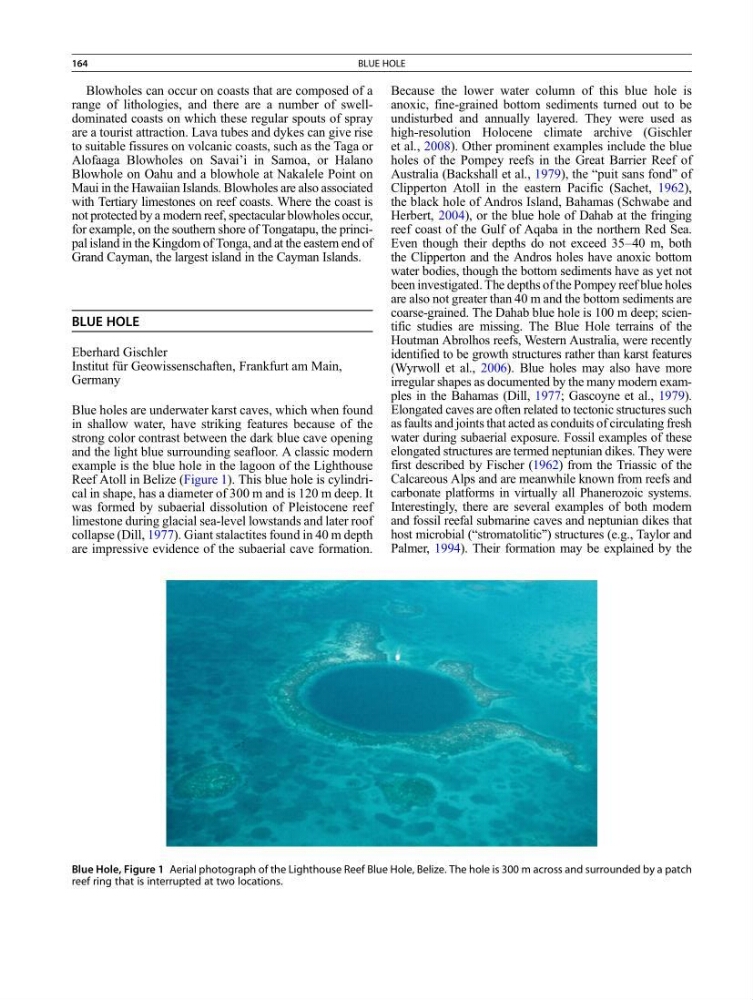
Blue holes are underwater karst caves, which when found
in shallow water, have striking features because of the
strong color contrast between the dark blue cave opening
and the light blue surrounding seafloor. A classic modern
example is the blue hole in the lagoon of the Lighthouse
Reef Atoll in Belize (Figure 1). This blue hole is cylindrical in shape, has a diameter of 300 m and is 120 m deep. It
was formed by subaerial dissolution of Pleistocene reef
limestone during glacial sea-level lowstands and later roof
collapse (Dill, 1977). Giant stalactites found in 40 m depth
are impressive evidence of the subaerial cave formation.
Because the lower water column of this blue hole is
anoxic, fine-grained bottom sediments turned out to be
undisturbed and annually layered. They were used as
high-resolution Holocene climate archive (Gischler
et al., 2008). Other prominent examples include the blue
holes of the Pompey reefs in the Great Barrier Reef of
Australia (Backshall et al., 1979), the “puit sans fond” of
Clipperton Atoll in the eastern Pacific (Sachet, 1962),
the black hole of Andros Island, Bahamas (Schwabe and
Herbert, 2004), or the blue hole of Dahab at the fringing
reef coast of the Gulf of Aqaba in the northern Red Sea.
Even though their depths do not exceed 35–40 m, both
the Clipperton and the Andros holes have anoxic bottom
water bodies, though the bottom sediments have as yet not
been investigated. The depths of the Pompey reef blue holes
are also not greater than 40 m and the bottom sediments are
coarse-grained. The Dahab blue hole is 100 m deep; scientific studies are missing. The Blue Hole terrains of the
Houtman Abrolhos reefs, Western Australia, were recently
identified to be growth structures rather than karst features
(Wyrwoll et al., 2006). Blue holes may also have more
irregular shapes as documented by the many modern examples in the Bahamas (Dill, 1977; Gascoyne et al., 1979).
Elongated caves are often related to tectonic structures such
as faults and joints that acted as conduits of circulating fresh
water during subaerial exposure. Fossil examples of these
elongated structures are termed neptunian dikes. They were
first described by Fischer (1962) from the Triassic of the
Calcareous Alps and are meanwhile known from reefs and
carbonate platforms in virtually all Phanerozoic systems.
Interestingly, there are several examples of both modern
and fossil reefal submarine caves and neptunian dikes that
host microbial (“stromatolitic”) structures (e.g., Taylor and
Palmer, 1994). Their formation may be explained by the
Blue Hole, Figure 1 Aerial photograph of the Lighthouse Reef Blue Hole, Belize. The hole is 300 m across and surrounded by a patch
reef ring that is interrupted at two locations.
164
BLUE HOLE
range of lithologies, and there are a number of swelldominated coasts on which these regular spouts of spray
are a tourist attraction. Lava tubes and dykes can give rise
to suitable fissures on volcanic coasts, such as the Taga or
Alofaaga Blowholes on Savai’i in Samoa, or Halano
Blowhole on Oahu and a blowhole at Nakalele Point on
Maui in the Hawaiian Islands. Blowholes are also associated
with Tertiary limestones on reef coasts. Where the coast is
not protected by a modern reef, spectacular blowholes occur,
for example, on the southern shore of Tongatapu, the principal island in the Kingdom of Tonga, and at the eastern end of
Grand Cayman, the largest island in the Cayman Islands.
BLUE HOLE
Eberhard Gischler
Institut für Geowissenschaften, Frankfurt am Main,
Germany
Blue holes are underwater karst caves, which when found
in shallow water, have striking features because of the
strong color contrast between the dark blue cave opening
and the light blue surrounding seafloor. A classic modern
example is the blue hole in the lagoon of the Lighthouse
Reef Atoll in Belize (Figure 1). This blue hole is cylindrical in shape, has a diameter of 300 m and is 120 m deep. It
was formed by subaerial dissolution of Pleistocene reef
limestone during glacial sea-level lowstands and later roof
collapse (Dill, 1977). Giant stalactites found in 40 m depth
are impressive evidence of the subaerial cave formation.
Because the lower water column of this blue hole is
anoxic, fine-grained bottom sediments turned out to be
undisturbed and annually layered. They were used as
high-resolution Holocene climate archive (Gischler
et al., 2008). Other prominent examples include the blue
holes of the Pompey reefs in the Great Barrier Reef of
Australia (Backshall et al., 1979), the “puit sans fond” of
Clipperton Atoll in the eastern Pacific (Sachet, 1962),
the black hole of Andros Island, Bahamas (Schwabe and
Herbert, 2004), or the blue hole of Dahab at the fringing
reef coast of the Gulf of Aqaba in the northern Red Sea.
Even though their depths do not exceed 35–40 m, both
the Clipperton and the Andros holes have anoxic bottom
water bodies, though the bottom sediments have as yet not
been investigated. The depths of the Pompey reef blue holes
are also not greater than 40 m and the bottom sediments are
coarse-grained. The Dahab blue hole is 100 m deep; scientific studies are missing. The Blue Hole terrains of the
Houtman Abrolhos reefs, Western Australia, were recently
identified to be growth structures rather than karst features
(Wyrwoll et al., 2006). Blue holes may also have more
irregular shapes as documented by the many modern examples in the Bahamas (Dill, 1977; Gascoyne et al., 1979).
Elongated caves are often related to tectonic structures such
as faults and joints that acted as conduits of circulating fresh
water during subaerial exposure. Fossil examples of these
elongated structures are termed neptunian dikes. They were
first described by Fischer (1962) from the Triassic of the
Calcareous Alps and are meanwhile known from reefs and
carbonate platforms in virtually all Phanerozoic systems.
Interestingly, there are several examples of both modern
and fossil reefal submarine caves and neptunian dikes that
host microbial (“stromatolitic”) structures (e.g., Taylor and
Palmer, 1994). Their formation may be explained by the
Blue Hole, Figure 1 Aerial photograph of the Lighthouse Reef Blue Hole, Belize. The hole is 300 m across and surrounded by a patch
reef ring that is interrupted at two locations.
164
BLUE HOLE