

with animals preying upon each other, feeding on the
endolithic algae and recycling sediment and mucous
trapped within the substrate. A few studies have attempted
to quantify the density and diversity of this combined
community (Grassle, 1973; Kohn and White, 1977) which
is very diverse and abundant although the taxonomy of
many of the groups is poorly known. As well as errant species of cryptofauna there are many encrusting species of
bryozoans, sponges, and ascidians which utilize these burrows all contributing to the incredible diversity of coral
reef invertebrates.
Environmental factors influencing rates and
agents of bioerosion
Studies have shown that rates and agents of bioerosion
exhibit spatial and temporal differences (Kiene and
Hutchings, 1994b) within a single reefal system, subtidal
reef slopes, and lagoonal sites experienced higher rates
of grazing than deeper sites and reef flats and these differences were maintained in experimental substrates exposed
for 9 years (Kiene and Hutchings, 1994a). These differences could be explained by the distribution of
the dominant parrotfish in the region. Many of the boring organism exhibit seasonal variation in recruitment
and these patterns are influenced by prevailing winds
(Hutchings and Murray, 1982) but storms may modify
these patterns transporting larvae to unsuitable habitats.
Experimental studies have also shown that the composition of both the micro and macroboring communities
varies not only according to site but to environmental conditions (Hutchings et al., 2005). Inshore sites with heavy
sedimentation from river run off are characterized by
deposit feeding polychaetes and filter feeding sponges
and low densities of endolithic algae are restricted due
to light availability which reduced levels of grazing.
In contrast communities further offshore in clear waters
with little or no sedimentation are characterized by high
rates of bioerosion due to grazing and internal bioerosion by macroborers such as bivalves and filter and surface deposit feeding polychaetes (Osorno et al., 2005;
Hutchings et al., 2005).
Reefs have always been subjected to storm events and
probably plague events such as Crown of Thorns starfish,
which leads to a temporary increase in dead coral substrate
and local increases in rates of bioerosion, over time these
reefs recover providing surrounding reefs are “healthy”
(Brodie et al., 2005) and the balance between reef growth
and reef destruction is restored. But increasingly this balance is being changed with losses exceeding gains and
the next section discusses the factors which are disrupting
this balance.
Anthropogenic factors influencing rates and
agents of bioerosion
Poor water quality
Experimental studies have shown that rates of
microbioerosion and erosion by grazing predominantly
by parrotfishes increased when nutrients are added to the
water column (Osorno, 2005). Studies in French Polynesia at selected sites which were subjected to both increased
sediment loads and elevated nutrients and significant differences were found between sites some of which were
separated by thousands of kilometers. Both eutrophic and
pristine sites exhibited high rates of bioerosion although
the processes responsible for this loss differed. At the most
eutrophic site Faaa, Tahiti, rates of loss were largely due to
grazing by echinoids especially Echinometra mathaei,
whereas at the pristine site at Tikehau, high rates of internal
bioerosion were due to sponges (Pari et al., 2002). At Faaa,
densities of 201 Æ 60.4 indi m
À2 of echinoids were
recorded (Pari et al., 1998) and an almost complete absence
of herbivorous fish especially parrotfishes, due to
overfishing. A river flowing out on this lagoonal site at Faaa
is highly polluted as untreated sewage and other organic
pollutants are allowed to be discharged into this river. These
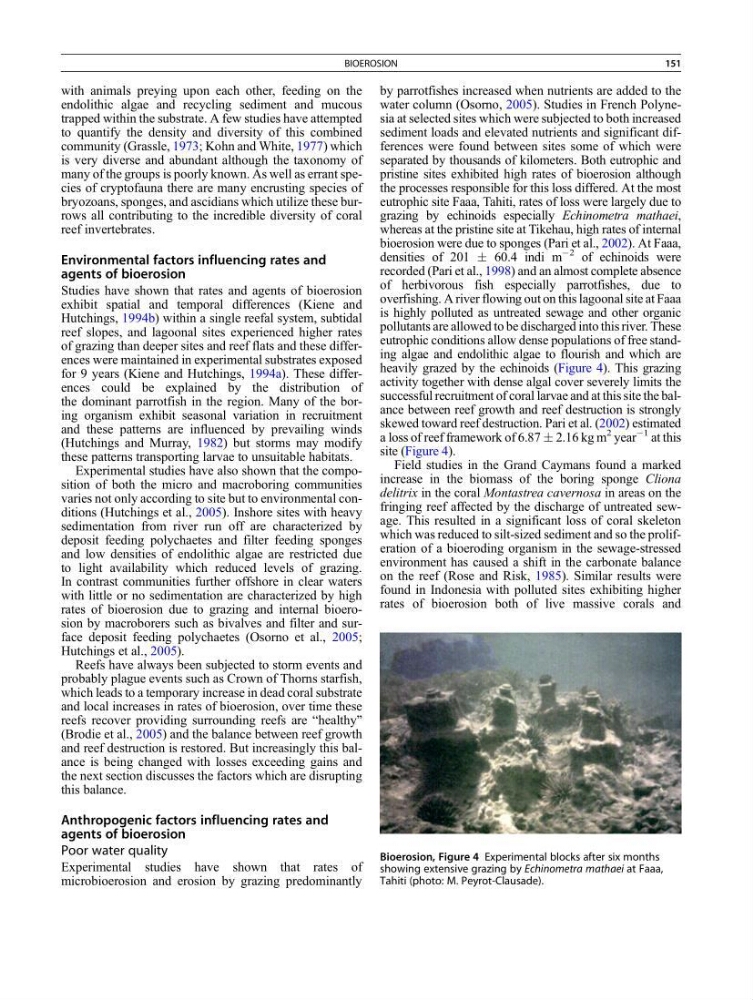
eutrophic conditions allow dense populations of free standing algae and endolithic algae to flourish and which are
heavily grazed by the echinoids (Figure 4). This grazing
activity together with dense algal cover severely limits the
successful recruitment of coral larvae and at this site the balance between reef growth and reef destruction is strongly
skewed toward reef destruction. Pari et al. (2002) estimated
a loss of reef framework of 6.87 Æ 2.16 kg m
2 year
À1 at this
site (Figure 4).
Field studies in the Grand Caymans found a marked
increase in the biomass of the boring sponge Cliona
delitrix in the coral Montastrea cavernosa in areas on the
fringing reef affected by the discharge of untreated sewage. This resulted in a significant loss of coral skeleton
which was reduced to silt-sized sediment and so the proliferation of a bioeroding organism in the sewage-stressed
environment has caused a shift in the carbonate balance
on the reef (Rose and Risk, 1985). Similar results were
found in Indonesia with polluted sites exhibiting higher
rates of bioerosion both of live massive corals and
Bioerosion, Figure 4 Experimental blocks after six months
showing extensive grazing by Echinometra mathaei at Faaa,
Tahiti (photo: M. Peyrot-Clausade).
BIOEROSION
151
endolithic algae and recycling sediment and mucous
trapped within the substrate. A few studies have attempted
to quantify the density and diversity of this combined
community (Grassle, 1973; Kohn and White, 1977) which
is very diverse and abundant although the taxonomy of
many of the groups is poorly known. As well as errant species of cryptofauna there are many encrusting species of
bryozoans, sponges, and ascidians which utilize these burrows all contributing to the incredible diversity of coral
reef invertebrates.
Environmental factors influencing rates and
agents of bioerosion
Studies have shown that rates and agents of bioerosion
exhibit spatial and temporal differences (Kiene and
Hutchings, 1994b) within a single reefal system, subtidal
reef slopes, and lagoonal sites experienced higher rates
of grazing than deeper sites and reef flats and these differences were maintained in experimental substrates exposed
for 9 years (Kiene and Hutchings, 1994a). These differences could be explained by the distribution of
the dominant parrotfish in the region. Many of the boring organism exhibit seasonal variation in recruitment
and these patterns are influenced by prevailing winds
(Hutchings and Murray, 1982) but storms may modify
these patterns transporting larvae to unsuitable habitats.
Experimental studies have also shown that the composition of both the micro and macroboring communities
varies not only according to site but to environmental conditions (Hutchings et al., 2005). Inshore sites with heavy
sedimentation from river run off are characterized by
deposit feeding polychaetes and filter feeding sponges
and low densities of endolithic algae are restricted due
to light availability which reduced levels of grazing.
In contrast communities further offshore in clear waters
with little or no sedimentation are characterized by high
rates of bioerosion due to grazing and internal bioerosion by macroborers such as bivalves and filter and surface deposit feeding polychaetes (Osorno et al., 2005;
Hutchings et al., 2005).
Reefs have always been subjected to storm events and
probably plague events such as Crown of Thorns starfish,
which leads to a temporary increase in dead coral substrate
and local increases in rates of bioerosion, over time these
reefs recover providing surrounding reefs are “healthy”
(Brodie et al., 2005) and the balance between reef growth
and reef destruction is restored. But increasingly this balance is being changed with losses exceeding gains and
the next section discusses the factors which are disrupting
this balance.
Anthropogenic factors influencing rates and
agents of bioerosion
Poor water quality
Experimental studies have shown that rates of
microbioerosion and erosion by grazing predominantly
by parrotfishes increased when nutrients are added to the
water column (Osorno, 2005). Studies in French Polynesia at selected sites which were subjected to both increased
sediment loads and elevated nutrients and significant differences were found between sites some of which were
separated by thousands of kilometers. Both eutrophic and
pristine sites exhibited high rates of bioerosion although
the processes responsible for this loss differed. At the most
eutrophic site Faaa, Tahiti, rates of loss were largely due to
grazing by echinoids especially Echinometra mathaei,
whereas at the pristine site at Tikehau, high rates of internal
bioerosion were due to sponges (Pari et al., 2002). At Faaa,
densities of 201 Æ 60.4 indi m
À2 of echinoids were
recorded (Pari et al., 1998) and an almost complete absence
of herbivorous fish especially parrotfishes, due to
overfishing. A river flowing out on this lagoonal site at Faaa
is highly polluted as untreated sewage and other organic
pollutants are allowed to be discharged into this river. These
eutrophic conditions allow dense populations of free standing algae and endolithic algae to flourish and which are
heavily grazed by the echinoids (Figure 4). This grazing
activity together with dense algal cover severely limits the
successful recruitment of coral larvae and at this site the balance between reef growth and reef destruction is strongly
skewed toward reef destruction. Pari et al. (2002) estimated
a loss of reef framework of 6.87 Æ 2.16 kg m
2 year
À1 at this
site (Figure 4).
Field studies in the Grand Caymans found a marked
increase in the biomass of the boring sponge Cliona
delitrix in the coral Montastrea cavernosa in areas on the
fringing reef affected by the discharge of untreated sewage. This resulted in a significant loss of coral skeleton
which was reduced to silt-sized sediment and so the proliferation of a bioeroding organism in the sewage-stressed
environment has caused a shift in the carbonate balance
on the reef (Rose and Risk, 1985). Similar results were
found in Indonesia with polluted sites exhibiting higher
rates of bioerosion both of live massive corals and
Bioerosion, Figure 4 Experimental blocks after six months
showing extensive grazing by Echinometra mathaei at Faaa,
Tahiti (photo: M. Peyrot-Clausade).
BIOEROSION
151