

(i.e., time since death of coral colony) present, as rates tend
to increase with increasing maturity of boring communities
(Peyrot et al., 1992). While most studies on the distribution
of boring communities have focused on the massive coral
Porites, all corals are bored once they die, but dense coral
skeletons are most impacted. Comparing rates of bioerosion
across or between reefs must be carefully considered as
rates vary according to amounts and types of substrate available. Rates will also vary over time as the composition of
boring communities change and may stabilize as the component individuals mature. Rates of grazing and accretion
may vary over time and sediment may also be washed into
the burrows created by the borers, recemented and thus
strengthening the substrate, so just comparing rates of
bioerosion can be fairly meaningless unless information
on all the components contributing to the balance between
reef growth and destruction are known.
In addition to calculating rates of loss by internal erosion, it is important to identify the organisms responsible
for these losses. The easiest method for extracting the
macroborers is to dissolve the substrate in a weak acid
solution and sort the residue into the relevant groups and
identify to species. However, typically the volume of the
macroborers is lower than the loss of substrate calculated
from measuring the size of the burrows and this probably
is a reflection that some of the borers have established themselves in the substrate and then died during
the exposure period but their burrows remain (Pari et al.,
2002). Determination of the species composition of the
microborers requires a variety of techniques, see Tribollet
(2008). Amongst both the micro and macro- borers there
appears to be some widely distributed species, however
it may be that with more detailed taxonomic investigations
involving both morphological and molecular techniques
that suites of cryptic species will be found.
Another method of calculating rates of bioerosion is to
collect large heads of dead coral of known age, slice them
and measure the loss of substrate by internal erosion and
extrapolate to losses per kg m
À2 year
À1 (Hudson, 1977).
This makes the assumption that rates of boring are
consistent over time but we know that this is not correct
and so such methods of estimating rates may be of limited
value. Examining such heads of dead coral often reveals
that much of the erosion occurs at the base of the colony
and this may make the colony more susceptible to being
dislodged during storms or when large heads of corals
are rolled down the reef slope during a storm clearing
everything in its path. Although there are some data to suggest that heavily sponge bored coral heads may be more
flexible and able to withstand some storm activity, other
data from branching corals indicate the reverse that such
colonies are more susceptible to being damaged (LópezVictoria and Zea, 2004; Chaves-Fonnegra and Zea, 2007).
Habitat creators
Bioerosion, as well as generating sediment, which may
either be washed out of the substrate and contribute to
inter reefal and lagoonal sediments or retained within the
burrows and subsequently become cemented, also creates
a 3D habitat. The creation of this habitat provides suitable
refuges for a wide variety of invertebrates and some of the
smaller fish species and is referred to as the cryptofauna or
nestlers. This is where the majority of reefal biodiversity
and productivity resides and is a critical component of
reefal food chains, trapping sediments, and recycling
mucus, providing food for many other organisms. While
much of the cryptofauna lives permanently within the substrate, some venture out at night to feed or extend their tentacles, arms or feeding crowns, etc., out over the surface of
substrate to feed. This fauna cannot themselves bore but
they occupy the vacant burrows created by the borers.
Some cryptofauna are preyed upon by a range of other
organisms, for example, species of the gastropod Conus
feed selectively on certain species of polychaetes. Conus
uses its proboscis to suck out these species from within
the coral substrate (Kohn and Nybakken, 1975) and some
species are highly selective as to which species of polychaetes they prey upon. One presumes that within the substrate the borers and cryptofauna function as an ecosystem
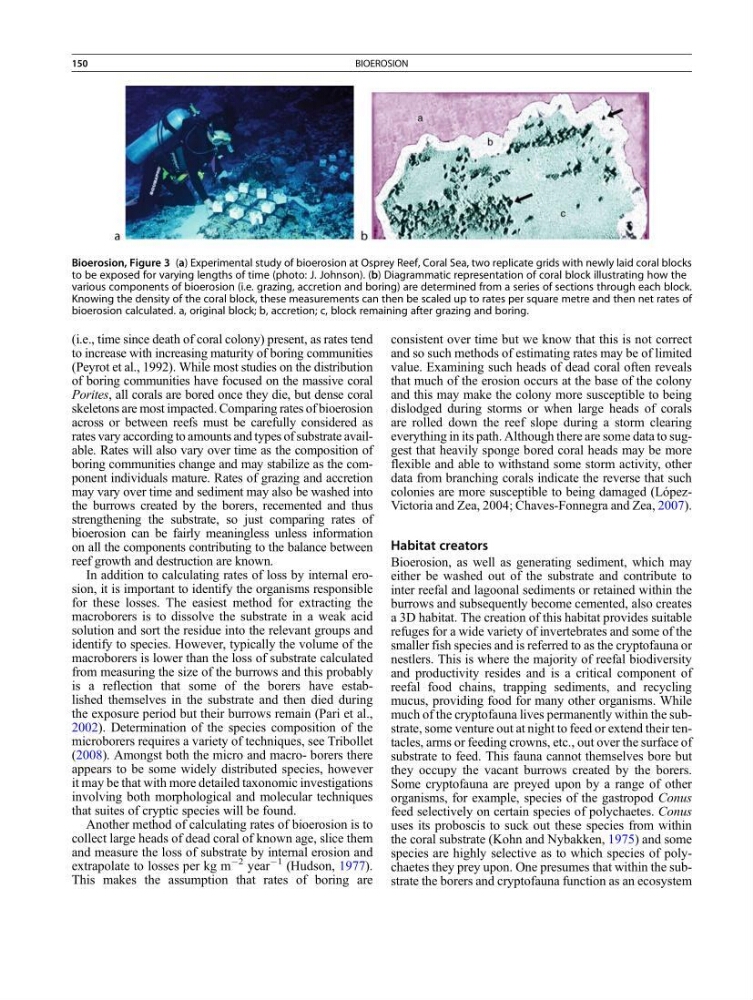
Bioerosion, Figure 3 (a) Experimental study of bioerosion at Osprey Reef, Coral Sea, two replicate grids with newly laid coral blocks
to be exposed for varying lengths of time (photo: J. Johnson). (b) Diagrammatic representation of coral block illustrating how the
various components of bioerosion (i.e. grazing, accretion and boring) are determined from a series of sections through each block.
Knowing the density of the coral block, these measurements can then be scaled up to rates per square metre and then net rates of
bioerosion calculated. a, original block; b, accretion; c, block remaining after grazing and boring.
150
BIOEROSION
to increase with increasing maturity of boring communities
(Peyrot et al., 1992). While most studies on the distribution
of boring communities have focused on the massive coral
Porites, all corals are bored once they die, but dense coral
skeletons are most impacted. Comparing rates of bioerosion
across or between reefs must be carefully considered as
rates vary according to amounts and types of substrate available. Rates will also vary over time as the composition of
boring communities change and may stabilize as the component individuals mature. Rates of grazing and accretion
may vary over time and sediment may also be washed into
the burrows created by the borers, recemented and thus
strengthening the substrate, so just comparing rates of
bioerosion can be fairly meaningless unless information
on all the components contributing to the balance between
reef growth and destruction are known.
In addition to calculating rates of loss by internal erosion, it is important to identify the organisms responsible
for these losses. The easiest method for extracting the
macroborers is to dissolve the substrate in a weak acid
solution and sort the residue into the relevant groups and
identify to species. However, typically the volume of the
macroborers is lower than the loss of substrate calculated
from measuring the size of the burrows and this probably
is a reflection that some of the borers have established themselves in the substrate and then died during
the exposure period but their burrows remain (Pari et al.,
2002). Determination of the species composition of the
microborers requires a variety of techniques, see Tribollet
(2008). Amongst both the micro and macro- borers there
appears to be some widely distributed species, however
it may be that with more detailed taxonomic investigations
involving both morphological and molecular techniques
that suites of cryptic species will be found.
Another method of calculating rates of bioerosion is to
collect large heads of dead coral of known age, slice them
and measure the loss of substrate by internal erosion and
extrapolate to losses per kg m
À2 year
À1 (Hudson, 1977).
This makes the assumption that rates of boring are
consistent over time but we know that this is not correct
and so such methods of estimating rates may be of limited
value. Examining such heads of dead coral often reveals
that much of the erosion occurs at the base of the colony
and this may make the colony more susceptible to being
dislodged during storms or when large heads of corals
are rolled down the reef slope during a storm clearing
everything in its path. Although there are some data to suggest that heavily sponge bored coral heads may be more
flexible and able to withstand some storm activity, other
data from branching corals indicate the reverse that such
colonies are more susceptible to being damaged (LópezVictoria and Zea, 2004; Chaves-Fonnegra and Zea, 2007).
Habitat creators
Bioerosion, as well as generating sediment, which may
either be washed out of the substrate and contribute to
inter reefal and lagoonal sediments or retained within the
burrows and subsequently become cemented, also creates
a 3D habitat. The creation of this habitat provides suitable
refuges for a wide variety of invertebrates and some of the
smaller fish species and is referred to as the cryptofauna or
nestlers. This is where the majority of reefal biodiversity
and productivity resides and is a critical component of
reefal food chains, trapping sediments, and recycling
mucus, providing food for many other organisms. While
much of the cryptofauna lives permanently within the substrate, some venture out at night to feed or extend their tentacles, arms or feeding crowns, etc., out over the surface of
substrate to feed. This fauna cannot themselves bore but
they occupy the vacant burrows created by the borers.
Some cryptofauna are preyed upon by a range of other
organisms, for example, species of the gastropod Conus
feed selectively on certain species of polychaetes. Conus
uses its proboscis to suck out these species from within
the coral substrate (Kohn and Nybakken, 1975) and some
species are highly selective as to which species of polychaetes they prey upon. One presumes that within the substrate the borers and cryptofauna function as an ecosystem
Bioerosion, Figure 3 (a) Experimental study of bioerosion at Osprey Reef, Coral Sea, two replicate grids with newly laid coral blocks
to be exposed for varying lengths of time (photo: J. Johnson). (b) Diagrammatic representation of coral block illustrating how the
various components of bioerosion (i.e. grazing, accretion and boring) are determined from a series of sections through each block.
Knowing the density of the coral block, these measurements can then be scaled up to rates per square metre and then net rates of
bioerosion calculated. a, original block; b, accretion; c, block remaining after grazing and boring.
150
BIOEROSION