

present, especially as encrusters on senescent patches.
Patch-reef coral diversity is high, e.g., 26 species in the
Exumas (Chiappone et al., 1997a), despite the absence of
acroporids. Pante et al. (2008) reported a decline in coral
cover from 13 to 3%, accompanied by extensive rubble production, on an Exuma patch reef between 1991 and 2004.
MASC was the biggest loser, although it remained dominant, whereas M. alcicornis gained both in coverage and
number of colonies.
Corals on the deeper terraces and the wall are also dominated by MASC (45% of coral cover) and Siderastrea
siderea (20%) (Bunt et al., 1981). The 26 species reported
include all of the forms abundant on the shallow reefs
(Table 1), except the acrophobic acroporids.
Atlantic reefs contain many more octocorals and
sponges (Figure 5) than Pacific reefs, which have much
higher coral diversity. Thirty-five species of octocorals
have been identified from the Bahamas (Table 2; Bunt
et al., 1981; Chiappone et al., 1997b). Wiedenmayer
(1980) recorded 84 species or forms of sponges from shallow rock and reef substrates. Curiously, the brightly colored, ubiquitous, and prodigous reef/rock borer, Cliona,
was not among them. Of the 19 deep-water sponge genera
mentioned anecdotally by Maldonado and Young (1996),
16 are not recorded from shallow water.
Crustose coralline algae, including Lithophyllum
congestum and Porolithon pachydermum, are common
in Bahaman reefs (Adey, 1978), constituting 30% of the
total algal cover (Kramer, 2003). They construct cups
and linear “algal ridges” on Great Inagua and the Plana
Cays (east of Crooked–Acklins platform), although ridges
are lacking further north (Adey, 1978). Arborescent Jania,
Amphiroa, and Neogoniolithon contribute generously to
the sediment accumulation, if not to the mass of the reefs.
Calcified green algae, notably Halimeda opuntia, are the
major contributors to the skeletal sand around reefs
because of their high production and disarticulation rates.
Multitudes of fleshy macroalgae populate the reefs. They
are considered a sign of declining reefs, as they can
outcompete stony corals for space and light, especially
since the catastrophic die-off of the algal-grazing urchin,
Diadema antillarum, in 1983 (Kramer, 2003). Andros reef
tract had the highest “macroalgal index” (relative abundance x colony height) reported from the Atlantic to
1999 (Kramer, 2003), although later surveys in the central
and western Caribbean reported indices up to 40% higher
(AGRRA database, http:/ /www.agrra.org).
Reefs are the shelter, grazing range, home, or hunting
grounds of many organisms. Prominent in the Bahamian
reefs are multitudes of fish (Kramer, 2003), urchins, lobsters, shrimp, worms, bivalves, gastropods, bryozoans,
anemones, and foraminifers. Particularly important in degrading the reefs into sediment are various bioeroders that
include fungi, cyanobacteria, sponges, lithophagid and
pholad bivalves, chitons, boring and rasping gastropods,
sipunculid and polychaete worms, barnacles, boring and
rasping echinoids, parrot fish, and many other grazing fish.
Reef health
Worldwide decline of reefs, one of the most diverse of ecosystems, is causing grave concern and intensive research.
A reef-health index based on 13 parameters including
coral cover, mortality, and disease; macroalgal index;
and fish populations was devised from the initial AGRRA
survey of Atlantic reefs (Kramer, 2003). Andros had the
worst health index of 17 Caribbean and Gulf sites
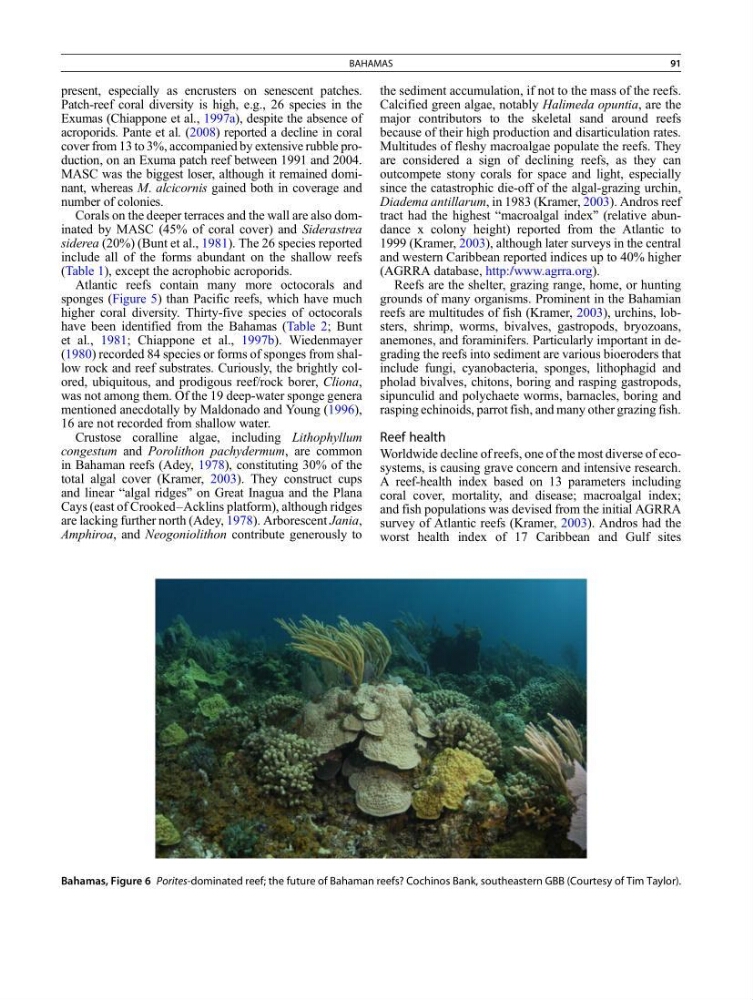
Bahamas, Figure 6 Porites-dominated reef; the future of Bahaman reefs? Cochinos Bank, southeastern GBB (Courtesy of Tim Taylor).
BAHAMAS
91
Patch-reef coral diversity is high, e.g., 26 species in the
Exumas (Chiappone et al., 1997a), despite the absence of
acroporids. Pante et al. (2008) reported a decline in coral
cover from 13 to 3%, accompanied by extensive rubble production, on an Exuma patch reef between 1991 and 2004.
MASC was the biggest loser, although it remained dominant, whereas M. alcicornis gained both in coverage and
number of colonies.
Corals on the deeper terraces and the wall are also dominated by MASC (45% of coral cover) and Siderastrea
siderea (20%) (Bunt et al., 1981). The 26 species reported
include all of the forms abundant on the shallow reefs
(Table 1), except the acrophobic acroporids.
Atlantic reefs contain many more octocorals and
sponges (Figure 5) than Pacific reefs, which have much
higher coral diversity. Thirty-five species of octocorals
have been identified from the Bahamas (Table 2; Bunt
et al., 1981; Chiappone et al., 1997b). Wiedenmayer
(1980) recorded 84 species or forms of sponges from shallow rock and reef substrates. Curiously, the brightly colored, ubiquitous, and prodigous reef/rock borer, Cliona,
was not among them. Of the 19 deep-water sponge genera
mentioned anecdotally by Maldonado and Young (1996),
16 are not recorded from shallow water.
Crustose coralline algae, including Lithophyllum
congestum and Porolithon pachydermum, are common
in Bahaman reefs (Adey, 1978), constituting 30% of the
total algal cover (Kramer, 2003). They construct cups
and linear “algal ridges” on Great Inagua and the Plana
Cays (east of Crooked–Acklins platform), although ridges
are lacking further north (Adey, 1978). Arborescent Jania,
Amphiroa, and Neogoniolithon contribute generously to
the sediment accumulation, if not to the mass of the reefs.
Calcified green algae, notably Halimeda opuntia, are the
major contributors to the skeletal sand around reefs
because of their high production and disarticulation rates.
Multitudes of fleshy macroalgae populate the reefs. They
are considered a sign of declining reefs, as they can
outcompete stony corals for space and light, especially
since the catastrophic die-off of the algal-grazing urchin,
Diadema antillarum, in 1983 (Kramer, 2003). Andros reef
tract had the highest “macroalgal index” (relative abundance x colony height) reported from the Atlantic to
1999 (Kramer, 2003), although later surveys in the central
and western Caribbean reported indices up to 40% higher
(AGRRA database, http:/ /www.agrra.org).
Reefs are the shelter, grazing range, home, or hunting
grounds of many organisms. Prominent in the Bahamian
reefs are multitudes of fish (Kramer, 2003), urchins, lobsters, shrimp, worms, bivalves, gastropods, bryozoans,
anemones, and foraminifers. Particularly important in degrading the reefs into sediment are various bioeroders that
include fungi, cyanobacteria, sponges, lithophagid and
pholad bivalves, chitons, boring and rasping gastropods,
sipunculid and polychaete worms, barnacles, boring and
rasping echinoids, parrot fish, and many other grazing fish.
Reef health
Worldwide decline of reefs, one of the most diverse of ecosystems, is causing grave concern and intensive research.
A reef-health index based on 13 parameters including
coral cover, mortality, and disease; macroalgal index;
and fish populations was devised from the initial AGRRA
survey of Atlantic reefs (Kramer, 2003). Andros had the
worst health index of 17 Caribbean and Gulf sites
Bahamas, Figure 6 Porites-dominated reef; the future of Bahaman reefs? Cochinos Bank, southeastern GBB (Courtesy of Tim Taylor).
BAHAMAS
91