

reef tract in 1998 (Kramer et al., 2003), although it is much
reduced today. It was less dominant elsewhere: 35% in
Turks and Caicos reefs (Riegl et al., 2003) and 13–18%
at San Salvador (Peckol et al., 2003). Abaco reefs on
LBB are low-relief structures dominated by Porites
astreoides, Diploria spp., and Millepora spp. These northernmost reefs in the Atlantic, except for the Bermuda outlier,
are apparently beyond the optimal range of acroporids.
Arborescent A. cervicornis (staghorn coral) once formed
vast thickets in many reefs, but they are largely a memory,
victims of disease and destruction.
In shallow fore-reef and back-reef environments, massive heads of the Montastraea annularis species complex
(MASC) are dominant. The complex encompasses three
similar sympatric forms, considered valid species by Weil
and Knowlton (1994), but overlapping morphologically in
the Bahamas (Fukami et al., 2004). Prior studies treated
M. franksi and M. faveolata as environmentally controlled
variants of M. annularis (boulder coral) and some current
work continues this practice. In the Andros fore reefs, 67%
of the counts of corals !25 cm were MASC in 1988; 45%
were M. annularis S.S. (Figure 4; Kramer et al., 2003).
Given the robustness of MASC colonies, the spatial dominance would be even greater. Montastraea is less
dominant in other surveyed Bahaman reefs, including
Abaco, although this is well within its geographic range.
Common accessory corals on all reefs include Porites
astreoides, P. porites, Agaricia spp., and Diploria spp., and
any of these may dominate on a specific reef. Siderastrea
siderea is also nearly ubiquitous, but is more common
in deeper and more sheltered settings. The hydrozoans,
Millepora alcicornis and M. complanata, occur throughout
the reefs with abundances as high as 20% (Abaco, Feingold
et al., 2003). A complete list of observed Bahaman corals
includes approximately 43 species (Table 1), comparable
to the most diverse (and well studied) sites in the western
Atlantic (Chiappone et al., 1996; Kramer, 2003).
Among patch reefs, MASC is dominant with varying
abundances of Diploria spp., Porites porites, P. astreoides,
and Siderastrea siderea. Millepora alcicornis is always
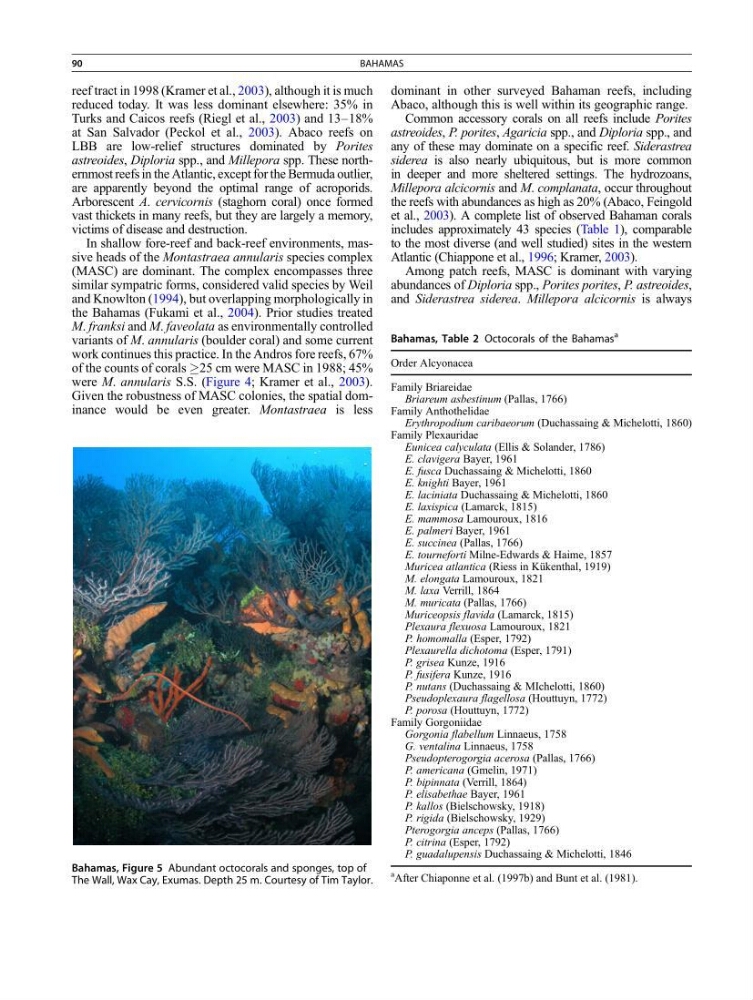
Bahamas, Figure 5 Abundant octocorals and sponges, top of
The Wall, Wax Cay, Exumas. Depth 25 m. Courtesy of Tim Taylor.
Bahamas, Table 2 Octocorals of the Bahamas
a
Order Alcyonacea
Family Briareidae
Briareum asbestinum (Pallas, 1766)
Family Anthothelidae
Erythropodium caribaeorum (Duchassaing & Michelotti, 1860)
Family Plexauridae
Eunicea calyculata (Ellis & Solander, 1786)
E. clavigera Bayer, 1961
E. fusca Duchassaing & Michelotti, 1860
E. knighti Bayer, 1961
E. laciniata Duchassaing & Michelotti, 1860
E. laxispica (Lamarck, 1815)
E. mammosa Lamouroux, 1816
E. palmeri Bayer, 1961
E. succinea (Pallas, 1766)
E. tourneforti Milne-Edwards & Haime, 1857
Muricea atlantica (Riess in Kükenthal, 1919)
M. elongata Lamouroux, 1821
M. laxa Verrill, 1864
M. muricata (Pallas, 1766)
Muriceopsis flavida (Lamarck, 1815)
Plexaura flexuosa Lamouroux, 1821
P. homomalla (Esper, 1792)
Plexaurella dichotoma (Esper, 1791)
P. grisea Kunze, 1916
P. fusifera Kunze, 1916
P. nutans (Duchassaing & MIchelotti, 1860)
Pseudoplexaura flagellosa (Houttuyn, 1772)
P. porosa (Houttuyn, 1772)
Family Gorgoniidae
Gorgonia flabellum Linnaeus, 1758
G. ventalina Linnaeus, 1758
Pseudopterogorgia acerosa (Pallas, 1766)
P. americana (Gmelin, 1971)
P. bipinnata (Verrill, 1864)
P. elisabethae Bayer, 1961
P. kallos (Bielschowsky, 1918)
P. rigida (Bielschowsky, 1929)
Pterogorgia anceps (Pallas, 1766)
P. citrina (Esper, 1792)
P. guadalupensis Duchassaing & Michelotti, 1846
a After Chiaponne et al. (1997b) and Bunt et al. (1981).
90
BAHAMAS
reduced today. It was less dominant elsewhere: 35% in
Turks and Caicos reefs (Riegl et al., 2003) and 13–18%
at San Salvador (Peckol et al., 2003). Abaco reefs on
LBB are low-relief structures dominated by Porites
astreoides, Diploria spp., and Millepora spp. These northernmost reefs in the Atlantic, except for the Bermuda outlier,
are apparently beyond the optimal range of acroporids.
Arborescent A. cervicornis (staghorn coral) once formed
vast thickets in many reefs, but they are largely a memory,
victims of disease and destruction.
In shallow fore-reef and back-reef environments, massive heads of the Montastraea annularis species complex
(MASC) are dominant. The complex encompasses three
similar sympatric forms, considered valid species by Weil
and Knowlton (1994), but overlapping morphologically in
the Bahamas (Fukami et al., 2004). Prior studies treated
M. franksi and M. faveolata as environmentally controlled
variants of M. annularis (boulder coral) and some current
work continues this practice. In the Andros fore reefs, 67%
of the counts of corals !25 cm were MASC in 1988; 45%
were M. annularis S.S. (Figure 4; Kramer et al., 2003).
Given the robustness of MASC colonies, the spatial dominance would be even greater. Montastraea is less
dominant in other surveyed Bahaman reefs, including
Abaco, although this is well within its geographic range.
Common accessory corals on all reefs include Porites
astreoides, P. porites, Agaricia spp., and Diploria spp., and
any of these may dominate on a specific reef. Siderastrea
siderea is also nearly ubiquitous, but is more common
in deeper and more sheltered settings. The hydrozoans,
Millepora alcicornis and M. complanata, occur throughout
the reefs with abundances as high as 20% (Abaco, Feingold
et al., 2003). A complete list of observed Bahaman corals
includes approximately 43 species (Table 1), comparable
to the most diverse (and well studied) sites in the western
Atlantic (Chiappone et al., 1996; Kramer, 2003).
Among patch reefs, MASC is dominant with varying
abundances of Diploria spp., Porites porites, P. astreoides,
and Siderastrea siderea. Millepora alcicornis is always
Bahamas, Figure 5 Abundant octocorals and sponges, top of
The Wall, Wax Cay, Exumas. Depth 25 m. Courtesy of Tim Taylor.
Bahamas, Table 2 Octocorals of the Bahamas
a
Order Alcyonacea
Family Briareidae
Briareum asbestinum (Pallas, 1766)
Family Anthothelidae
Erythropodium caribaeorum (Duchassaing & Michelotti, 1860)
Family Plexauridae
Eunicea calyculata (Ellis & Solander, 1786)
E. clavigera Bayer, 1961
E. fusca Duchassaing & Michelotti, 1860
E. knighti Bayer, 1961
E. laciniata Duchassaing & Michelotti, 1860
E. laxispica (Lamarck, 1815)
E. mammosa Lamouroux, 1816
E. palmeri Bayer, 1961
E. succinea (Pallas, 1766)
E. tourneforti Milne-Edwards & Haime, 1857
Muricea atlantica (Riess in Kükenthal, 1919)
M. elongata Lamouroux, 1821
M. laxa Verrill, 1864
M. muricata (Pallas, 1766)
Muriceopsis flavida (Lamarck, 1815)
Plexaura flexuosa Lamouroux, 1821
P. homomalla (Esper, 1792)
Plexaurella dichotoma (Esper, 1791)
P. grisea Kunze, 1916
P. fusifera Kunze, 1916
P. nutans (Duchassaing & MIchelotti, 1860)
Pseudoplexaura flagellosa (Houttuyn, 1772)
P. porosa (Houttuyn, 1772)
Family Gorgoniidae
Gorgonia flabellum Linnaeus, 1758
G. ventalina Linnaeus, 1758
Pseudopterogorgia acerosa (Pallas, 1766)
P. americana (Gmelin, 1971)
P. bipinnata (Verrill, 1864)
P. elisabethae Bayer, 1961
P. kallos (Bielschowsky, 1918)
P. rigida (Bielschowsky, 1929)
Pterogorgia anceps (Pallas, 1766)
P. citrina (Esper, 1792)
P. guadalupensis Duchassaing & Michelotti, 1846
a After Chiaponne et al. (1997b) and Bunt et al. (1981).
90
BAHAMAS