

Flourishing reefs attain relief of 4 m or more. At the margins of platforms, large and small patch reefs are common
on the narrow shelves between bank/barrier reefs and
islands.
The Bahamas even boast one atoll, Hogsty Reef, north
of Great Inagua (Milliman, 1967).
Stromatolites, layered mounds of varied shapes up to
2.5 m high composed of carbonate sand bound by microbial mats and lithified by marine carbonate cement, form
transverse “reefs” or sediment dams in high-energy tidal
channels (Dill et al., 1986). Similar structures also occur
in a sandy embayment and intertidal beaches (Reid et al.,
1995), but all 14 localities studied are in the Exuma Islands.
Deeper waters in the Bahamas host major coral growths,
commonly called reefs, although few have significant constructional relief. A typical margin of a Bahaman platform
has a shallow slope break at a barrier reef or the edge of
the flat-topped bank. A narrow slope descends in a series
of erosional and constructional terraces to a sharp slope
break at À25 to À60 m, where a near-vertical “wall”
plunges for about a 100 m (Figure 2; Grammer and Ginsburg, 1992). The wall is probably a Pleistocene sea cliff,
buried at the base by cemented rubble from above. This
configuration is obscured on many leeward margins by
thick drifts of sediment washed off the bank tops. Rocky
terraces at the top of the wall support thickets that include
69 types of sponges, 28 species of corals, 27 species of
octocorals, and Millepora alcicornis (Bunt et al., 1981).
The vertical wall, within the “mesophotic zone,” is covered by a profusion of sponges (Maldonado and Young,
1996) as well as corals and octocorals, which have not
been studied. Sponges, which extend beyond depths of
500 m, include the light-shunning sclerosponges that
secrete massive carbonate skeletons (Hartman, 1980).
Reef biota and zonation
The dominant frame builder of most shallow bank/barrier
reefs of the Bahamas, as throughout the Caribbean, has
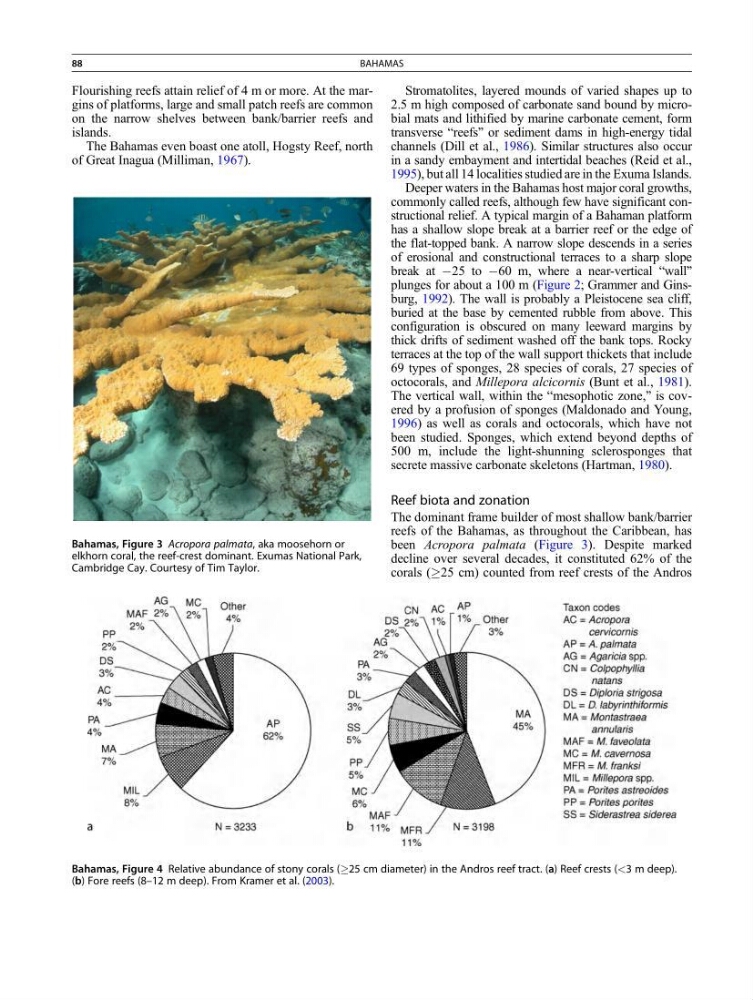
been Acropora palmata (Figure 3). Despite marked
decline over several decades, it constituted 62% of the
corals (!25 cm) counted from reef crests of the Andros
Bahamas, Figure 4 Relative abundance of stony corals (!25 cm diameter) in the Andros reef tract. (a) Reef crests (<3 m deep).
(b) Fore reefs (8–12 m deep). From Kramer et al. (2003).
Bahamas, Figure 3 Acropora palmata, aka moosehorn or
elkhorn coral, the reef-crest dominant. Exumas National Park,
Cambridge Cay. Courtesy of Tim Taylor.
88
BAHAMAS
on the narrow shelves between bank/barrier reefs and
islands.
The Bahamas even boast one atoll, Hogsty Reef, north
of Great Inagua (Milliman, 1967).
Stromatolites, layered mounds of varied shapes up to
2.5 m high composed of carbonate sand bound by microbial mats and lithified by marine carbonate cement, form
transverse “reefs” or sediment dams in high-energy tidal
channels (Dill et al., 1986). Similar structures also occur
in a sandy embayment and intertidal beaches (Reid et al.,
1995), but all 14 localities studied are in the Exuma Islands.
Deeper waters in the Bahamas host major coral growths,
commonly called reefs, although few have significant constructional relief. A typical margin of a Bahaman platform
has a shallow slope break at a barrier reef or the edge of
the flat-topped bank. A narrow slope descends in a series
of erosional and constructional terraces to a sharp slope
break at À25 to À60 m, where a near-vertical “wall”
plunges for about a 100 m (Figure 2; Grammer and Ginsburg, 1992). The wall is probably a Pleistocene sea cliff,
buried at the base by cemented rubble from above. This
configuration is obscured on many leeward margins by
thick drifts of sediment washed off the bank tops. Rocky
terraces at the top of the wall support thickets that include
69 types of sponges, 28 species of corals, 27 species of
octocorals, and Millepora alcicornis (Bunt et al., 1981).
The vertical wall, within the “mesophotic zone,” is covered by a profusion of sponges (Maldonado and Young,
1996) as well as corals and octocorals, which have not
been studied. Sponges, which extend beyond depths of
500 m, include the light-shunning sclerosponges that
secrete massive carbonate skeletons (Hartman, 1980).
Reef biota and zonation
The dominant frame builder of most shallow bank/barrier
reefs of the Bahamas, as throughout the Caribbean, has
been Acropora palmata (Figure 3). Despite marked
decline over several decades, it constituted 62% of the
corals (!25 cm) counted from reef crests of the Andros
Bahamas, Figure 4 Relative abundance of stony corals (!25 cm diameter) in the Andros reef tract. (a) Reef crests (<3 m deep).
(b) Fore reefs (8–12 m deep). From Kramer et al. (2003).
Bahamas, Figure 3 Acropora palmata, aka moosehorn or
elkhorn coral, the reef-crest dominant. Exumas National Park,
Cambridge Cay. Courtesy of Tim Taylor.
88
BAHAMAS