

in the Abaco reefs, which contain 36 scleractinian species
(Feingold et al., 2003).
The Andros reef tract bordering TOTO on GBB is
217 km long, a close second to the more continuous Belize
reef tract, longest in the Atlantic. Coral cover in 1997–
1998 was 38 Æ 17% for reef crests (<3.5 m), the highest
in the Atlantic, and 25 Æ 14% for fore-reef transects
(5.5–12.5 m; Kramer, 2003). Disease and extensive
bleaching events (stress-induced loss of symbiotic zooxanthellae) in 1998 and 2005 reduced cover to <10% on
some fore reefs (Kramer, 2008). Reefs in the Berry Islands
are limited to small fringing reefs and near-shore patch
reefs, despite the very exposed setting (Figure 1).
The Exuma Islands’ setting is similar to Andros, facing
deep water of Exuma Sound. However, bank/barrier reefs
are virtually absent, apparently because of the small size
of the islands and the many tidal channels into the bank
interior. Corals, gorgonians, and sponges colonize hard
substrates in tidal channels and on the narrow shelf windward of the islands (Chiappone et al., 1997a). Patch reefs
are abundant in the platform interior (unpublished data;
Taft et al., 1968).
At the NE corner of GBB, Eleuthera Island, 135 km
long, faces the abyssal open Atlantic Ocean. Flourishing
shallow reefs that fulfilled expectations of this setting in
1990 were reduced to algal-dominated shadows by 2000
and have not recovered (Craig Dahlgren, pers. commun.).
Reef development was continuous along the east-facing
southern half of the island; gaps appeared further north.
Pigmented skeletal fragments of the abundant encrusting
foraminifer Homotrema rubrum produce the famous pink
beaches of Eleuthera.
Cat Island, 85 km long and facing NE into the open
Atlantic, has well-developed reefs, except where oceanic
waves impinge directly on the sea cliffs. Long Island,
comparable in size and setting at the eastern extremity of
GBB, has well-developed bank/barrier reefs and patch
reefs on the narrow shelf along the north three-quarters
of the windward margin. Imagery is poor further south,
but lack of breakers suggests lack of barrier reefs.
Of the numerous isolated banks, only two have been
studied in any detail, the small San Salvador bank
($150 km
2 ; Peckol et al., 2003) and the largest, Caicos
platform (7,800 km
2
; Wanless and Dravis, 1989; Sullivan
et al., 1994; Chiappone et al., 1996; Rankey et al., 2009).
These studies as well as anecdotal accounts and imagery
analysis (Google Earth with widely variable resolution)
show that all of the banks have bank/barrier reefs and
patch reefs where substantial shelf exists. Reefs are best
developed on NE-facing margins, which are perpendicular
to the predominant wave direction in the adjacent North
Atlantic. However, shallow reefs are present on all but
the westernmost, leeward margins. Even here are a few
smaller, deeper reefs that have not aggraded to sea level
(Rankey et al., 2009).
Patch reefs are rare on much of the Andros lobe of GBB
and in the Bight of Eleuthera, probably because of the soft,
muddy substrates and elevated salinities. In contrast, on
the less restricted Exuma lobe and southeastern GBB,
where hard substrates are plentiful, patch reefs abound,
ranging in size from a few coral heads to reef clusters
1,200 m in length with areas over 1 km
2
. Density of patch
reefs visible on satellite imagery (>about 10 m diameter)
on the Exuma lobe is 25 per km
2 (unpublished data).
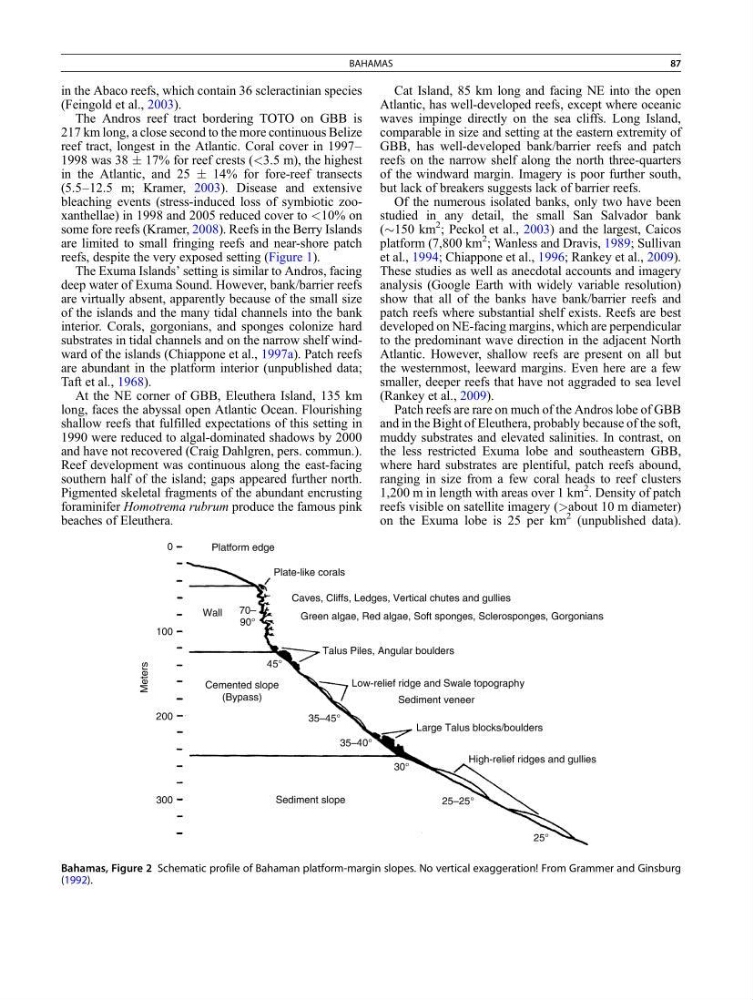
Bahamas, Figure 2 Schematic profile of Bahaman platform-margin slopes. No vertical exaggeration! From Grammer and Ginsburg
(1992).
BAHAMAS
87
(Feingold et al., 2003).
The Andros reef tract bordering TOTO on GBB is
217 km long, a close second to the more continuous Belize
reef tract, longest in the Atlantic. Coral cover in 1997–
1998 was 38 Æ 17% for reef crests (<3.5 m), the highest
in the Atlantic, and 25 Æ 14% for fore-reef transects
(5.5–12.5 m; Kramer, 2003). Disease and extensive
bleaching events (stress-induced loss of symbiotic zooxanthellae) in 1998 and 2005 reduced cover to <10% on
some fore reefs (Kramer, 2008). Reefs in the Berry Islands
are limited to small fringing reefs and near-shore patch
reefs, despite the very exposed setting (Figure 1).
The Exuma Islands’ setting is similar to Andros, facing
deep water of Exuma Sound. However, bank/barrier reefs
are virtually absent, apparently because of the small size
of the islands and the many tidal channels into the bank
interior. Corals, gorgonians, and sponges colonize hard
substrates in tidal channels and on the narrow shelf windward of the islands (Chiappone et al., 1997a). Patch reefs
are abundant in the platform interior (unpublished data;
Taft et al., 1968).
At the NE corner of GBB, Eleuthera Island, 135 km
long, faces the abyssal open Atlantic Ocean. Flourishing
shallow reefs that fulfilled expectations of this setting in
1990 were reduced to algal-dominated shadows by 2000
and have not recovered (Craig Dahlgren, pers. commun.).
Reef development was continuous along the east-facing
southern half of the island; gaps appeared further north.
Pigmented skeletal fragments of the abundant encrusting
foraminifer Homotrema rubrum produce the famous pink
beaches of Eleuthera.
Cat Island, 85 km long and facing NE into the open
Atlantic, has well-developed reefs, except where oceanic
waves impinge directly on the sea cliffs. Long Island,
comparable in size and setting at the eastern extremity of
GBB, has well-developed bank/barrier reefs and patch
reefs on the narrow shelf along the north three-quarters
of the windward margin. Imagery is poor further south,
but lack of breakers suggests lack of barrier reefs.
Of the numerous isolated banks, only two have been
studied in any detail, the small San Salvador bank
($150 km
2 ; Peckol et al., 2003) and the largest, Caicos
platform (7,800 km
2
; Wanless and Dravis, 1989; Sullivan
et al., 1994; Chiappone et al., 1996; Rankey et al., 2009).
These studies as well as anecdotal accounts and imagery
analysis (Google Earth with widely variable resolution)
show that all of the banks have bank/barrier reefs and
patch reefs where substantial shelf exists. Reefs are best
developed on NE-facing margins, which are perpendicular
to the predominant wave direction in the adjacent North
Atlantic. However, shallow reefs are present on all but
the westernmost, leeward margins. Even here are a few
smaller, deeper reefs that have not aggraded to sea level
(Rankey et al., 2009).
Patch reefs are rare on much of the Andros lobe of GBB
and in the Bight of Eleuthera, probably because of the soft,
muddy substrates and elevated salinities. In contrast, on
the less restricted Exuma lobe and southeastern GBB,
where hard substrates are plentiful, patch reefs abound,
ranging in size from a few coral heads to reef clusters
1,200 m in length with areas over 1 km
2
. Density of patch
reefs visible on satellite imagery (>about 10 m diameter)
on the Exuma lobe is 25 per km
2 (unpublished data).
Bahamas, Figure 2 Schematic profile of Bahaman platform-margin slopes. No vertical exaggeration! From Grammer and Ginsburg
(1992).
BAHAMAS
87