

be relatively insensitive to rapid sea-level jumps because
their assemblage of reef-crest corals had a larger depth
range (10 m) and were more diverse and difficult to identify in core. This is supported by quantitative analyses
of coral assemblages on the adjacent island of Moorea
by Bouchon (1985) who found that the shallow crest
assemblage of robust-branching corals extended down
the reef-front slope to $10 m. As a result, Blanchon
(1998) suggested that back-stepping may not have been
recorded because the magnitude of sea-level jumps during
Mwp-1b and 1c was not sufficient to displace the Tahitian
reef-crest assemblage out of its 10 m habitat zone, and the
reefs rapidly rebuilt to sea level without registering
a significant facies change in the cores.
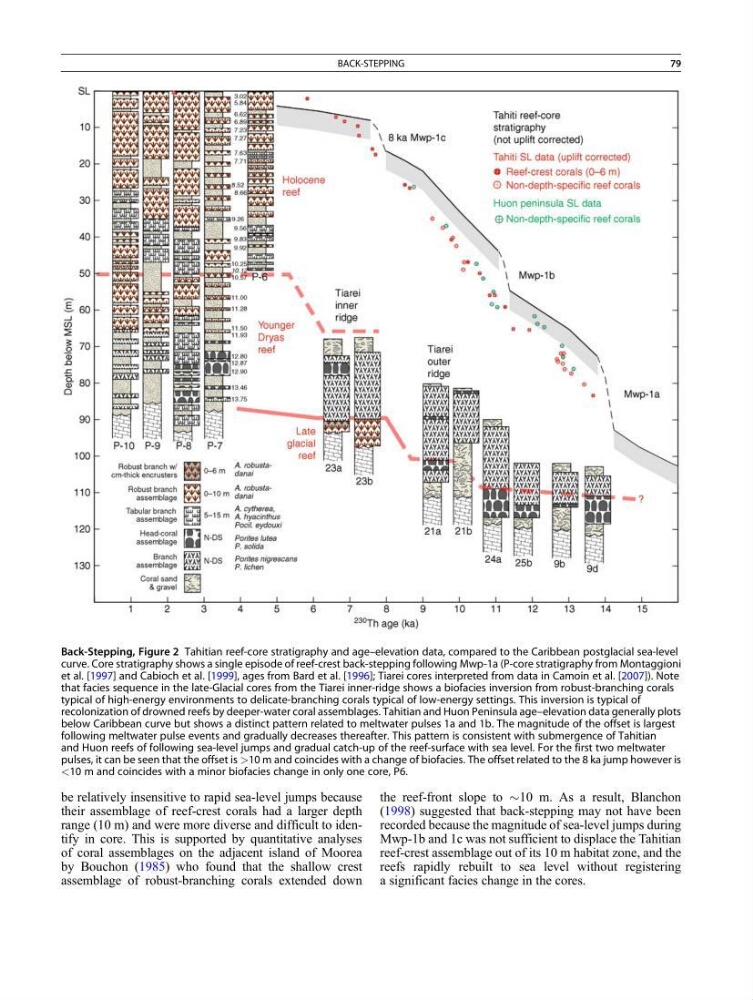
Back-Stepping, Figure 2 Tahitian reef-core stratigraphy and age–elevation data, compared to the Caribbean postglacial sea-level
curve. Core stratigraphy shows a single episode of reef-crest back-stepping following Mwp-1a (P-core stratigraphy from Montaggioni
et al. [1997] and Cabioch et al. [1999], ages from Bard et al. [1996]; Tiarei cores interpreted from data in Camoin et al. [2007]). Note
that facies sequence in the late-Glacial cores from the Tiarei inner-ridge shows a biofacies inversion from robust-branching corals
typical of high-energy environments to delicate-branching corals typical of low-energy settings. This inversion is typical of
recolonization of drowned reefs by deeper-water coral assemblages. Tahitian and Huon Peninsula age–elevation data generally plots
below Caribbean curve but shows a distinct pattern related to meltwater pulses 1a and 1b. The magnitude of the offset is largest
following meltwater pulse events and gradually decreases thereafter. This pattern is consistent with submergence of Tahitian
and Huon reefs of following sea-level jumps and gradual catch-up of the reef-surface with sea level. For the first two meltwater
pulses, it can be seen that the offset is >10 m and coincides with a change of biofacies. The offset related to the 8 ka jump however is
<10 m and coincides with a minor biofacies change in only one core, P6.
BACK-STEPPING
79
their assemblage of reef-crest corals had a larger depth
range (10 m) and were more diverse and difficult to identify in core. This is supported by quantitative analyses
of coral assemblages on the adjacent island of Moorea
by Bouchon (1985) who found that the shallow crest
assemblage of robust-branching corals extended down
the reef-front slope to $10 m. As a result, Blanchon
(1998) suggested that back-stepping may not have been
recorded because the magnitude of sea-level jumps during
Mwp-1b and 1c was not sufficient to displace the Tahitian
reef-crest assemblage out of its 10 m habitat zone, and the
reefs rapidly rebuilt to sea level without registering
a significant facies change in the cores.
Back-Stepping, Figure 2 Tahitian reef-core stratigraphy and age–elevation data, compared to the Caribbean postglacial sea-level
curve. Core stratigraphy shows a single episode of reef-crest back-stepping following Mwp-1a (P-core stratigraphy from Montaggioni
et al. [1997] and Cabioch et al. [1999], ages from Bard et al. [1996]; Tiarei cores interpreted from data in Camoin et al. [2007]). Note
that facies sequence in the late-Glacial cores from the Tiarei inner-ridge shows a biofacies inversion from robust-branching corals
typical of high-energy environments to delicate-branching corals typical of low-energy settings. This inversion is typical of
recolonization of drowned reefs by deeper-water coral assemblages. Tahitian and Huon Peninsula age–elevation data generally plots
below Caribbean curve but shows a distinct pattern related to meltwater pulses 1a and 1b. The magnitude of the offset is largest
following meltwater pulse events and gradually decreases thereafter. This pattern is consistent with submergence of Tahitian
and Huon reefs of following sea-level jumps and gradual catch-up of the reef-surface with sea level. For the first two meltwater
pulses, it can be seen that the offset is >10 m and coincides with a change of biofacies. The offset related to the 8 ka jump however is
<10 m and coincides with a minor biofacies change in only one core, P6.
BACK-STEPPING
79