

event that led to the establishment of modern Caribbean
reefs (Blanchon et al., 2002).
The discovery of reef back-stepping and rapid sea-level
jumps in the Caribbean led others to look for similar
events in other regions. Two cores recovered from the reef
crest around Tahiti by Bard et al., (1996) found that the
modern reef initiated there immediately following
Mwp-1a, much earlier than in the Caribbean, and then
kept pace with sea-level rise (Figure 2). The lack of evidence of reef back-stepping during Mwp-1b and 1c led
Montaggioni et al., (1997) to question the magnitude
and/or existence of these events. However, the keep-up
interpretation of the Tahiti cores was contested by
Blanchon (1998) who argued that Indo-Pacific reefs might
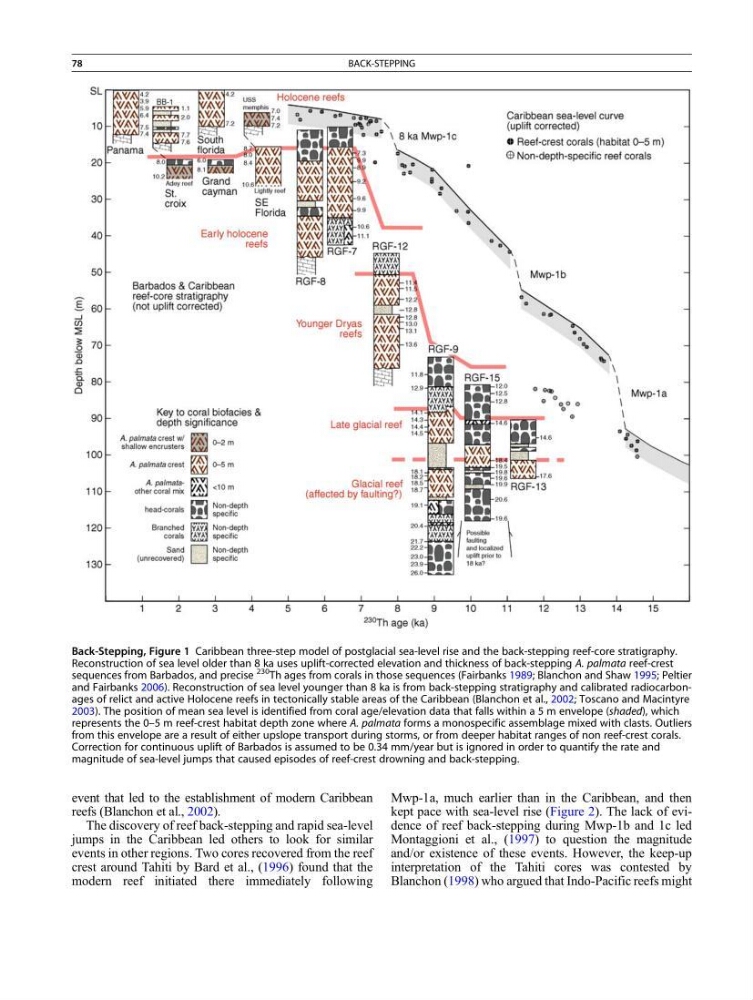
Back-Stepping, Figure 1 Caribbean three-step model of postglacial sea-level rise and the back-stepping reef-core stratigraphy.
Reconstruction of sea level older than 8 ka uses uplift-corrected elevation and thickness of back-stepping A. palmata reef-crest
sequences from Barbados, and precise
230 Th ages from corals in those sequences (Fairbanks 1989; Blanchon and Shaw 1995; Peltier
and Fairbanks 2006). Reconstruction of sea level younger than 8 ka is from back-stepping stratigraphy and calibrated radiocarbonages of relict and active Holocene reefs in tectonically stable areas of the Caribbean (Blanchon et al., 2002; Toscano and Macintyre
2003). The position of mean sea level is identified from coral age/elevation data that falls within a 5 m envelope (shaded), which
represents the 0–5 m reef-crest habitat depth zone where A. palmata forms a monospecific assemblage mixed with clasts. Outliers
from this envelope are a result of either upslope transport during storms, or from deeper habitat ranges of non reef-crest corals.
Correction for continuous uplift of Barbados is assumed to be 0.34 mm/year but is ignored in order to quantify the rate and
magnitude of sea-level jumps that caused episodes of reef-crest drowning and back-stepping.
78
BACK-STEPPING
reefs (Blanchon et al., 2002).
The discovery of reef back-stepping and rapid sea-level
jumps in the Caribbean led others to look for similar
events in other regions. Two cores recovered from the reef
crest around Tahiti by Bard et al., (1996) found that the
modern reef initiated there immediately following
Mwp-1a, much earlier than in the Caribbean, and then
kept pace with sea-level rise (Figure 2). The lack of evidence of reef back-stepping during Mwp-1b and 1c led
Montaggioni et al., (1997) to question the magnitude
and/or existence of these events. However, the keep-up
interpretation of the Tahiti cores was contested by
Blanchon (1998) who argued that Indo-Pacific reefs might
Back-Stepping, Figure 1 Caribbean three-step model of postglacial sea-level rise and the back-stepping reef-core stratigraphy.
Reconstruction of sea level older than 8 ka uses uplift-corrected elevation and thickness of back-stepping A. palmata reef-crest
sequences from Barbados, and precise
230 Th ages from corals in those sequences (Fairbanks 1989; Blanchon and Shaw 1995; Peltier
and Fairbanks 2006). Reconstruction of sea level younger than 8 ka is from back-stepping stratigraphy and calibrated radiocarbonages of relict and active Holocene reefs in tectonically stable areas of the Caribbean (Blanchon et al., 2002; Toscano and Macintyre
2003). The position of mean sea level is identified from coral age/elevation data that falls within a 5 m envelope (shaded), which
represents the 0–5 m reef-crest habitat depth zone where A. palmata forms a monospecific assemblage mixed with clasts. Outliers
from this envelope are a result of either upslope transport during storms, or from deeper habitat ranges of non reef-crest corals.
Correction for continuous uplift of Barbados is assumed to be 0.34 mm/year but is ignored in order to quantify the rate and
magnitude of sea-level jumps that caused episodes of reef-crest drowning and back-stepping.
78
BACK-STEPPING